7 Crypto Mistakes That Could Wipe Out Your Portfolio in 2026
Note: This article is for informational purposes only and does not constitute financial or legal advice.
Last verified Also on LinkedIn

On this page
- Mistake 1: The Copy Paste Trap, Also Known as Address Poisoning
- Mistake 2: Self-Custody Theatre
- Mistake 3: The Leverage Casino
- Mistake 4: Playing the Memecoin Lottery
- Mistake 5: Sleepwalking Into the New Tax Regime
- Mistake 6: Underestimating AI-Powered Scams
- Mistake 7: Falling for Recovery Scams
- The Pattern Underneath All 7
- References
Note: This article is for informational purposes only and does not constitute financial or legal advice.
In December 2025, a crypto trader did almost everything right. Before withdrawing a large sum from Binance, he sent a small test transaction first to confirm the destination address, which is exactly what every security guide tells you to do. It landed perfectly. So he sent the rest. 49,999,950 USDT went straight into an attacker’s wallet in a single click, nearly $50 million, gone in the time it takes to hit confirm.
That same year, 1.6 million traders were liquidated in a single 24-hour window, and roughly 86% of every token that has ever failed in crypto’s history died in the last 12 months alone. The people getting hurt right now are rarely the reckless ones. They are ordinary, careful investors who have not caught up with how much the threat landscape has changed. The exits are narrower. The scams are smarter. The tax authorities now see every transaction you make. This piece walks through the 7 mistakes doing the most damage in 2026, the actual mechanics behind each one, and the specific habits that protect against them.
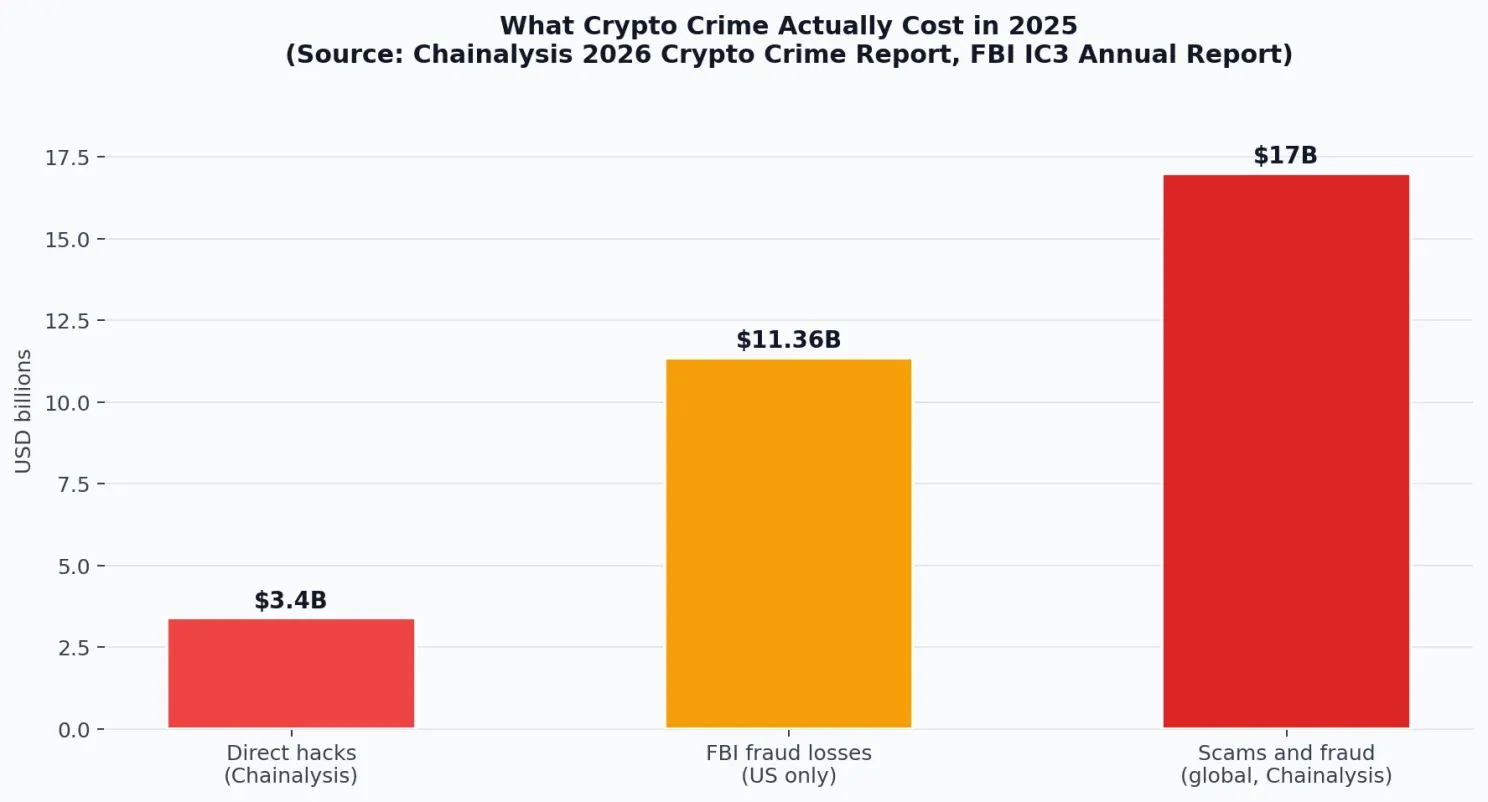
Crypto crime cost the industry an estimated $17 billion in scams and fraud globally in 2025, alongside $3.4 billion in direct hacks and over $11 billion in FBI-reported US fraud losses. Source: Chainalysis 2026 Crypto Crime Report, FBI IC3 Annual Rep
The overall numbers set the stage for everything that follows. Chainalysis recorded $3.4 billion stolen through direct hacks and exploits in 2025, with a single incident, the February 2025 Bybit hack attributed to North Korea’s Lazarus Group, accounting for $1.5 billion of that figure on its own. The FBI separately logged $11.36 billion in crypto-related fraud losses across the US alone, a 22% increase year over year. Chainalysis’s broader estimate covering scams and fraud globally puts the 2025 total closer to $17 billion. Frightened people make rushed decisions, and a fear-driven market gives criminals more openings to exploit.
Mistake 1: The Copy Paste Trap, Also Known as Address Poisoning
This is one of the most common mistakes in crypto right now, and also one of the easiest to avoid once you understand how it actually works. An attacker watches the blockchain for your transactions, then generates a lookalike wallet address that shares the same first few and last few characters as an address you actually use. They send you a tiny, near-worthless dust transaction from that fake address so it sits quietly in your transaction history looking completely innocuous. Then they wait. Eventually you go to send crypto again, glance at your history for the address you last used, and copy the poisoned one instead of the real one.
This method is extremely popular with attackers right now. Carnegie Mellon researchers identified 270 million address poisoning attempts targeting 17 million potential victims, and separate research has found that a majority of new Ethereum addresses get dusted on their very first stablecoin interaction, meaning newcomers are frequently targeted before they have done anything else on-chain at all.
The $50 million trader mentioned earlier followed the textbook security procedure of sending a test transaction first. According to blockchain security firm SlowMist, an automated bot spotted that test transaction, generated a vanity address matching the first 3 and last 4 characters of his actual destination, and poisoned his transaction history within minutes. He came back later, copied the address from his own transaction log rather than the original destination, and sent the full amount. The stolen funds were converted to ETH, distributed across multiple wallets, and partially funnelled through Tornado Cash within minutes.
Checking the first and last few characters of an address is not enough. A poisoning attack is specifically designed to match those characters. Copy the destination address fresh from the source every single time, never from your own transaction history.
The fix is simple to state and easy to build into habit. Always copy the address you are sending to directly from the destination itself, whether that is the recipient’s app, their published wallet page, or a QR code they provide, never from your own transaction history, no matter how recent or familiar it looks. Verify the complete address character by character for any transfer above a trivial amount, or use a hardware wallet that displays the full address on its own screen before you confirm.
Mistake 2: Self-Custody Theatre
You have almost certainly heard the phrase not your keys, not your coins, and it remains as true today as it has ever been. But owning your private keys is the starting point, not the finish line. Self-custody only actually protects you if your operational security is genuinely solid, and for a large share of people, it is not.
TRM Labs found that in the first half of 2025, over 80% of all stolen crypto value came from what the industry calls infrastructure attacks, which is a polite way of describing private key and seed phrase theft rather than sophisticated code exploits. Applied to the roughly $3.4 billion figure for the full year, that implies well over $2 billion lost not to clever smart contract bugs but to plain mismanaged keys.
This happens through several well-documented patterns. Tampered hardware wallets purchased through unofficial resellers sometimes arrive with a recovery card the attacker has already filled in themselves, waiting for you to fund the device. Fake wallet applications occasionally slip through official app store review and harvest your seed phrase the moment you type it in. Perhaps most common of all is simply screenshotting a seed phrase into cloud photo storage, creating a permanent, searchable backdoor the moment that cloud account itself gets compromised through an entirely unrelated phishing attempt.
The fix here is about discipline rather than technology. Buy hardware wallets directly from the manufacturer rather than through third-party marketplaces where tampering is a documented risk. Generate your own seed phrase on the device itself rather than trusting one that came pre-printed. Never let that seed phrase touch an internet-connected device in any form, not a photo, not a note-taking app, not a password manager, under any circumstance.
Mistake 3: The Leverage Casino
On October 10, 2025, President Trump posted on Truth Social threatening a 100% tariff on Chinese imports. Crypto markets, which trade 24 hours a day with no circuit breakers and were sitting near record-high open interest at the time, had nowhere to hide. What followed was the single largest liquidation event in crypto’s history: more than $19 billion in leveraged positions were forcibly closed within 24 hours, affecting approximately 1.6 million trading accounts. At the most violent point of the cascade, Amberdata research found nearly $7 billion in positions were liquidated in under a single hour, a liquidation rate of more than $10 billion per hour at its peak.
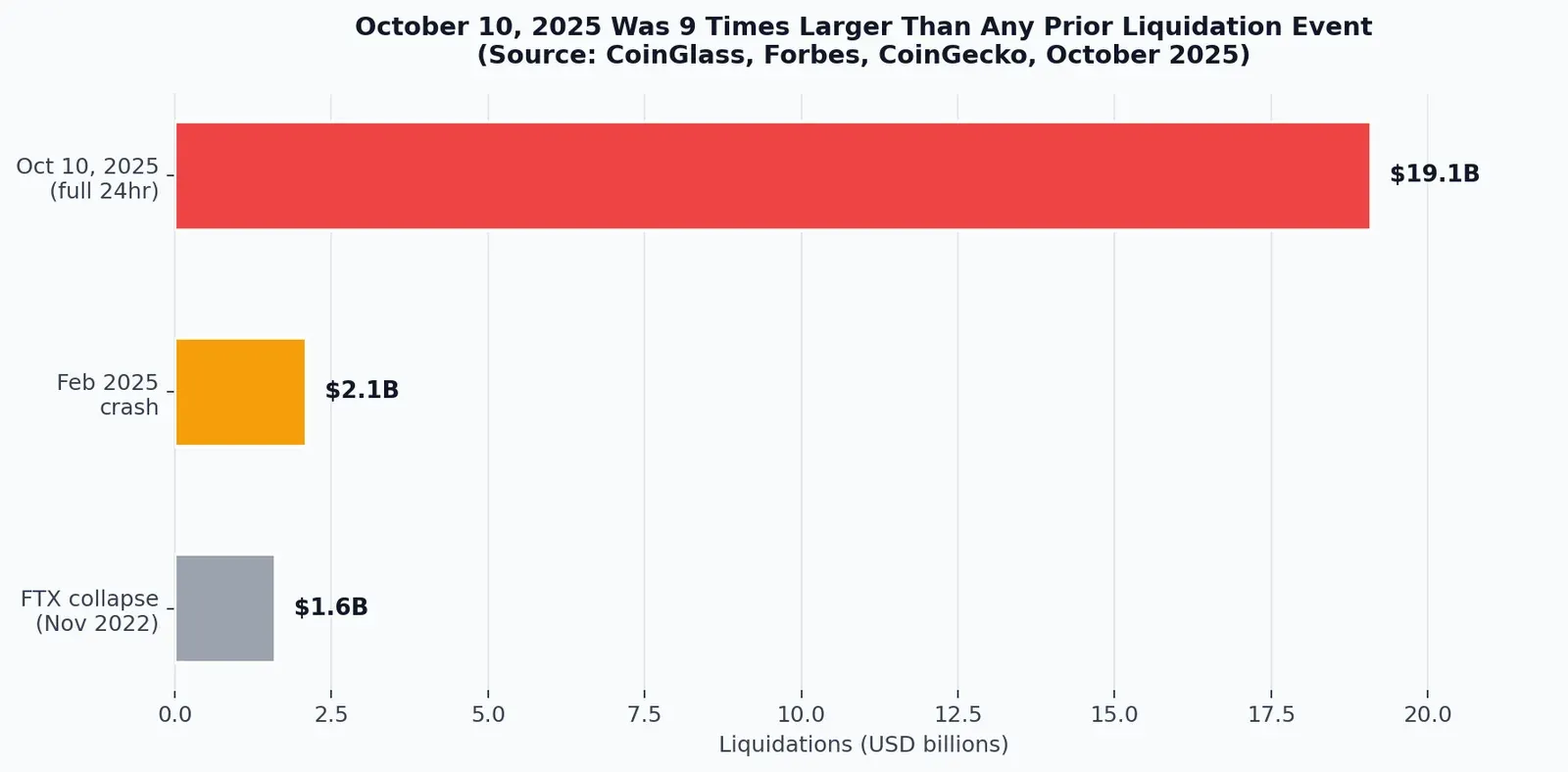
The October 10, 2025 liquidation event was roughly 9 times larger than the previous largest single-day liquidation on record. Source: CoinGlass data via Forbes and CoinGecko, October 2025 and February 2026 reporting.
To put the scale in perspective, the entire FTX collapse in November 2022 triggered approximately $1.6 billion in liquidations. October 10 was roughly 9 times larger, and by some analyst estimates the true figure including under-reported positions may have exceeded $50 billion. Roughly 16.7 billion of the 19.1 billion in liquidated positions were longs being forcibly closed, meaning the overwhelming majority of traders were positioned on one side of the market when the shock hit, and whoever was short collected the difference.
The mechanics of why leverage is this dangerous are worth understanding precisely. When price drops, leveraged long positions hit their margin threshold and the exchange forcibly sells the position to cover the borrowed funds. That forced selling pushes the price lower still, which tips the next tier of leveraged longs past their own threshold, triggering further forced selling. The cascade feeds on itself entirely mechanically, with no human decision-making involved once it starts. In a sufficiently fast and violent move, even conservative 2x leverage can be liquidated before a margin call notification has time to reach your phone. The only reliable protection is position sizing you can genuinely afford to lose entirely, not a belief that modest leverage is inherently safe.
Mistake 4: Playing the Memecoin Lottery
Root Data has documented that more than 11.5 million tokens failed in 2025, representing approximately 86% of every token failure recorded across the entire 2021 to 2025 dataset compressed into a single year. The memecoin sector that fuelled much of this activity has been gutted alongside it. Sector market capitalisation fell from a peak of approximately $80 billion around October 10, 2025 to roughly $47 billion by year end, and separate data has placed the December 2024 peak considerably higher again before the broader decline. Memecoins genuinely made a small number of early, well-timed traders wealthy. The base rate for anyone arriving after that initial window is overwhelmingly unfavourable, and the failure statistics reflect that clearly.
Mistake 5: Sleepwalking Into the New Tax Regime
This is the least exciting mistake on the list, which is exactly why it catches so many people off guard. As of the 2025 tax year, US brokers including Coinbase, Kraken, and PayPal are required to file Form 1099-DA, reporting your transactions directly to the IRS with no minimum threshold. The IRS is no longer estimating your activity. It has a direct data feed, and a mismatch between what you report and what the exchange reports triggers an automated flag with no human review involved.
Under Revenue Procedure 2024–28, the universal wallet accounting method, the old practice of pooling all your crypto holdings across every wallet into a single shared cost basis, ended on January 1, 2025. Every wallet and every account is now treated as its own separate ledger for cost basis purposes, and the safe harbour window that allowed taxpayers to fix historical allocation records under the old method has already closed.
There is a specific twist worth understanding for anyone active in DeFi. Congress repealed the DeFi broker reporting rule in April 2025, which felt like a genuine win for permissionless protocols at the time. What it does not do is exempt DeFi activity from tax liability. There is no automated data feed from a decentralised protocol to the IRS, so the agency instead treats the absence of a data feed as a reason to examine your on-chain activity directly rather than as a free pass, and the burden of proof for any DeFi position falls entirely on the taxpayer. An honest mistake carries a 20% accuracy-related penalty. Anything the IRS characterises as fraud carries a civil penalty of up to 75% of the underpayment, on top of the underlying tax owed.
Mistake 6: Underestimating AI-Powered Scams
In its 2025 annual report, the FBI tracked AI-related fraud as a standalone category for the first time, logging more than 22,000 complaints and $893 million in losses, while explicitly noting that figure is very likely an undercount since most victims never realise AI was involved in the scam that targeted them at all.
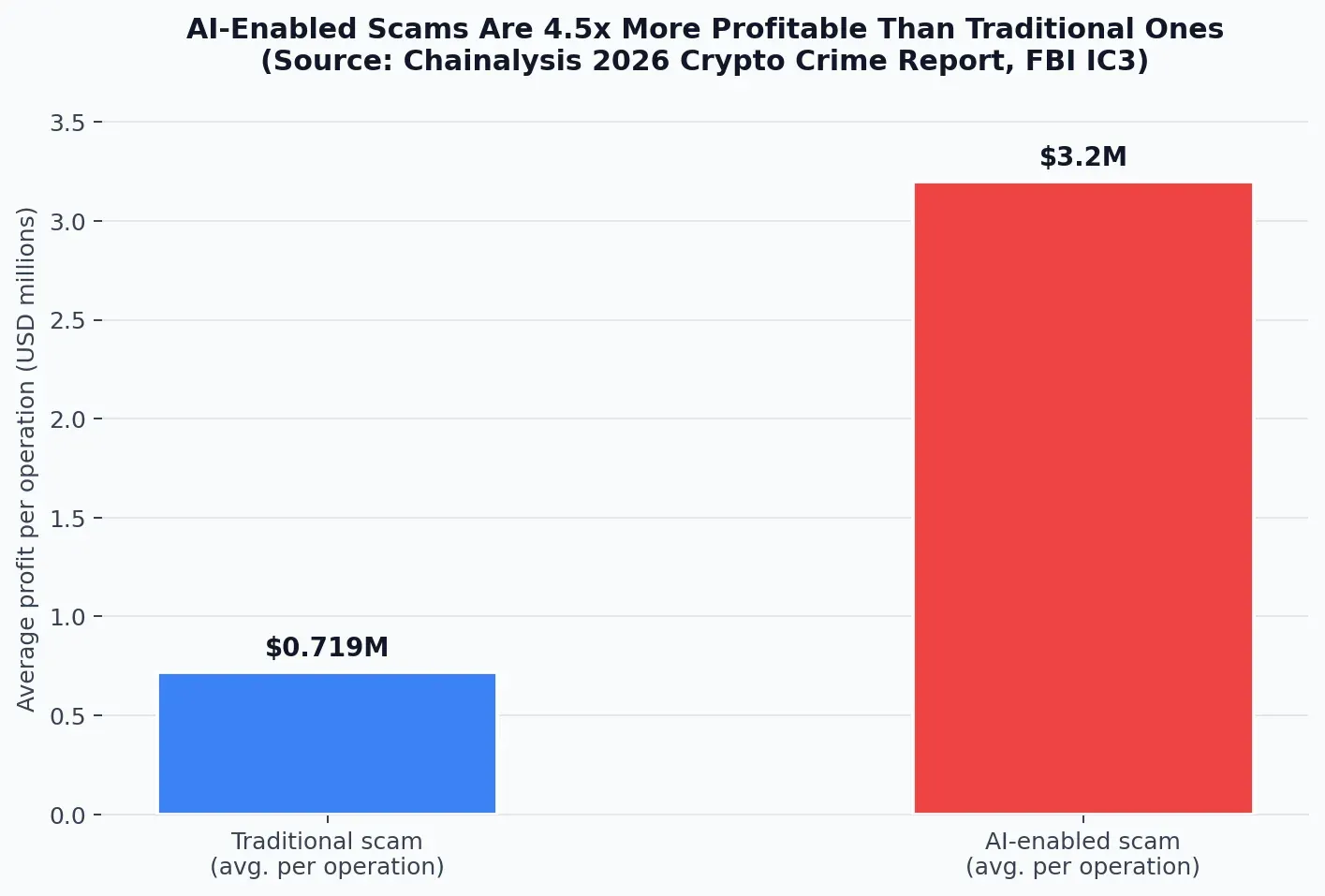
AI-enabled scam operations average roughly 4.5 times the profit of traditional scams, according to Chainalysis’s 2026 Crypto Crime Report. The economics overwhelmingly favour scammers who adopt these tools.
The reason this category is expanding so quickly comes down to plain economics. Chainalysis found AI-enabled scam operations average approximately $3.2 million in profit per operation, compared to roughly $719,000 for traditional scams, a gap of roughly 4.5 times. That includes deepfake videos of recognisable figures promoting fake token giveaways, polished fake Web3 job interviews where a convincing recruiter eventually asks a developer to download a malicious HR portal that is actually a wallet drainer, and voice cloning technology that can produce a highly convincing replica of someone you trust from just a few seconds of source audio.
The old advice to watch for bad grammar or an obviously fake profile photo is no longer reliable protection. As one FBI official put it in reporting on the trend, AI-generated communications now look genuinely official and legitimate even to trained, security-conscious individuals. That warning applies broadly, not only to less experienced users.
Mistake 7: Falling for Recovery Scams
This is arguably the darkest pattern on this list, which is a genuinely high bar in crypto. Recovery scams specifically target people who have already been victimised once. Once your details, name, contact information, and the amount you lost, circulate on dark web marketplaces as a resaleable commodity, a second wave of scammers monitors public forums for anyone posting about a recent loss. Within minutes of a public post, direct messages start arriving from people claiming to be forensic blockchain analysts, sometimes claiming an affiliation with law enforcement, offering to trace and recover the stolen funds for an upfront retainer or release fee, paid in crypto, naturally. The money vanishes along with the second retainer, leaving the victim worse off than before.
A small number of rules are worth memorising permanently. Legitimate law enforcement agencies never ask for upfront fees to recover funds under any circumstance. No third party can reverse a completed blockchain transaction, full stop, and that impossibility is the foundation the entire recovery scam industry is built on top of. If someone has proactively found you rather than the reverse, that alone is close to definitive evidence you are already being targeted again. A significant share of the crypto help content circulating publicly, including coordinated comment threads claiming someone recovered tens of thousands of dollars within 48 hours, is itself recovery scam bait designed to build false credibility. The only legitimate reporting channel for US victims is the FBI’s own portal at ic3.gov.
The Pattern Underneath All 7
Scammers are only getting more capable. Their tools are better, their infrastructure is more professional, and their methods have been refined through years of iteration against millions of real victims. The one thing that has consistently failed to keep pace is the average investor’s awareness of exactly how these mechanisms work in practice, rather than in the abstract.
The address you trusted because it looked familiar. The keys you assumed were safe because you controlled them. The leverage that felt conservative until the market moved fast enough. The token that looked early rather than doomed. The taxes nobody explained clearly enough in advance. The scam sophisticated enough to survive scrutiny. The helping hand that turns out to be a second theft. Every one of these 7 patterns is genuinely avoidable once you understand the actual mechanics rather than a vague warning to be careful. Stay sceptical of anything urgent, verify addresses at the source rather than from memory or history, keep leverage sized to what you can genuinely afford to lose entirely, and there is no structural reason you need to become part of next year’s loss statistics.
References
- Yahoo Finance / Cryptonews: Address Poisoning Scam Costs Trader Nearly $50 Million — Full SlowMist incident report, December 2025. Character-matching mechanics and fund laundering path confirmed.
- CoinLaw: Crypto Security Statistics 2026 — Carnegie Mellon address poisoning research, FBI complaint figures, TRM Labs infrastructure attack data.
- Chainalysis: 2025 Crypto Theft Reaches $3.4 Billion — Official 2026 Crypto Crime Report hacking figures. Bybit hack attribution and DPRK theft data.
- Chainalysis: 2026 Crypto Crime Report, Scams — $17 billion global scam total, AI-enabled scam profitability multiplier, impersonation scam growth.
- GovTech: FBI, Crypto and AI Scams Drove Billions in Losses in 2025 — Full FBI IC3 2025 Annual Report breakdown, AI fraud category detail, investment scam totals.
- Forbes: Crypto’s Black Friday, Inside the $19 Billion Market Meltdown — Full October 10, 2025 liquidation event breakdown, Binance collateral pricing detail.
- CoinGecko: What Is October 10th? Crypto’s Mass Liquidation Event Explained — Amberdata cascade timeline, memecoin sector collapse figures, open interest data.
- CCN: Crypto’s $19 Billion Liquidation Explained — Long versus short liquidation ratio, 1.6 million affected accounts confirmed.
- RSM US: Congress Nullifies IRS Crypto Reporting Regulations for DeFi Platforms — Form 1099-DA requirements, DeFi broker rule repeal detail, Revenue Procedure 2024–28 confirmation.
.
Sources
No sources have been filed for this piece yet.
Related stories
Crypto & markets
Why More Than 50 of the World’s Biggest Banks Are Quietly Building on Chainlink
Note: This article is for informational purposes only and does not constitute financial or investment advice.
Crypto & markets
Richard Heart Beat the SEC on a Technicality, Then His Own Tax Office Caught Up With Him in…
On 14 October 2026, Turkish police arrested the founder of Hex and PulseChain on an Interpol red notice issued for Finland, which suspects him of gross tax evasion. He had walked away from a $1 billion SEC case 18 months earlier, not because a court cleared him, but because the judge found no US jurisdiction. I went through the whole arc, the sacrifice mechanism, the allegations, the dismissal that was not an acquittal, and a blockchain whose biggest customer was its own founder.
Crypto & markets
Will Altcoins Ever Recover? The Honest Answer Is Not the One X(Twitter) Wants.
Note: This article is for informational purposes only and does not constitute financial or investment advice.