Flathub Closed Its Forum. Chat Apps Are a Poor Replacement.
On October 23, 2026, Flathub made its Discourse forum read only and pointed people to Matrix and issue trackers. Days later, Discord announced it will put public server messages into web search. Together they show what a forum does that a chat room has never done well.
Last verified Also on Medium
On this page
On October 23, 2026, Flathub shut down the forum it had run since 2020. I want to walk through what Flathub said, what the archive it left behind shows, and why I think the move says more about how we treat questions than about one app store. I also want to cover Discord’s plan to make public server messages searchable, because it lands in the same month and changes one of the main arguments about chat.
I should be clear about my own position. Flathub had good reasons, and I will lay them out fairly. I still think a chat room is a weak place to put support questions, and I will explain why with specifics.
What Flathub announced on October 23
Flathub published a short post titled Flathub Discourse is now read only on October 23, 2026, signed by Bart Piotrowski, who goes by Flathub Janitor. Existing threads stay available, and nobody can start a new topic or reply. The forum home page now describes itself as a read only archive with its content preserved for reference.
The post gives the reason in 3 sentences. The forum opened in 2020 as a place for asynchronous discussion outside GitHub issues and IRC. It never took off and became another issue tracker to watch. A forum where people post and wait for an answer that never comes, in the post’s words, is worse than no forum at all.
The post also lists where each kind of question should go now. Packaging and submission help goes to the Flathub Matrix channel, and questions about Flatpak itself go to the Flatpak channel. Problems with an app go to the issue tracker linked as Manifest on the app’s Flathub page. Problems with Flathub itself go to the flathub/flathub repository. Flathub does not take app requests, so you ask the app’s developers to submit it or submit it yourself. Runtime projects such as freedesktop SDK can post announcements on the Flathub blog.
Why a forum existed in the first place
Flathub opened the forum in late January 2020. A message on the Flatpak mailing list dated January 25, 2020 says the Flathub Discourse had just opened that day. The reason appears in a reply by Alexander Larsson on January 28. He called the lack of a Flathub specific forum a problem, because when the team changed how the infrastructure worked, it could not get the message to packagers in a good way. He pointed out that the flathub-admins list exists but carries low traffic limited to sysadmin matters, and that GitHub issues host some discussion without being a good communication tool or reaching the right audience.
The forum became a working part of the project quickly. On April 1, 2020, Larsson posted a link to a Discourse thread for the Flathub vision statement, so people had a place for comments. By July 22, 2020, GNOME’s Felipe Borges was telling a newcomer that the forum had a specific section for Flathub application requests, and warning that the work is voluntary, so nobody might take the request. That category has no equivalent today, since Flathub’s 2026 post says it does not take app requests at all.
GitHub’s own forum feature did not exist yet. GitHub announced Discussions in early May 2020 for selected public repositories and opened it to all projects as a public beta in December 2020, according to an academic study of the beta. It left beta on August 17, 2021. By then Flathub’s forum had been running for more than a year and a half.
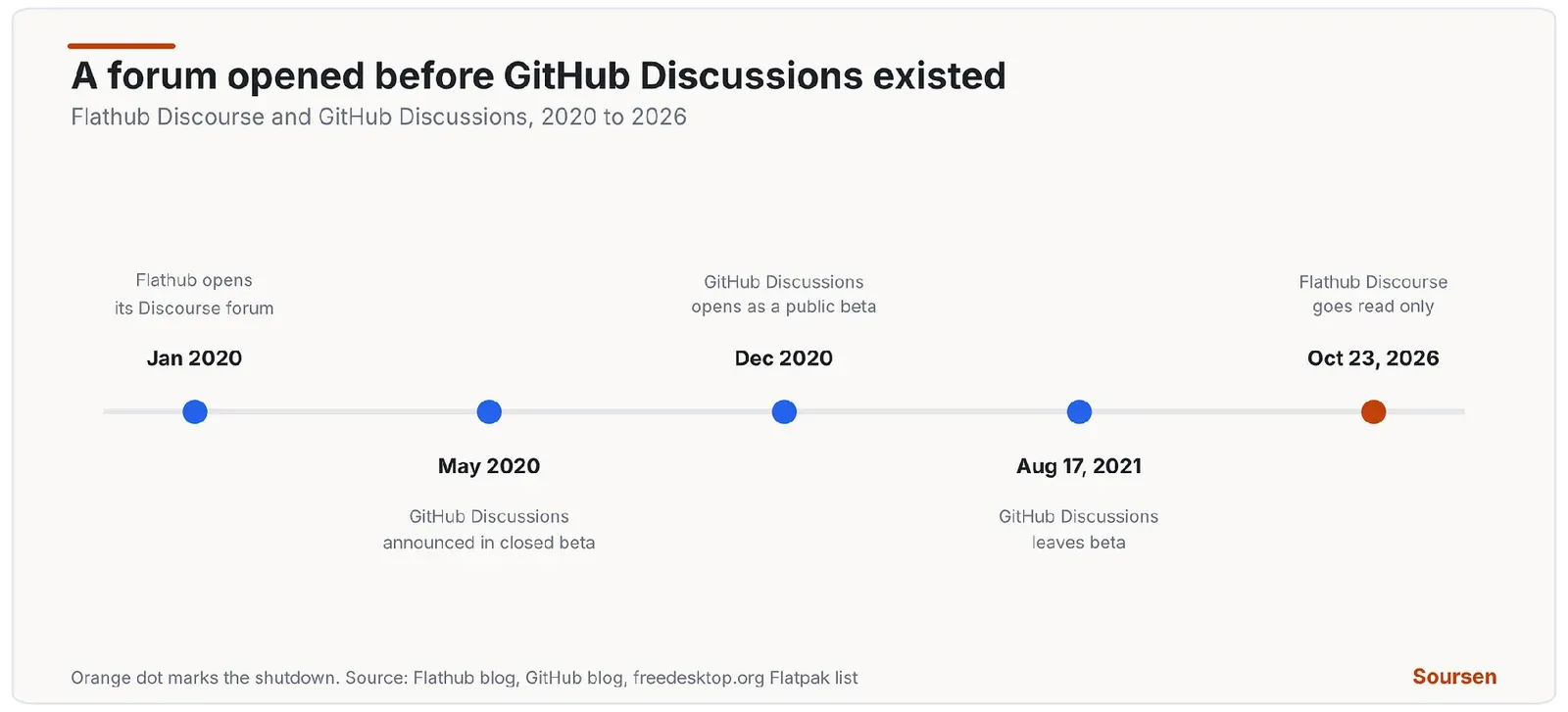
A forum opened before GitHub Discussions existed. Flathub’s Discourse started 4 months before GitHub announced Discussions. Source: Flathub blog, GitHub blog,freedesktop.orgFlatpak mailing list
What the archive shows
The archive is big enough to matter. The forum’s category page lists 24 announcement topics, about 1,900 in General, 63 in Tutorials and Tips, and 101 in Site Help and Feedback. That adds up to about 2,100 topics of questions and answers from nearly 7 years of use.
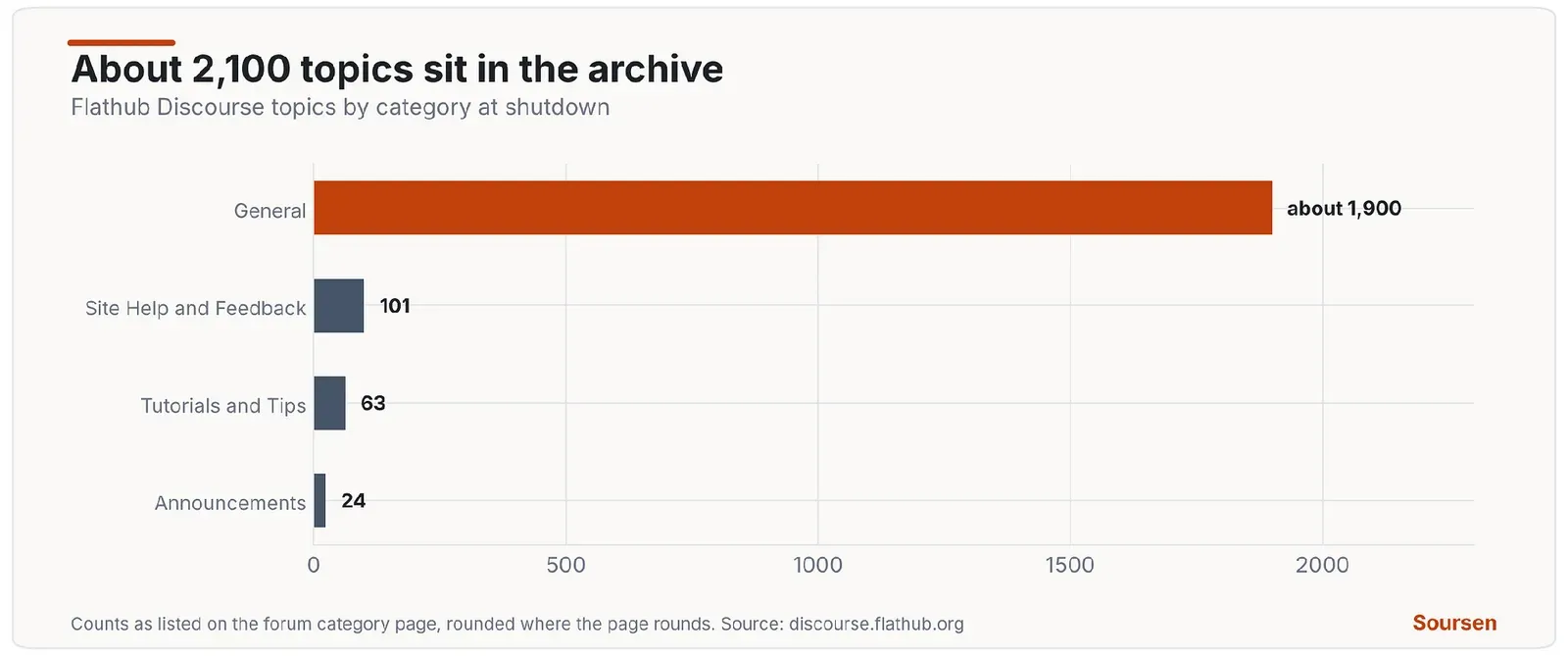
About 2,100 topics sit in the archive. Almost all of them live in the General category. Source: discourse.flathub.org
The archive itself is a static copy. Its front page reads as a read only archive with 71 pages of topics and links for Latest, Categories and Search, so the old answers stay reachable.
The activity numbers explain Flathub’s frustration, and they also show something else. The latest topics page in February 2026 lists threads with 7, 18, 12, 7 and 9 replies, which is modest traffic for a project of Flathub’s size. The same threads drew 5,825, 1,825, 1,058, 421 and 121 views. The thread about installing older versions had 7 replies and 5,825 views, a ratio of about 830 readers for each reply.
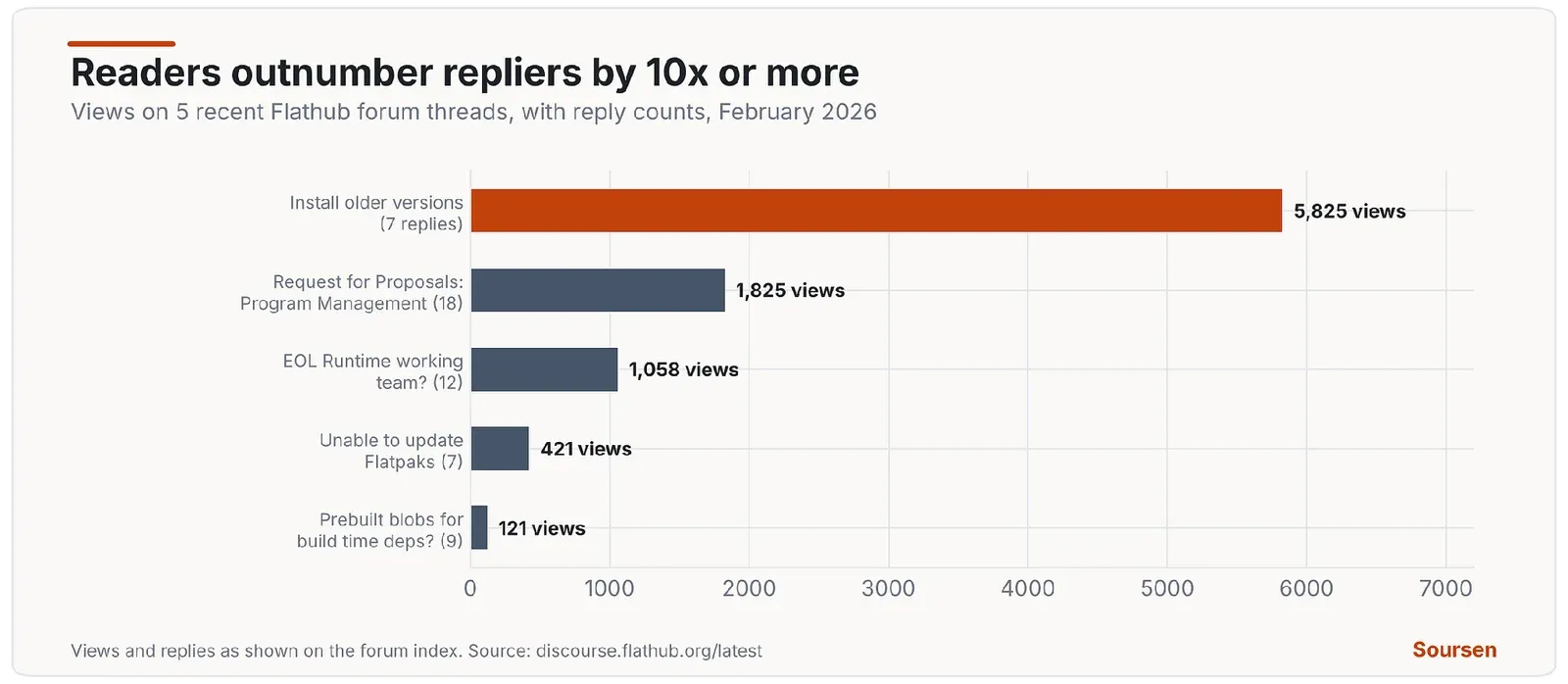
Readers outnumber repliers by 10x or more. Every one of these 5 threads had at least 13 views for each reply. Source: discourse.flathub.org/latest
I read that as a sign the forum worked as a library. Few people replied, and many people read. That is the pattern a searchable archive is built for, and it is the pattern a chat room cannot reproduce once the messages scroll away.
One older thread shows the same tension from the inside. In June 2022 a developer asked where to put Flatpak developer questions because the mailing list seemed dead. A reply said the forum was fine because developers monitor it, and that live chat might be more responsive, with a link to the Flatpak Matrix channel. The thread has 4 replies, and a 2023 comment noted that Discourse chat was disabled on Flathub’s server, so Matrix was the recommendation. In that thread, chat was offered for speed and the forum was offered as the place developers watch.
I only checked 5 threads for the view counts, so treat the ratio as an illustration. Flathub’s own judgment, that too few questions got answers, is a different measurement and I have no data to dispute it.
Why chat is a weak home for support questions
I have 4 specific problems with answering support questions in a chat room, and I think each one is a mechanical limit of the format.
The first is finding the earlier answer. A person with a question wants to know whether someone already asked it. On a forum, a search engine can answer that before the person ever signs up. In a chat room, they have to join first and then rely on the room’s own search. Element’s help page says that in encrypted Matrix rooms, search only works on the desktop app and only after you turn on message search in settings. One university’s Matrix help page adds that unencrypted rooms are searchable without that step. So the answer depends on the room settings and the app a person happens to use.
The second is duplicates. If people cannot find the earlier answer, they ask again, and the people who know the answer cannot find it either. A forum moderator can link the old thread. A chat helper has to remember where the answer was posted, or retype it.
The third is structure. A chat room is one stream. A new question breaks into whatever conversation is already happening, and the reply feature that links an answer to its question only works when the person answering uses it. Skip it once and the asker returns to a wall of newer messages with no sign their question was answered.
The fourth is shelf life. A question asked in a forum stays at the top of a category list and gets found by people who browse back a few pages. A question asked in chat is pushed down by the next 20 messages within minutes. If nobody answers it in the first hour, I think it is effectively gone.
Chat does plenty of things well. It builds community, it works for quick back and forth, and it handles throwaway questions without ceremony. The trouble starts when a project expects it to double as a public knowledge base.
Discord is changing the premise
The argument that chat history is invisible to search is shifting, and Discord is the reason. On October 27, 2026, Discord announced plans to make some messages from its Discoverable Servers searchable on the web. Redact.dev’s explainer puts the number of Discoverable Servers at more than 63,000, with a minimum of 1,000 members and a minimum server age of 8 weeks.
The rollout has 3 steps. Controls for admins and members went live on October 27. Every Discoverable Server gets a public web page on November 16, along with automated channel summaries. Individual messages from eligible channels start to appear in mid December, in a gradual rollout, according to PCWorld.
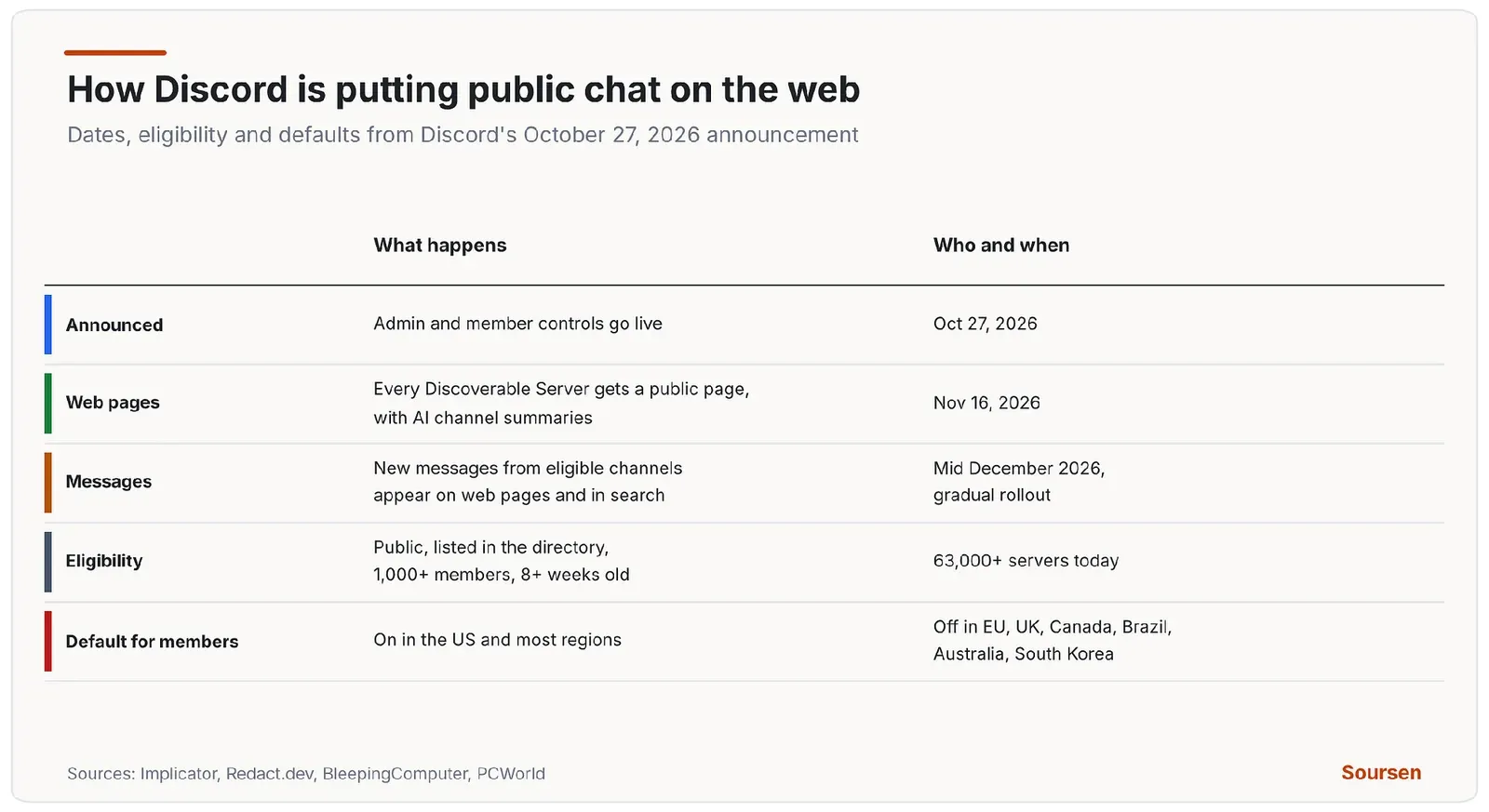
How Discord is putting public chat on the web. Messages begin to appear in mid December, and the member setting defaults on in the US. Source: Implicator,Redact.dev, BleepingComputer, PCWorld
The limits are worth knowing, because the first reactions I saw ignored them. Direct messages, group DMs and private servers are excluded. Messages sent before the mid December rollout are excluded. Published messages leave out usernames and avatars, but Implicator notes that identifying details in the text can remain. Members can switch off the sharing of their message content under User Settings and Data and Privacy, and that applies only to later messages. Messages that were already published stay unless the member deletes them. Search engines may keep cached copies longer, IBTimes reports, and removal can take a separate request. The member setting defaults off in the EU, the UK, Canada, Brazil, Australia and South Korea, and on in most other regions including the US. Teen accounts cannot turn it on.
Discord’s pilots ran in the NBA 2K, Rust and Dead by Daylight communities, according to BleepingComputer, and Implicator adds that the pilots used only administrator and moderator posts. The mid December rollout is the first time regular members’ messages will be published.
On AI, Implicator reports that Discord denies selling messages to AI companies. A Discord staff member also acknowledged that anything on the public web can be accessed by people and bots. Redact.dev adds context about earlier scraping. A 2025 project called Searchcord claimed to have archived more than 63 billion messages from Discoverable Servers, and Spy.pet sold searchable archives of public server messages until Discord banned the accounts behind it.
I find the stated motive the most telling part. Implicator reports that Discord group product manager Kelsey Duncombe-Smith wrote that web search would help people find answers currently locked inside Discord conversations. That is Discord agreeing that chat hides answers. The company is now building the index that a forum has by default.
The idea is older than Discord’s announcement. A service called Answer Overflow has let server owners index chosen Discord channels into Google through a sitemap since at least 2023. Communities that wanted a searchable archive have been bolting one onto chat for years.
Other projects made the same move
Other projects closed Discourse forums before Flathub did, and the destinations differ. Keycloak sunset its Discourse on June 26, 2023, saying that managing multiple channels was a challenge and that fewer channels should allow more meaningful conversations. It pointed people to Google Groups, GitHub Discussions and Slack, and left the old threads accessible as an archive. Bluefin, a Linux distribution, announced on July 17, 2025 that it was moving discussions to GitHub Discussions and announcements to a blog. One of the reasons it gave was that a single source of truth is easier for AI tools to index than content spread across several places, and another was that its Discord was nearing 20,000 members.
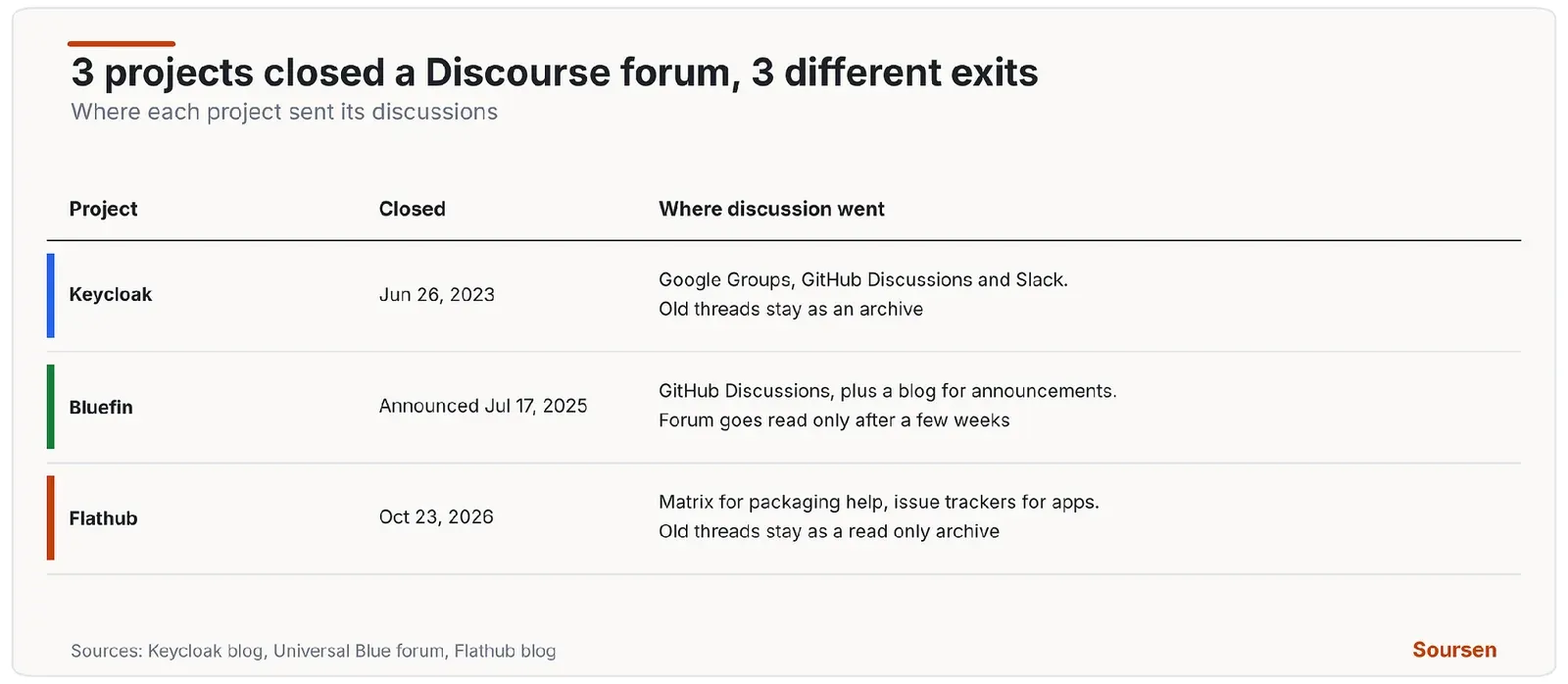
3 projects closed a Discourse forum, 3 different exits. Keycloak and Bluefin sent discussion to GitHub Discussions, and Flathub sent it to Matrix and issue trackers. Source: Keycloak blog, Universal Blue forum, Flathub blog
That comparison shapes my view of Flathub’s choice. Two of the 3 projects moved discussion to GitHub Discussions, a public web venue. Flathub sent packaging questions to a chat room. I think that is the weakest part of the plan, because the questions Flathub says it wants to keep answering are the ones with answers worth keeping.
The issue tracker worry
Flathub’s post says the forum became another issue tracker to keep an eye on. I think that observation is accurate, and I doubt that closing the forum fixes it. People report a problem in whichever place feels least intimidating. An issue template with fields for reproduction steps and logs scares some people off, and a plain discussion thread does not. Take the discussion venue away and some of those reports move to places the project does not control.
Flathub’s replacement for packaging help is the Matrix channel. I would not send a question that needs a durable answer there for the reasons above. The Flathub issue tracker works for problems with an app because the answer ends up attached to the report, and the tracker is public and searchable. That leaves general questions with the weakest home, and those are the questions a forum was best at.
Flathub also made 2 decisions I would copy. It kept the old threads online as a read only archive, so the answers did not disappear with the venue. It also named a specific destination for each category of question. Closing a forum is easier to defend when the old content stays findable.
2 things from this generalize
First, match the channel to how long the answer stays useful. A question whose answer will help the next person belongs somewhere a stranger can find without joining anything. A question about what someone is doing right now belongs in chat. Most communities mix the two in one room and then wonder why the same questions repeat.
Second, never close a venue without keeping its content readable. Flathub’s archive of about 2,100 topics keeps working for anyone who searches for a Flatpak problem. A deleted forum or a private chat server loses that value on the day it closes.
This week, list the 5 questions your community asked most often last month and check whether a stranger could find each answer through a search engine without joining anything. Move the ones that fail onto a public page, and link that page from the chat room.
Sources
- Flathub Discourse is now read only, Flathub Documentationdocs.flathub.org. Accessed 12 November 2026.
- Flathub Discourse archivediscourse.flathub.org. Accessed 12 November 2026.
- Flathub Discourse categoriesdiscourse.flathub.org. Accessed 12 November 2026.
- Flathub Discourse latest topicsdiscourse.flathub.org. Accessed 12 November 2026.
- Flathub’s future, Flatpak mailing list, January 25, 2020lists.freedesktop.org. Accessed 12 November 2026.
- Flathub’s future, reply by Alexander Larsson, January 28, 2020lists.freedesktop.org. Accessed 12 November 2026.
- Flathub’s future, vision statement thread, April 2020lists.freedesktop.org. Accessed 12 November 2026.
- Hello, how can I contact you, Flatpak mailing list, July 2020lists.freedesktop.org. Accessed 12 November 2026.
- Where is the right place to ask flatpak developer questions, Flathub Discoursediscourse.flathub.org. Accessed 12 November 2026.
- Sunsetting Discourse, Keycloakkeycloak.org. Accessed 12 November 2026.
- Bluefin discussions moving to GitHub, Universal Blueuniversal-blue.discourse.group. Accessed 12 November 2026.
- GitHub Discussions announced at Satellite 2020, InfoQinfoq.com. Accessed 12 November 2026.
- GitHub Discussions early adopter study, arXivarxiv.org. Accessed 12 November 2026.
- GitHub Discussions is out of beta, GitHub Bloggithub.blog. Accessed 12 November 2026.
- Element Help, message searchelement.io. Accessed 12 November 2026.
- Message search in Element, Matrix documentationdocs.matrix.kit.edu. Accessed 12 November 2026.
- Discord public chats and web search, Implicatorimplicator.ai. Accessed 12 November 2026.
- Discord Is Putting Public Server Messages in Google Search, Redact.devredact.dev. Accessed 12 November 2026.
- Discord is letting search engines read public messages, PCWorldpcworld.com. Accessed 12 November 2026.
- Discord to let search engines index public server messages, BleepingComputerbleepingcomputer.com. Accessed 12 November 2026.
- Discord messages could appear on Google, IBTimesibtimes.co.uk. Accessed 12 November 2026.
- Answer Overflow indexing, Answer Overflow Docsdocs.answeroverflow.com. Accessed 12 November 2026.
Related stories
Linux & open source
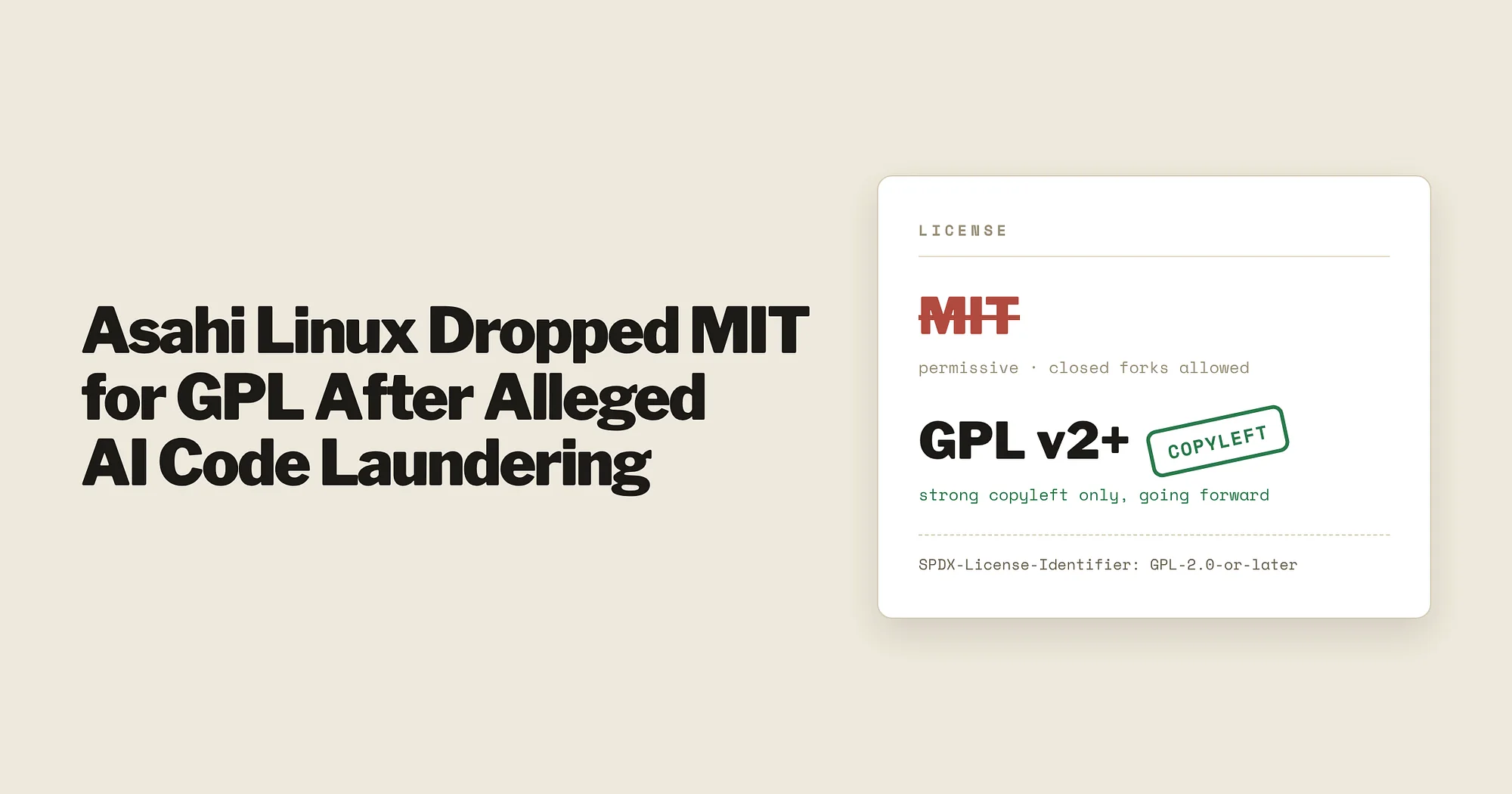
Asahi Linux Dropped MIT for GPL After Alleged AI Code Laundering
On November 7, 2026, Asahi Linux said it is moving every repository to GPL v2 or later. Asahi alleges that unreleased code was lifted from personal forks and that some of it was rewritten with LLM help to hide its origin. The report names no one, and the legal and community questions are still open.
Linux & open source
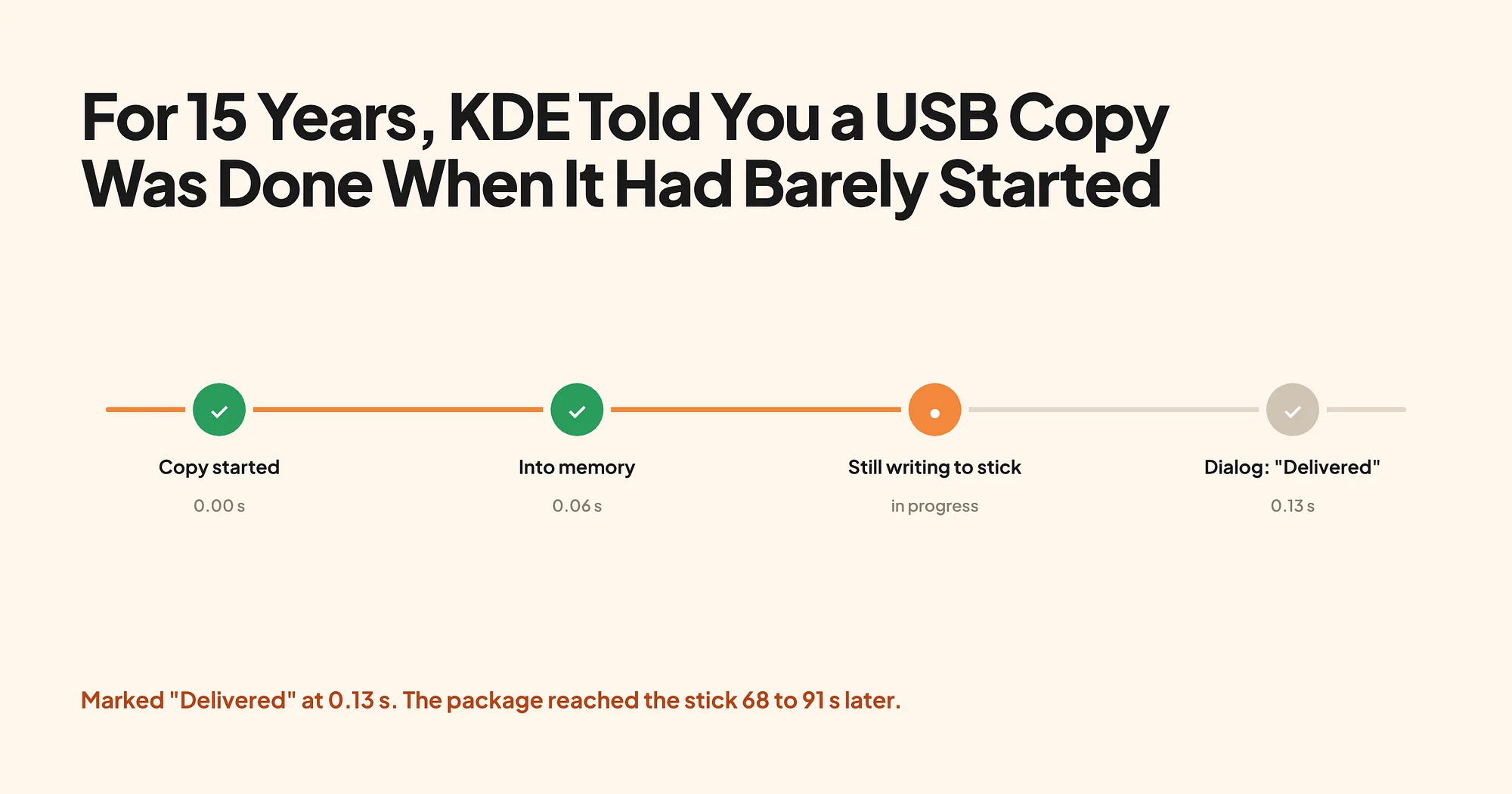
For 15 Years, KDE Told You a USB Copy Was Done When It Had Barely Started
A progress bar that timed the copy into memory, while the stick lagged far behind, corrupted files for anyone who trusted it and pulled the stick. The fix took 4 merge requests and a Linux call so sharp its own manual calls it extremely dangerous.
Linux & open source
Linux 7.4 Had the Biggest Merge Window in History, and Linus Torvalds Wrote Some of It With Claude
The kernel just took in nearly 20,000 commits in one cycle, a record. The reason is the same force straining its maintainers, AI. The release is the clearest look yet at what that help gives and what it costs.