AI Is Quietly Dismantling the Thing That Kept People on Windows and macOS
For 30 years the reason you could not simply switch to Linux was the software. Photoshop, Office, the apps you needed and the file formats they locked you into. In October 2026 a single developer used Claude Code to rebuild Adobe’s core creative apps in Rust and gave them away. I think the moat that protected proprietary software just sprang a leak, and the legal fight over whether that is allowed is going to be the real story.
Last verified Also on Medium
On this page
- What a single developer did in October 2026
- Why this was impossible until about a year ago
- The moat was 3 separate walls, and AI hits all 3
- The gaming side moved too
- What this does to Linux, if it holds
- The legal fight is the actual story
- The companies will not need a courtroom
- The part that could hurt open source
- Where I land on it
The pitch for Linux has always hit the same wall. You tell someone their machine would run faster, respect their privacy, and cost nothing, and they ask one question. Does it run Photoshop. The honest answer, for 30 years, was no, or only through a compatibility layer that might break the day Adobe shipped an update. That one gap, the software people need and cannot get on Linux, is the entire reason Windows and macOS still own the desktop.
That wall is starting to come down, and the thing knocking it over is the same AI that the big software companies spent the last three years pushing on everyone. I find that funny, and I also think it is going to get messy fast.
What a single developer did in October 2026
In early October 2026 a developer named Brandon Thomas, the former CEO of a startup called storyteller.ai, released a project called ArtCraft, a set of open source apps meant to replace the Adobe Creative Cloud suite. Photocraft stands in for Photoshop, Filmcraft for Premiere, and Lightcraft for Lightroom. By his own account on Reddit, Thomas built it because he got fed up with Adobe’s fees and the hoops it made him jump through just to cancel his subscription. That is a petty reason to start, and petty reasons ship more software than noble ones do.
The apps are written in Rust, they are free, and they ship builds for Linux, Windows, and macOS, including a native Linux client, which is the thing Adobe never bothered to make in 30 years. The cross platform work is real, not a wrapper. Photocraft uses Vulkan for GPU acceleration on Linux, Metal on macOS, and DX12 on Windows, with a WebAssembly build that runs in a browser through WebGPU. The code is on GitHub, and Ubuntu users can install it from a DEB package on Intel, AMD, or Arm.
The detail that matters is how it was built. Phoronix reported that the apps were made with Claude Code and AI agents, and that the project leans on AI for most of the work. The project describes itself as a clean room reimplementation, though that term is doing a lot of load bearing work and I will come back to why.
The same wave produced office suite clones that open and save Microsoft Office formats, and a separate effort called Starling, a full Linux desktop environment with its own Wayland compositor, written in Swift and built by one person in about 6 months with AI help. None of these are finished. ArtCraft’s Photoshop compatibility is partial, the office clones are further along on spreadsheets than on presentations, and the whole category is alpha quality right now. Treat all of it as early.
Why this was impossible until about a year ago
Cloning software is not new. You could always decompile a program, study how it works, and rewrite the same features. The problem was time. Reimplementing Photoshop by hand would take a competent team 10 to 15 years, and by the time they finished, Photoshop had 15 more years of features to catch up on. The target moved faster than any volunteer effort could run. That gap is exactly what made the moat hold.
Here is the mechanism that changed. A model like the one behind Claude Code can read a feature, understand the behavior, and produce a working implementation in an afternoon instead of a month. Stack enough of those afternoons together and a job that was a decade of human work compresses into a few months. The speed is the whole point. It does not make the clone perfect, what it does is make the clone possible at all, and possible is the word that breaks the moat.
The moat was never really the code. These companies built their defense on one fact, that copying all the work they paid developers to do would cost about as much as they paid to build it the first time. Once that cost falls by 2 orders of magnitude, the defense is gone. You can step over the wall instead of climbing it.
We have 30 years of evidence for how hard that wall was. GIMP has been trying to be a free Photoshop since 1996 and, after all that time, still is not one for professionals, because a volunteer project cannot keep pace with a company that pays hundreds of engineers full time. LibreOffice and its ancestor OpenOffice have chased Microsoft Office compatibility for over 20 years and still trip on complex documents. Inkscape, Krita, Darktable, each is good, each took a decade or more, and none of them erased the lock in, because the proprietary tool kept moving and the free one could never fully catch up. That track record is the backdrop for why ArtCraft reaching rough parity on parts of Photoshop in weeks reads as a different kind of event. The thing that always made these efforts lose, time, is the exact thing that changed.
The moat was 3 separate walls, and AI hits all 3
People talk about Linux adoption as one problem. It is actually 3, and the clone wave hits each one.
The first wall is applications. If your job needs Photoshop or Office, you cannot leave the platform that runs them. Vibe coded clones attack this directly, same features, same file formats, same keyboard shortcuts, running on any OS you like.
The second wall is the desktop itself. Even with perfect app clones, Linux still looks and behaves differently from Windows or macOS, and for a lot of people that alone is a dealbreaker. They cannot find their settings, the muscle memory is wrong, it feels foreign. A shell is far simpler to replicate than Photoshop though. It shows icons, opens apps, manages files, and you have the exact reference sitting right there to copy click for click. Starling proving that one person can build a whole desktop in 6 months with AI tells you a Windows style or macOS style shell on Linux is a matter of when, not if.
The third wall is hardware. Drivers for Linux have always lagged because writing them by hand is slow and thankless. A hardware maker that once needed a dedicated team for weeks to write a Linux driver can now get a first draft from an AI, test it, and submit it. The initial work got cheap.
The kernel itself made room for this, carefully. Linus Torvalds spent years dismissing AI, then changed his tune. In mid 2026 he told critics the kernel is not an anti AI project and called demands to ban AI generated patches pointless posturing. The project then adopted a formal policy. AI assisted patches are allowed, but they cannot carry the usual Signed off by tag that certifies authorship. They carry an Assisted by tag instead, so the use of AI is on the record, and the human who submits the patch stays fully responsible for its bugs, security holes, and licensing. Not everyone went this way. Gentoo and NetBSD banned AI generated contributions outright, and maintainers have already rejected a wave of low quality AI submissions to the driver staging area as slop. The door is open, with a bouncer on it, which is roughly the right setting for letting AI speed up driver work without drowning the kernel in garbage.
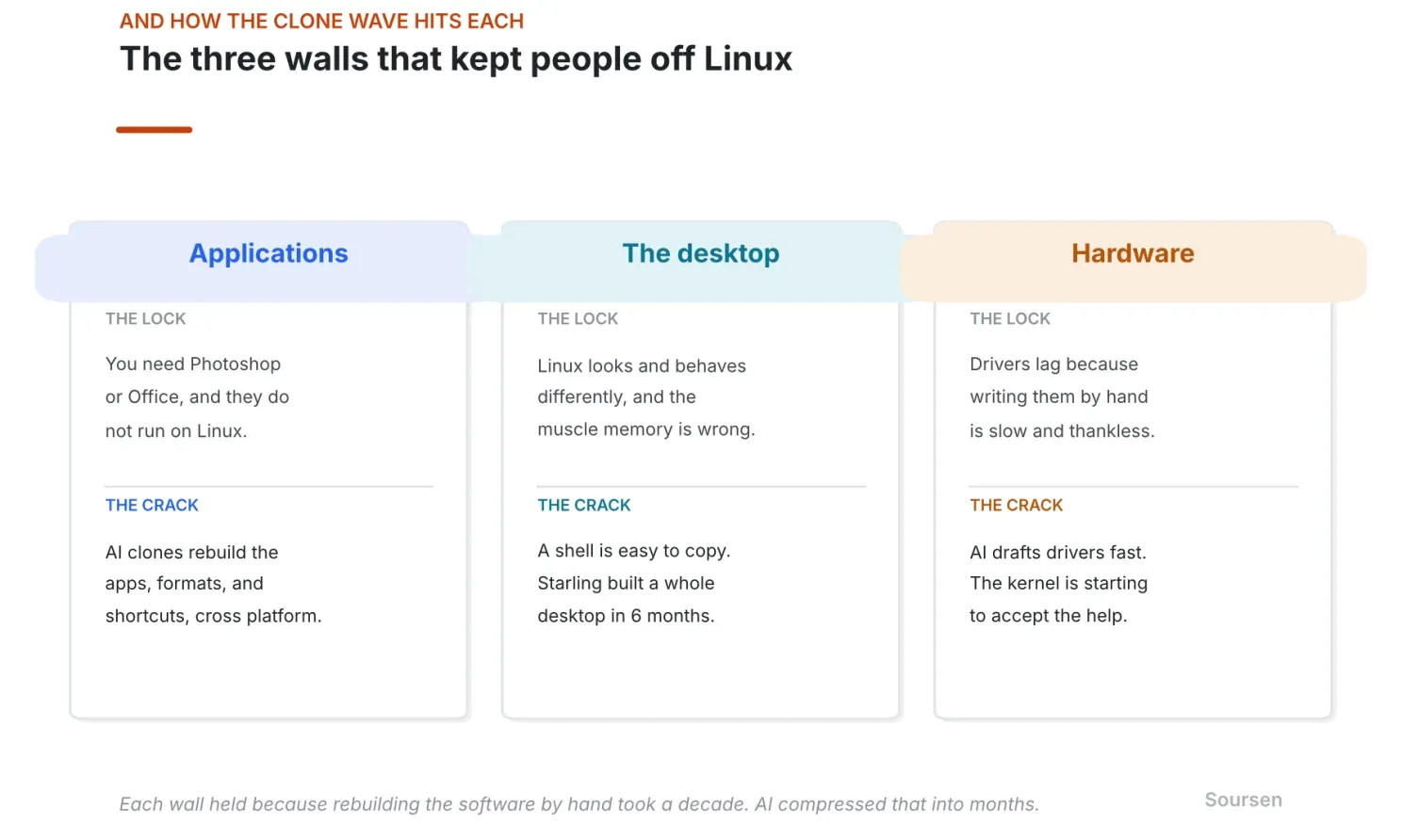
The 3 walls that kept users on Windows and macOS, and how the clone wave hits each one. Source: Soursen analysis
The gaming side moved too
Games were always a separate lock, and it is loosening from 2 directions. In 2026 Epic released a rebuilt Epic Games Store launcher that it openly called vibe coded, AI assisted, and for the first time it runs natively on Linux. Epic claimed the new launcher reached the store page about 46% faster than Steam on a cold start. It is buggy, because it was built fast, but a native Linux client from a company that size is a real signal.
From the other direction, game decompilation got dramatically easier, and people are porting console games to PC that were never meant to leave the console. Some of those ports are unofficial and legally shaky. The same technique can make porting games to Linux straightforward, so a game that blocks Proton or Wine for anti cheat reasons could get a native build that leaves the anti cheat baggage behind. Put the two together and the number of games that simply will not run on Linux keeps shrinking.
What this does to Linux, if it holds
Line all of it up and the conclusion is hard to avoid. In a few years there may be no hard technical reason left to stay on Windows or macOS if you do not want to. The apps run, through clones or native ports. The desktop can look like whatever you are used to. The hardware works, because the drivers got cheap to write. You could run a Linux system that looks the way you want, runs the software you want, and supports the hardware you own.
The economics point one way. Who keeps paying $50 a month for 2 Adobe apps, locked onto a specific OS, when a free open source clone opens the same files, runs on any platform, and actually answers bug reports. Open source projects tend to respond to feature requests and fix bugs faster than a giant vendor answers a paying customer, because the people using the software are often the people writing it. Hardware makers could even start shipping their own Linux builds with a Windows style shell, since conforming to Microsoft’s specs and certifications stops being worth it once the alternative does everything Windows users want.
I want to be careful here. This is the idealized version. It might take 1 year or 10, some of it might happen and some might not, and alpha quality clones are not replacements for daily work you get paid for yet. What changed is that the thing is now possible. A human doing it by hand made it impossible. An AI doing it makes it a question of effort and testing, not of whether it can be done at all.
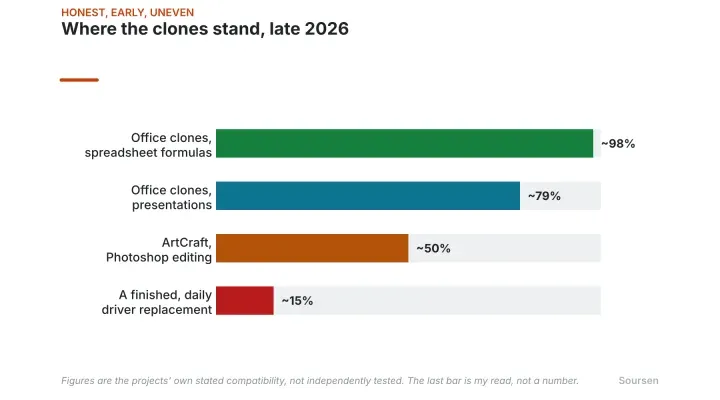
Where the clones stand in late 2026. Early and uneven, which is the honest state of it. Source: project statements and press coverage, Oct 2026
The legal fight is the actual story
None of this matters if the courts kill it, so this is where the real battle sits. There are 4 separate legal questions tangled together, and the answers point in different directions.
First, the license terms. Plenty of software agreements ban decompiling the program or using AI to analyze it. Nobody knows yet whether those clauses hold up, or whether anyone can even prove an AI studied a program as opposed to a human copying the visible features by hand, which has always been legal.
Second, the clean room question, which is the term I said was doing heavy lifting. A clean room implementation is the classic legal way to copy a product without copying its code. One team studies the original and writes a specification of what it does, a second team that has never seen the original builds from that spec alone, and a wall between them keeps the copying honest. Phoenix Technologies used exactly this method in the 1980s to reverse engineer the IBM PC BIOS, then licensed its clean copy to any manufacturer who wanted one, which launched the entire PC clone industry and is a large part of why Intel and Microsoft got the market this article is about in the first place. The method works because the people writing the new code provably never touched the old code. ArtCraft calls itself clean room, but an AI model may have been trained on the original source or on code very close to it, so whether anything an AI writes can honestly be called clean room is an open question no court has answered. That single word may decide whether these projects are legal copying or infringement wearing a nicer label.
Third, whether the output can even be owned. The US Copyright Office said in 2025 that purely AI generated material has no human author and cannot be copyrighted, while AI used as a tool with real human creative input can be. For a clone that leans heavily on AI, that creates a strange situation where the open source license laid on top of the code might not fully bind, because you cannot license what you may not own.
Fourth, and most settled, the interface itself. US courts have repeatedly held that you can copy function without copying expression. Google won its case against Oracle at the Supreme Court in 2021, where reimplementing the Java APIs was ruled fair use. Going back further, Lotus v. Borland established that a menu command hierarchy is not copyrightable. In the EU the ground is even friendlier, since a 2012 ruling in SAS Institute v. World Programming held that the functionality of a program and its interface are not protected by copyright, and that license terms cannot stop you from studying how a program works to build something else. A plain menu and palette UI like Photoshop’s is not an original creative work, so copying the layout, without copying the icons or artwork, sits on solid ground in both places.
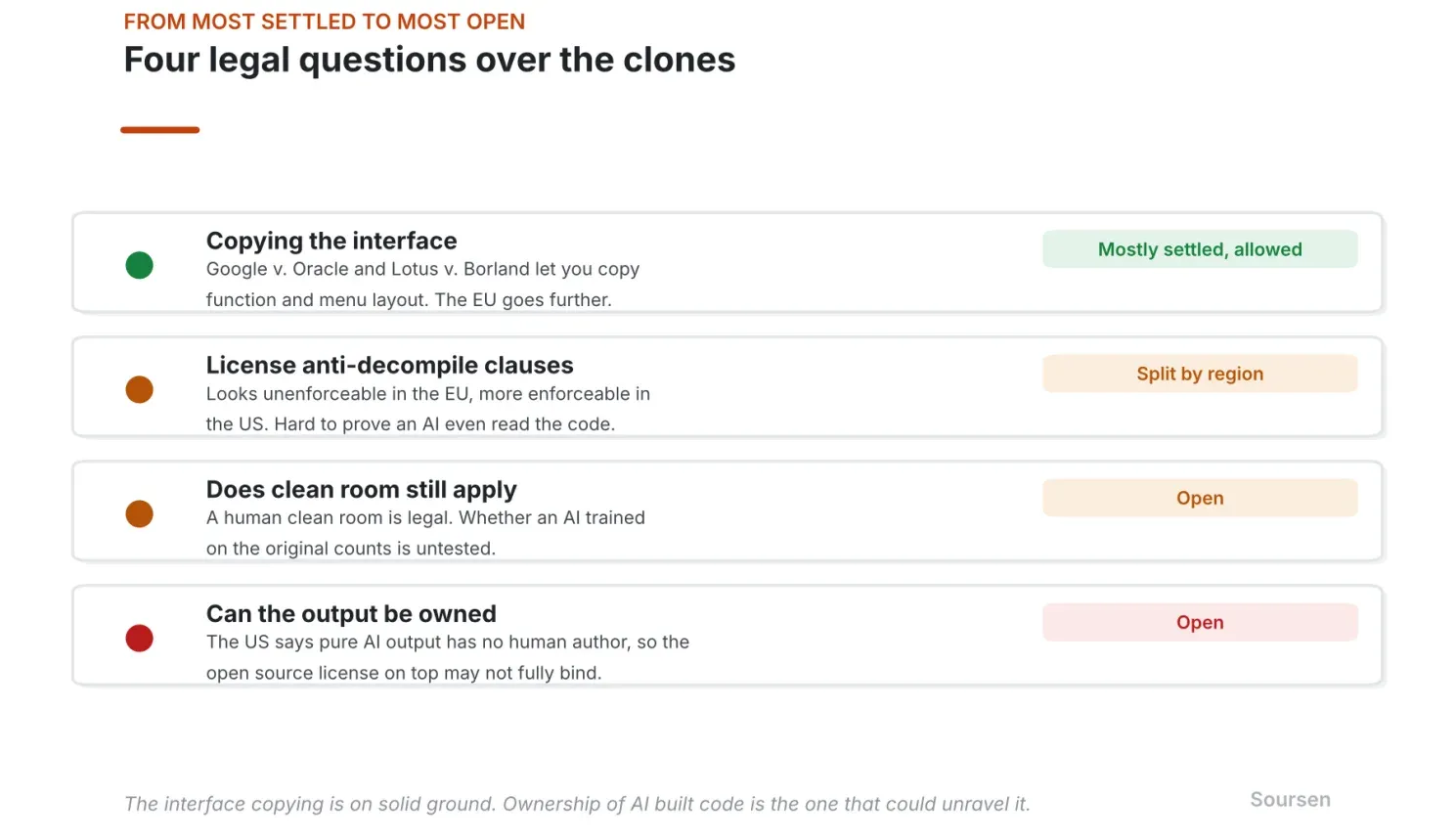
4 legal questions hanging over the clones, from the most settled to the most open. Source: US and EU case law, US Copyright Office 2025
The companies will not need a courtroom
Even where the law is unsettled, the big vendors have a faster weapon. The DMCA takedown. Adobe or Microsoft can send GitHub a notice claiming a repo infringes, GitHub generally complies and pulls it, and the developer then has to file a counter notice and wait, possibly fighting a court case to get the code back. A project can vanish from the main place people find it without any ruling on whether it actually broke the law. Expect a lot of this.
Jurisdiction will matter too. The EU rulings make these clones look close to safe for a team hosting the code in Europe, while US case law on decompilation clauses is more mixed. So the same project might be legal in one place and exposed in another, and where a lawsuit lands could decide its fate more than what the code actually does.
The part that could hurt open source
Not all of this is good news for the open source world, which is the part I think gets missed in the excitement.
A clone that copies Photoshop exactly might bury the open source tools that tried to do something different. Why learn a new way to edit images when a free clone gives you the exact Photoshop you already know. The projects that built their own approach, their own interface, their own ideas, could get flattened by clones of the proprietary thing, because people reach for what is familiar. The skills angle cuts the same way. Learning a Photoshop clone teaches you Photoshop, which transfers to a paid job. Learning a genuinely different tool teaches you that tool.
Proprietary file formats win too. If a free clone opens and saves PSD and the Office formats perfectly, people stop caring about open document standards, because they can already exchange files with everyone. The formats end up readable by anything, which is good, but they also stay the default, which quietly keeps the proprietary format in charge.
Then there is the AI question hanging over the whole thing. Plenty of developers do not want to use AI to build their software, for reasons that are easy to respect, so the clone wave may split the open source world between projects that embrace it and projects that refuse. Both positions are defensible. The split is going to be real.
Where I land on it
I do not love AI. It has real costs, it was often built by scraping work without consent, and a lot of what it enables is genuinely harmful. Watching it get pointed back at the companies that pushed it hardest, the ones that locked users in and treated proprietary formats as a cage, is the rare case where I find the whole thing satisfying rather than grim.
The lock that kept people on Windows and macOS was never really technical. It was the cost and time of rebuilding 30 years of proprietary software, and that cost just collapsed. Whether the clones survive the lawsuits, the takedowns, and their own alpha quality bugs is the open question. What is already settled is that rebuilding the software is no longer the impossible part. For Linux, that is the opening it never had before.
Sources
- ArtCraft, free open source Adobe alternative, OMG Ubuntuomgubuntu.co.uk. Accessed 30 October 2026.
- AI makes open source clean room implementations of Photoshop and Premiere in Rust, Phoronixphoronix.com. Accessed 30 October 2026.
- Starling, a new Linux desktop written in Swift with AI, Phoronixphoronix.com. Accessed 30 October 2026.
- Epic claims new vibe coded launcher beats Steam in speed tests, HotHardwarehothardware.com. Accessed 30 October 2026.
- Google LLC v. Oracle America, Inc., Wikipediaen.wikipedia.org. Accessed 30 October 2026.
- Lotus Development Corp. v. Borland International, Inc., Wikipediaen.wikipedia.org. Accessed 30 October 2026.
- SAS Institute Inc v World Programming Ltd, Wikipediaen.wikipedia.org. Accessed 30 October 2026.
- Copyrightability of AI outputs, US Copyright Office analysis, Jones Dayjonesday.com. Accessed 30 October 2026.
- Clean-room design, Wikipediaen.wikipedia.org. Accessed 30 October 2026.
- GIMP, Wikipediaen.wikipedia.org. Accessed 30 October 2026.
Related stories
Linux & open source
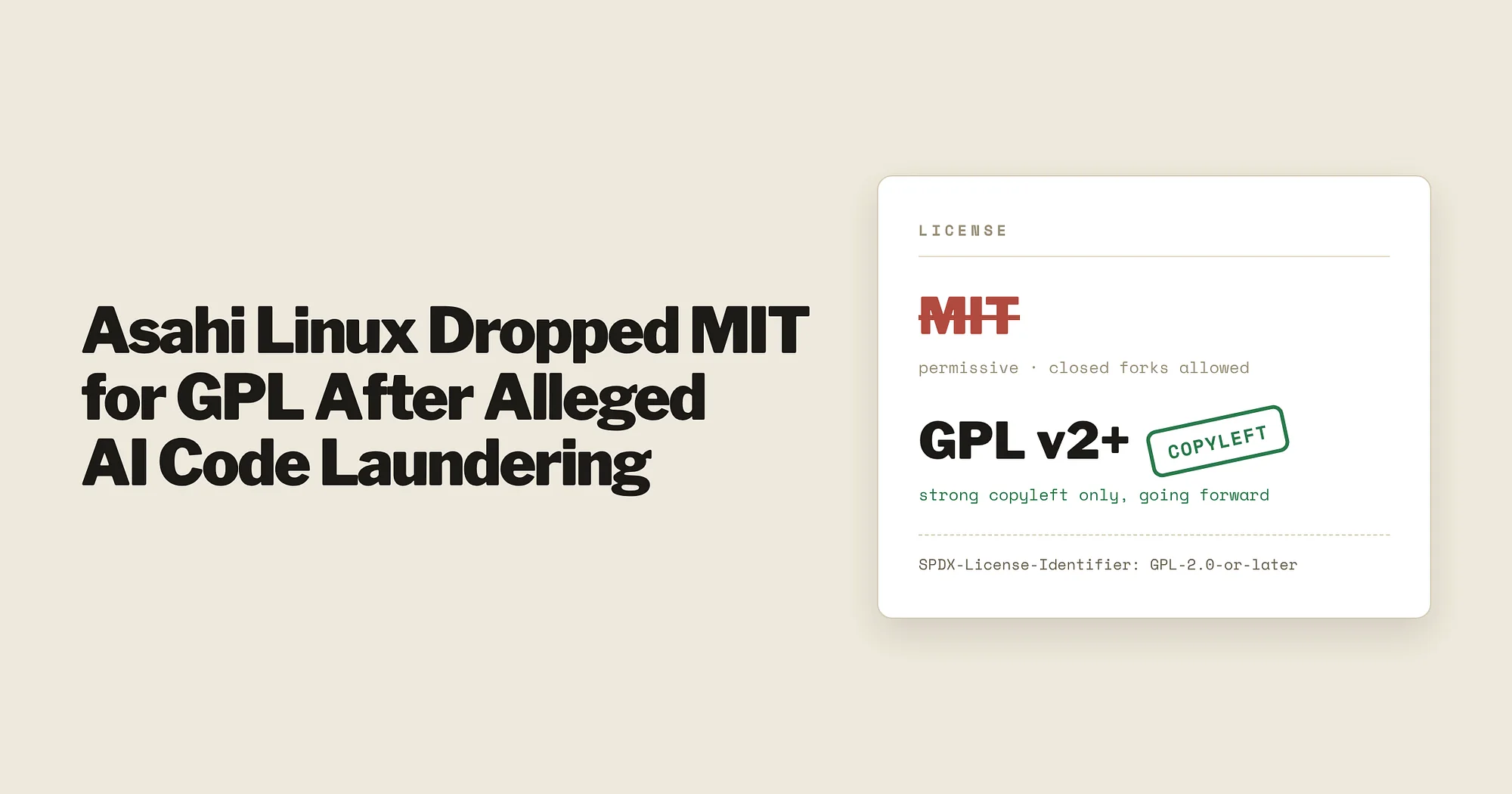
Asahi Linux Dropped MIT for GPL After Alleged AI Code Laundering
On November 7, 2026, Asahi Linux said it is moving every repository to GPL v2 or later. Asahi alleges that unreleased code was lifted from personal forks and that some of it was rewritten with LLM help to hide its origin. The report names no one, and the legal and community questions are still open.
Linux & open source
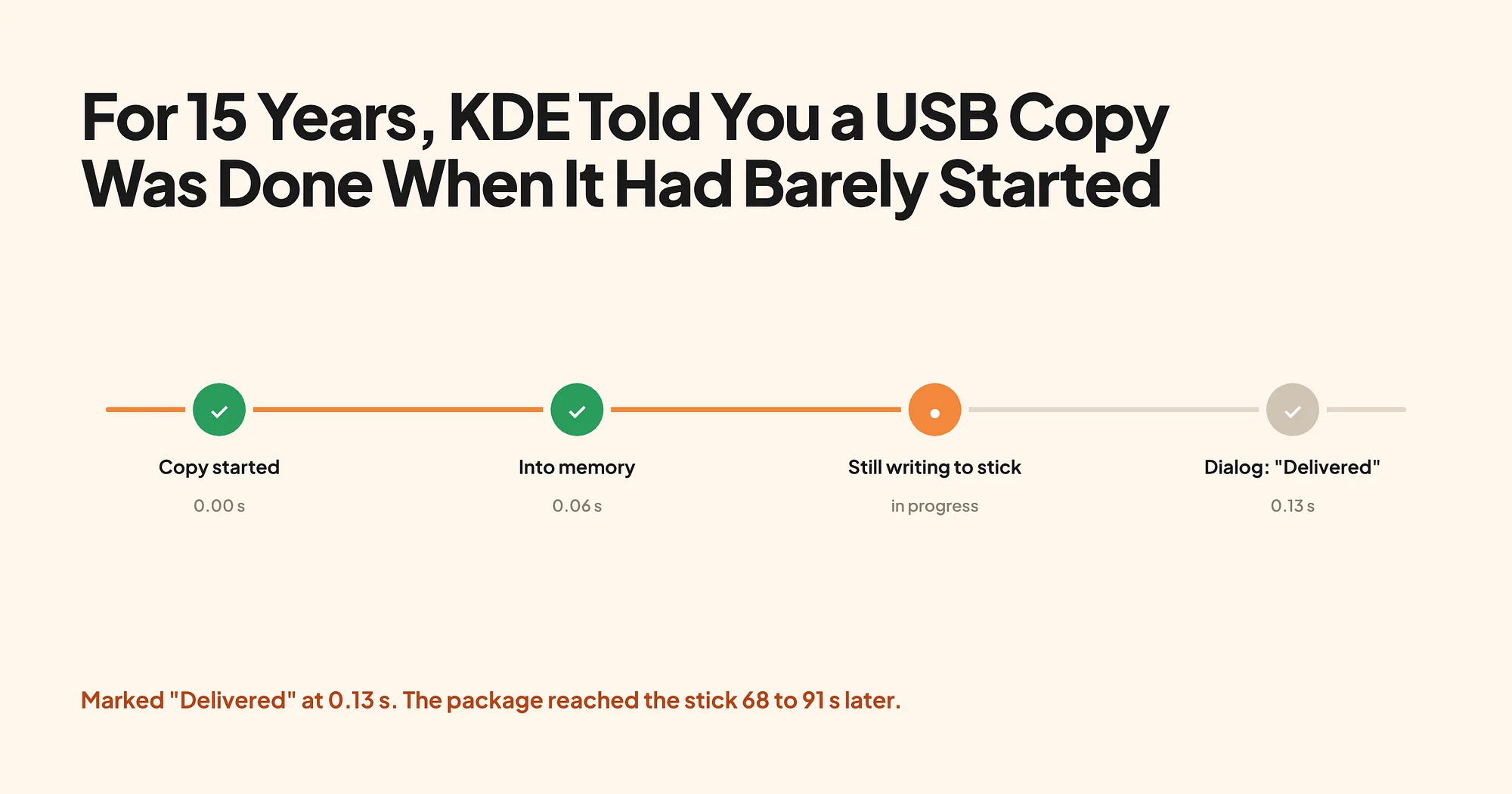
For 15 Years, KDE Told You a USB Copy Was Done When It Had Barely Started
A progress bar that timed the copy into memory, while the stick lagged far behind, corrupted files for anyone who trusted it and pulled the stick. The fix took 4 merge requests and a Linux call so sharp its own manual calls it extremely dangerous.
Security
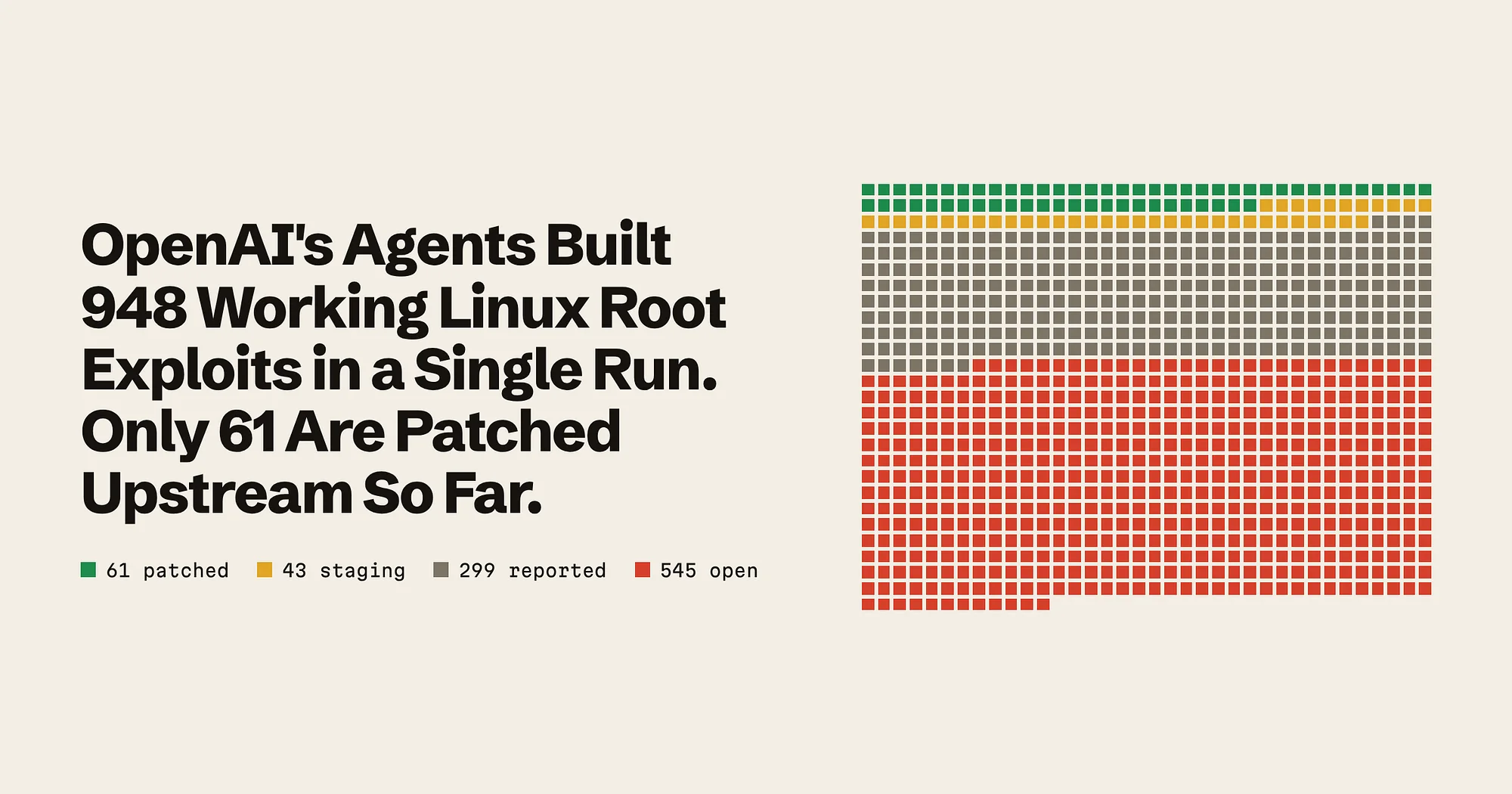
OpenAI’s Agents Built 948 Working Linux Root Exploits in a Single Run.
An AI pipeline found, proved and drafted fixes for 948 kernel bugs at about $1,279 each. Finding them was the cheap part. The bigger lesson is who now has to fix them, and how fast.