Will Altcoins Ever Recover? The Honest Answer Is Not the One X(Twitter) Wants.
Note: This article is for informational purposes only and does not constitute financial or investment advice.
Last verified Also on Medium
On this page
Note: This article is for informational purposes only and does not constitute financial or investment advice.
Back in 2021, a glance at CoinGecko or CoinMarketCap would show well over 100 altcoins worth more than 1 billion dollars each. Today that number has collapsed. Bitcoin dominance is sitting near multi-month highs, the vast majority of altcoins are trading below their 200-day moving average, and sentiment is somewhere between cautious and outright fearful.
Every single week on crypto Twitter, someone tells you the exact same thing. Alt season is just around the corner. Just hold on a little longer. Here is the uncomfortable possibility worth sitting with. The alt season you are waiting for, the one where everything moons simply because Bitcoin moves, might be structurally gone. The old rotation machine is broken, and the onchain data backs that up clearly enough that it is worth walking through in detail.
The Numbers That Make This Cycle Genuinely Different
Bitcoin has spent most of 2026 trading well off its highs in a cold, risk-off market. Bitcoin dominance broke out above 60% in mid-2026, ending an 8-month accumulation phase and pushing toward the 66% cycle high set back in June 2025. For context, dominance measures Bitcoin’s share of the entire crypto market. When it falls, capital is flowing out of BTC and into everything else. Historically, alt season needs dominance to break decisively below roughly 55% before genuine broad rotation fires. Back in 2021, dominance fell all the way to around 40%, and that collapse is exactly what let altcoins rip. This cycle, dominance has spent most of the year oscillating in the high 50s to mid 60s, and has not sustained a break below that critical threshold.

Both the Bitcoin dominance trigger (needs to break below 55%) and the Altcoin Season Index trigger (needs to exceed 75) remain far from firing in 2026, unlike the 2021 cycle when both conditions were met. Source: TradingView, CoinMarketCap, BeInCrypt
The Altcoin Season Index tells the same story from a different angle. The index currently reads somewhere in the 30s to high 40s, well below the 75 threshold that officially defines a true alt season, meaning 75 or more of the top 100 altcoins would need to be outperforming Bitcoin over a rolling 90-day window. Right now fewer than half are managing that. The index would need to climb by roughly 50 to 60% from current levels just to hit the alt season threshold, and historically the index has spent most of the past 4 years in neutral or Bitcoin-leaning territory rather than sustaining the kind of reading that defined 2021.
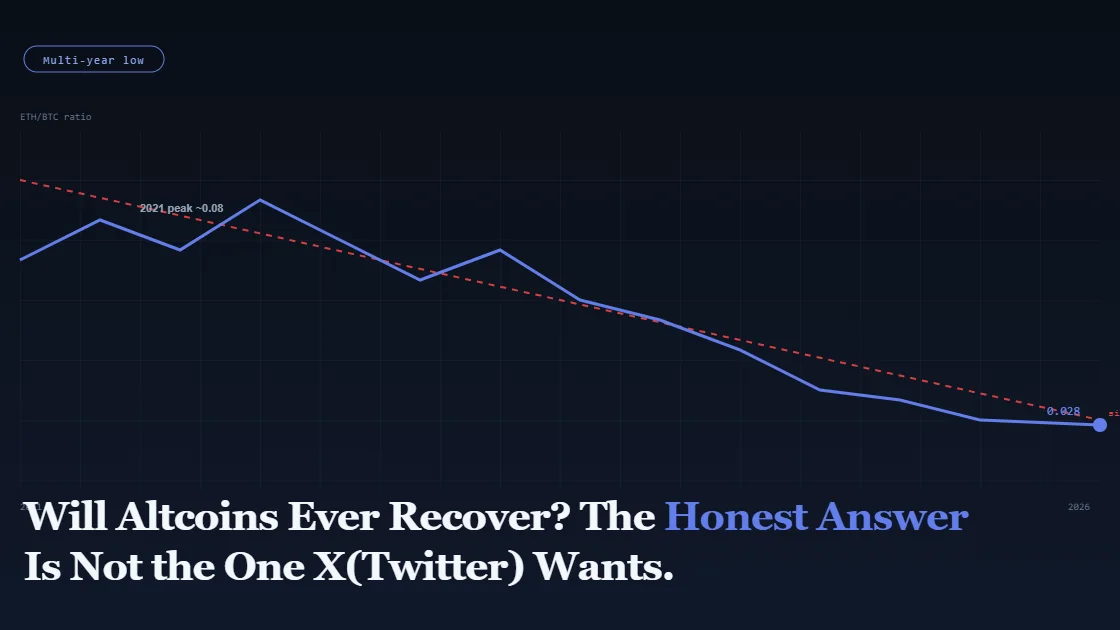
The ETH/BTC ratio, often the earliest and most reliable signal of broad rotation, tells the most sobering story of all. The ratio has fallen to somewhere around 0.026 to 0.031 depending on the exact measurement date, a multi-year low. Back during the 2021 alt season, that ratio traded closer to 0.08. Popular analyst Crypto Kaleo has pointed to a long-term descending trendline that has capped every ETH/BTC rally since 2017, with the pair currently pressing right up against it.
Why the Old Conveyor Belt Actually Broke
For years, the rotation model was beautifully simple. Bitcoin pumps, profits rotate into Ethereum, then into large-cap altcoins, then down into the long tail of smaller tokens. It functioned like a conveyor belt moving liquidity down the risk curve, lifting nearly everything in sequence as it went. That conveyor belt appears to have genuinely stopped, and the clearest evidence of the breakdown is the number 2 asset itself.
Ethereum was always supposed to function as the bridge, the asset capital flows through on its way to everything smaller and riskier. Instead, Ethereum has effectively been cannibalized by its own scaling solutions. Layer 2 networks, the faster and cheaper chains built on top of Ethereum, now handle the overwhelming majority of transaction volume, and critically, they do not send meaningful fee revenue back to the base layer. Before the Dencun upgrade in March 2024, Layer 2 networks paid approximately $113 million annually to the Ethereum mainnet. After Dencun dramatically cut L2 transaction costs by introducing a cheaper data storage mechanism, mainnet fee revenue from L2s collapsed to a small fraction of that figure, and Ethereum’s overall fee revenue flowing to the base layer is now down more than 95% from its 2021 peak, when the network was regularly generating over $1 billion a month at the height of the DeFi and NFT boom.
Ethereum’s mainnet fee revenue from Layer 2 networks has collapsed more than 95% since 2021, even as L2 transaction volume has grown dramatically. Source: Standard Chartered research, SahmCapital, The Block, 2026.
Standard Chartered’s Geoff Kendrick was the analyst who put the sharpest number on this dynamic, estimating that Coinbase’s Base network alone has removed roughly $50 billion from Ethereum’s market capitalization by diverting fee revenue that would otherwise have accrued to the mainnet. Kendrick’s framing is worth quoting directly: Layer 2 networks, and Base in particular, now extract what he called super-profits from the Ethereum ecosystem, passing nearly all of that value to Coinbase, Base’s corporate owner, rather than back to ETH holders. He did note that a proactive change from the Ethereum Foundation, such as taxing L2 activity directly, could mitigate the issue, but considered that outcome unlikely given the Foundation’s stated commitment to permissionless scaling.
Ethereum is busier than it has ever been in actual usage. Its fee revenue to the base layer has collapsed more than 95% from 2021 levels. If the second-largest asset in crypto has lost its gravitational pull, the long tail of smaller altcoins has nothing left to ride.
The Liquidity Did Not Vanish. It Concentrated.
The conveyor belt stopping is only half of this story. While the belt stopped moving, the liquidity itself did not disappear from crypto entirely. It simply concentrated into a much smaller number of stronger names, and above all, into Bitcoin itself through a channel that had no real equivalent in prior cycles.
Spot Bitcoin ETFs have created what analysts increasingly describe as a one-way funnel. Spot Bitcoin ETFs collectively hold approximately 1.5 million BTC, roughly 7% of Bitcoin’s entire maximum supply, and Grayscale’s own research has projected that ETF buying alone could absorb more than 100% of new Bitcoin issuance in 2026, comfortably exceeding the roughly 450 BTC produced daily by miners. That represents a structural, price-insensitive bid for Bitcoin specifically that simply has no altcoin equivalent.
The concentration inside the altcoin market itself is just as stark. A small handful of top altcoins now account for the overwhelming majority of the entire non-Bitcoin market capitalization, leaving thousands upon thousands of smaller tokens fighting over what remains. Worse than merely underperforming, many of these smaller projects are dying outright. Reports from onchain data trackers have documented dozens of crypto projects shutting down in the first half of 2026 alone, and these were not all scams or vapourware. Several were legitimately funded ventures that simply failed to find product-market fit as the broader pool of speculative attention and liquidity stopped expanding to accommodate them.
This Is Not the End of Crypto. It Is a Regime Change.
Before concluding that crypto is finished and every altcoin holder is doomed, it is worth being precise about what the actual cycle timing evidence still says. Historically, altcoin strength has tended to arrive somewhere between 18 and 30 months after a Bitcoin halving. The most recent halving was in April 2024, which keeps a historically plausible rotation window open through late 2026 and into 2027. The cycle clock itself is not necessarily broken.
What has changed is the underlying mechanism. The next genuine recovery, if and when it arrives, is very unlikely to look like a rising tide that lifts every token equally. It is far more likely to be selective, concentrated, and gated hard by actual fundamentals rather than pure sentiment and momentum. Looking closely at which sectors are actually surviving and growing right now gives a clear preview of what that selective recovery looks like in practice.
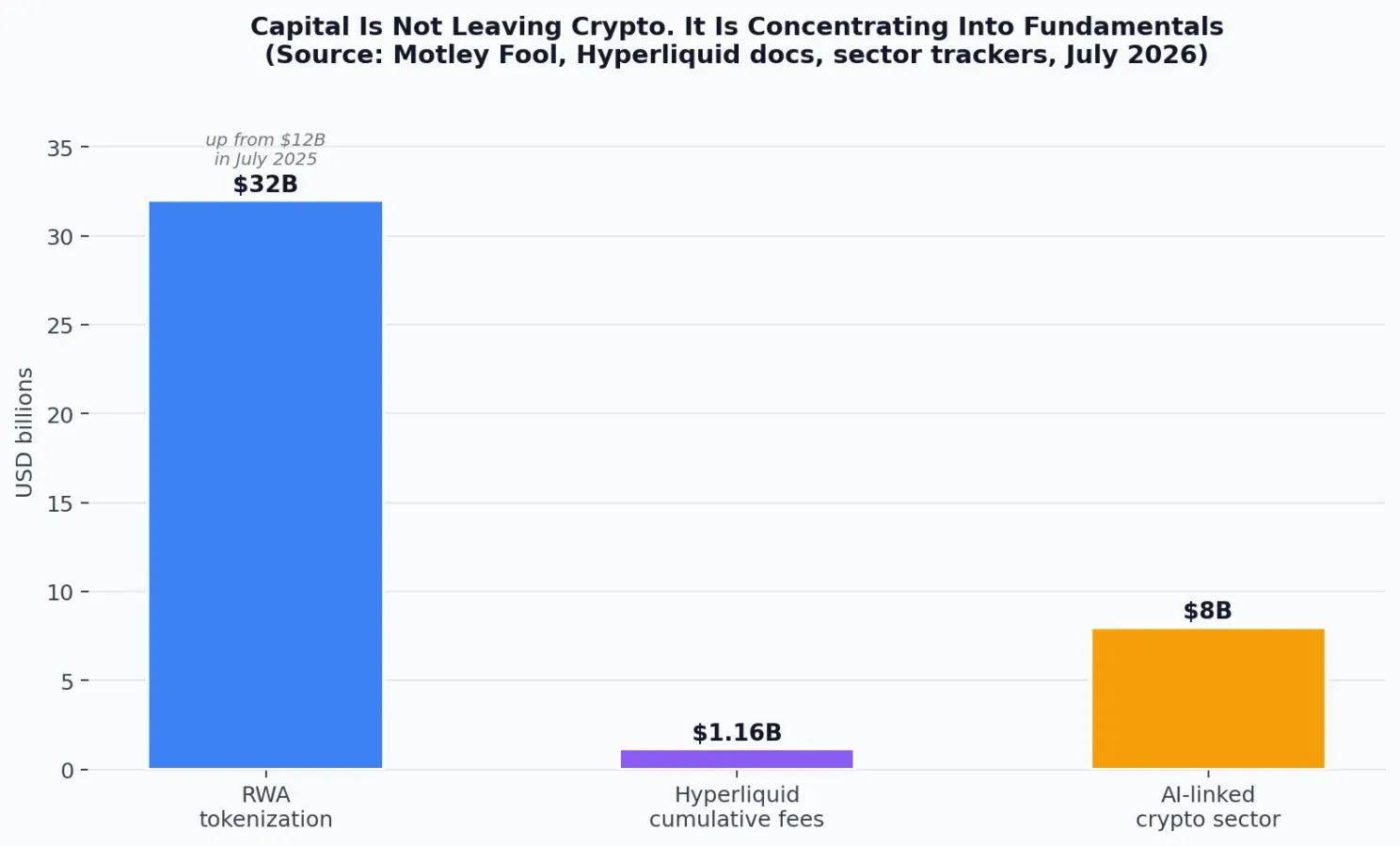
Capital concentrating into sectors with demonstrable fundamentals: real-world asset tokenization, revenue-generating DeFi protocols, and AI-linked crypto infrastructure. Source: Motley Fool, Hyperliquid public data, sector trackers, July 2026.
Real-world asset tokenization, meaning tokenized versions of Treasuries, private credit, and similar traditional instruments, has grown from roughly $12 billion in July 2025 to nearly $32 billion by mid-2026, according to Motley Fool’s analysis of the sector, without the benefit of any federal regulatory statute clarifying the space. Ethereum specifically holds an estimated 80% share of the tokenized asset market, which is one of the few genuine structural tailwinds working in the network’s favour despite its fee revenue problems.
DeFi protocols that generate genuine, verifiable revenue are the other clear pocket of relative strength. Hyperliquid has accumulated more than 1 billion dollars in cumulative protocol fees and routes the overwhelming majority of that revenue directly into buying back its own token, a mechanism that ties token value directly to platform usage rather than pure speculation. Aave has continued generating tens of millions in annual profit. Several newer lending protocols have raised meaningful capital at billion-dollar-plus valuations specifically on the strength of demonstrated revenue rather than narrative alone.
AI-linked crypto infrastructure has also genuinely surged, with some sector trackers placing total sector value above $8 billion and citing triple-digit year-on-year growth. Real-world asset tokenization specifically stands to benefit further if the Clarity Act passes, since institutional allocators have historically waited for regulatory clarity before committing serious capital, and passage would likely direct meaningful new inflows specifically toward the chains already leading in tokenized assets, namely Ethereum, Solana, and XRP.
The Practical Filter Worth Actually Using
The filter that separates survivors from what will likely become permanent exit liquidity is straightforward to state, even if applying it with discipline is harder than it sounds. Stop asking whether altcoins broadly will recover. Start asking, for each specific asset, whether it has real users, real revenue, or genuine, defensible utility that does not depend entirely on a broader market rotation to justify its price.
The 4 Signals Worth Actually Tracking
Rather than watching for a single alt season headline, 4 specific, checkable signals will tell you far more about whether a genuine broad rotation is forming.
- First, watch Bitcoin dominance directly. A decisive, sustained break below the 55% level is the trigger that needs to fire before any broad-based altcoin strength should be taken seriously. Until that happens, treat every alt season is here headline with real scepticism.
- Second, watch the Federal Reserve. The rate cuts many market participants expected earlier in 2026 have not fully materialised on the timeline hoped for, and inflation data has complicated the picture at various points through the year. The easy liquidity tailwind that historically fuels risk-on altcoin rallies has not clearly arrived, and the more cautious rate-cut timeline increasingly lines up with the broader post-halving window extending into 2027 rather than an imminent 2026 catalyst.
- Third, watch the Clarity Act specifically. Galaxy Research has cut its passage odds twice in recent weeks, first from 75% down to 60%, then further to a coin-flip 50%, citing a tightening Senate calendar rather than any weakening in underlying bipartisan support. Polymarket’s prediction market traders have priced the odds even lower, around 44%, down from roughly 74% back in May when ethics provision disputes first dented sentiment. If no floor vote materialises before the Senate’s August recess, passage odds decline further and the timeline likely slips into 2027, delaying the regulatory clarity that could otherwise direct meaningful institutional capital toward quality tokenized-asset and DeFi projects.
- Fourth, watch the ETH/BTC ratio specifically rather than Ethereum’s price in isolation. If Ethereum cannot reclaim meaningful ground against Bitcoin, the long tail of smaller altcoins has essentially no realistic path to a broad recovery, since ETH has historically been the transmission mechanism through which capital moves down the risk curve. A sustained recovery in that ratio specifically would be the earliest credible signal that capital is genuinely rotating back toward risk rather than staying concentrated in Bitcoin.
The comforting story many people want to hear is that if you simply hold on long enough, the old, indiscriminate alt season will eventually arrive and rescue every position equally, regardless of whether the underlying project ever had real users or revenue. The evidence increasingly suggests that story is not accurate for this cycle. That is not entirely bad news if you are willing to be genuinely selective about it, because the people most invested in you believing the indiscriminate-rescue narrative are frequently the ones already holding the positions they need new buyers for.
Whether this turns out to be a temporary reset ahead of one final everything-pumps alt season, or a permanent regime change toward a market that only rewards demonstrable users, revenue, and utility, is a question both camps are currently reading from the exact same charts. Which side proves correct will likely determine whether the next 2 years reward patient accumulation of genuine survivors, or leave a great many holders waiting on tickers that were never actually coming back.
Sources
- BeInCrypto: Bitcoin Dominance Hits 60.66%, Killing Altseason Hopes — Bitcoin dominance breakout above 60%, Altcoin Season Index at 37, ETH/BTC descending trendline analysis from Crypto Kaleo.beincrypto.com. Accessed 19 July 2026.
- Phemex: Bitcoin Dominance at 56% and What It Means for Altcoin Season — 2020–2021 dominance collapse comparison, ETH/BTC historical levels, Fed rate cut timeline context.phemex.com. Accessed 19 July 2026.
- Bitget: Altcoin Season Index and Altcoin Dominance Chart — Spot Bitcoin ETF holdings at 1.5 million BTC, Grayscale’s ETF absorption projection for 2026.bitget.com. Accessed 19 July 2026.
- The Block: Standard Chartered Cuts Ether Price Target to $4,000 — Geoff Kendrick’s full quotes on Base’s $50 billion market cap impact and Layer 2 super-profits framing.theblock.co. Accessed 19 July 2026.
- SahmCapital: Ethereum’s Fee Revenue Has Collapsed — Pre and post Dencun L2 fee revenue figures, 2021 peak monthly revenue context.sahmcapital.com. Accessed 19 July 2026.
- The Motley Fool: The Chances of the Clarity Act Passing This Year Are Now 50/50 — RWA tokenization growth from $12 billion to $32 billion, sector-specific rotation analysis.fool.com. Accessed 19 July 2026.
- BeInCrypto: CLARITY Act Odds Shrink as Galaxy Research Cuts Estimate — Full timeline of Galaxy Research’s odds downgrades, Polymarket comparison, ethics provision detail.beincrypto.com. Accessed 19 July 2026.
- CoinPaprika: Galaxy Sees Coin-Flip Odds for the CLARITY Act — Senate procedural detail, 60-vote requirement, Banking Committee 15–9 vote confirmation.coinpaprika.com. Accessed 19 July 2026.
Related stories

Crypto & markets
Richard Heart Beat the SEC on a Technicality, Then His Own Tax Office Caught Up With Him in…
On 14 October 2026, Turkish police arrested the founder of Hex and PulseChain on an Interpol red notice issued for Finland, which suspects him of gross tax evasion. He had walked away from a $1 billion SEC case 18 months earlier, not because a court cleared him, but because the judge found no US jurisdiction. I went through the whole arc, the sacrifice mechanism, the allegations, the dismissal that was not an acquittal, and a blockchain whose biggest customer was its own founder.
Crypto & markets
7 Crypto Mistakes That Could Wipe Out Your Portfolio in 2026
Note: This article is for informational purposes only and does not constitute financial or legal advice.
Crypto & markets
Why More Than 50 of the World’s Biggest Banks Are Quietly Building on Chainlink
Note: This article is for informational purposes only and does not constitute financial or investment advice.