Andrej Karpathy Rebuilt YouTube in a Weekend Because He Hated the Recommendations.
On 31 October 2026 one of the people who helped build modern AI put up a YouTube clone sourced from 20 years of Hacker News comments. He wrote almost none of the code himself. The build is a small thing. What it says about who can ship software now is not.
Last verified Also on Medium
On this page
On a Friday night at 11pm, Andrej Karpathy opened YouTube, got tired of what he called an enshittified wall of slop, and by Saturday morning had a working replacement live on the internet. He called it HackerTube, and he wrote about it in a short blog post on 31 October 2026. I want to walk through what he actually built and how, because the what is a neat weekend hack, and the how is the part that should make every working engineer pay attention.
A quick note on who is talking, since it changes how much weight the claim carries. Karpathy was a founding member of OpenAI, ran AI and Autopilot Vision at Tesla from 2017 to 2022, and in February 2025 coined the term vibe coding to describe building software by typing prompts instead of writing code. When this particular person says he no longer writes code by hand, it is worth taking seriously.
What HackerTube actually is
The idea is simple. Instead of trusting YouTube’s algorithm, which optimizes for the median viewer and serves exaggerated thumbnails and the same tired topics, Karpathy pulled video recommendations from the one place he trusts for taste, Hacker News comments. The tool downloaded the full Hacker News comment dataset, filtered it, and kept only comments that recommended a YouTube video.
The funnel is worth seeing in numbers. The filtering narrowed roughly 40,000 recommending comments down to 6,454 distinct YouTube videos, posted and praised by Hacker News users between 2007 and 2026, sorted into 150 topics. Those videos got wrapped in a familiar YouTube style interface, pushed to a server, and secured. The result is a video site where the recommendation engine is two decades of a technical community’s collective judgment rather than a model tuned to maximize engagement.
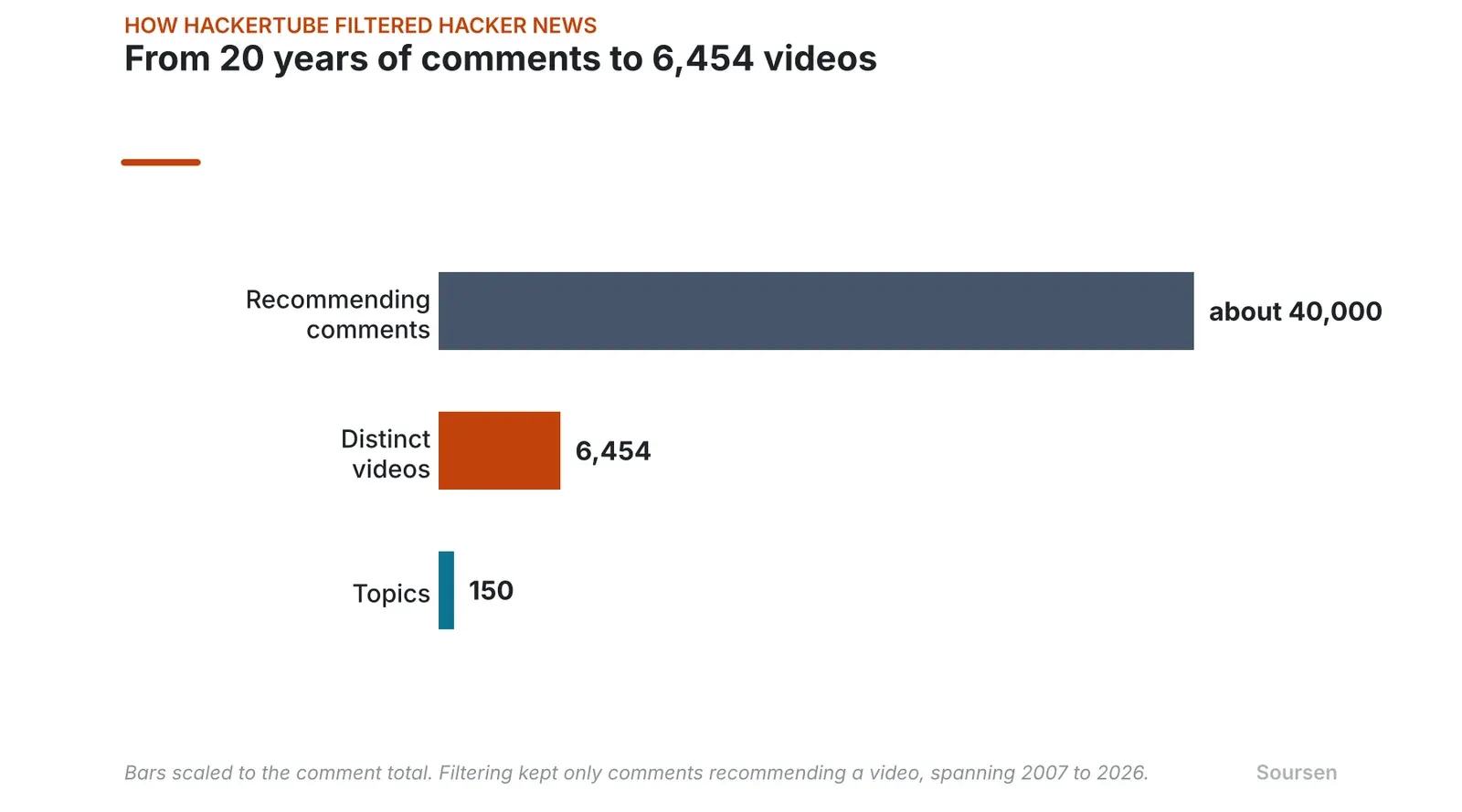
How 20 years of comments became a video library. Each step narrows the set toward videos real people vouched for. Source: Karpathy,karpathy.bearblog.dev, Oct 2026
The feature list is small and deliberate. HackerTube shows a frame from 50% into each video instead of the uploaded thumbnail, which kills clickbait at the source, because you see what the middle of the video actually looks like. It builds a personalized ForYou feed with no account and no login, storing state in the local browser session. It has keyboard shortcuts. It also lets you export the whole site’s data so you can hand it to your own agent and build your own version. That last feature is a tell about where Karpathy thinks this is going, software you fork by describing it, not by cloning a repository.
The part that matters, he barely touched the code
Here is the sentence from his post that I keep coming back to. Karpathy says he does not do anything resembling traditional engineering anymore, no reading or writing code, no running commands in a terminal. He talks to Claude and has it do everything.
Look at what counted as manual work on this project. He created a Google Cloud API key through a web UI so the tool could query YouTube for video metadata. He booted up a server. He bought the domain name. That is the entire list of things a human did with their hands. Once the box was running, he gave the model its IP address and told it to update, deploy, secure, harden, and optimize the code, and it did the whole thing. He describes working on other things in between the model’s work, so it still felt a little like teamwork.
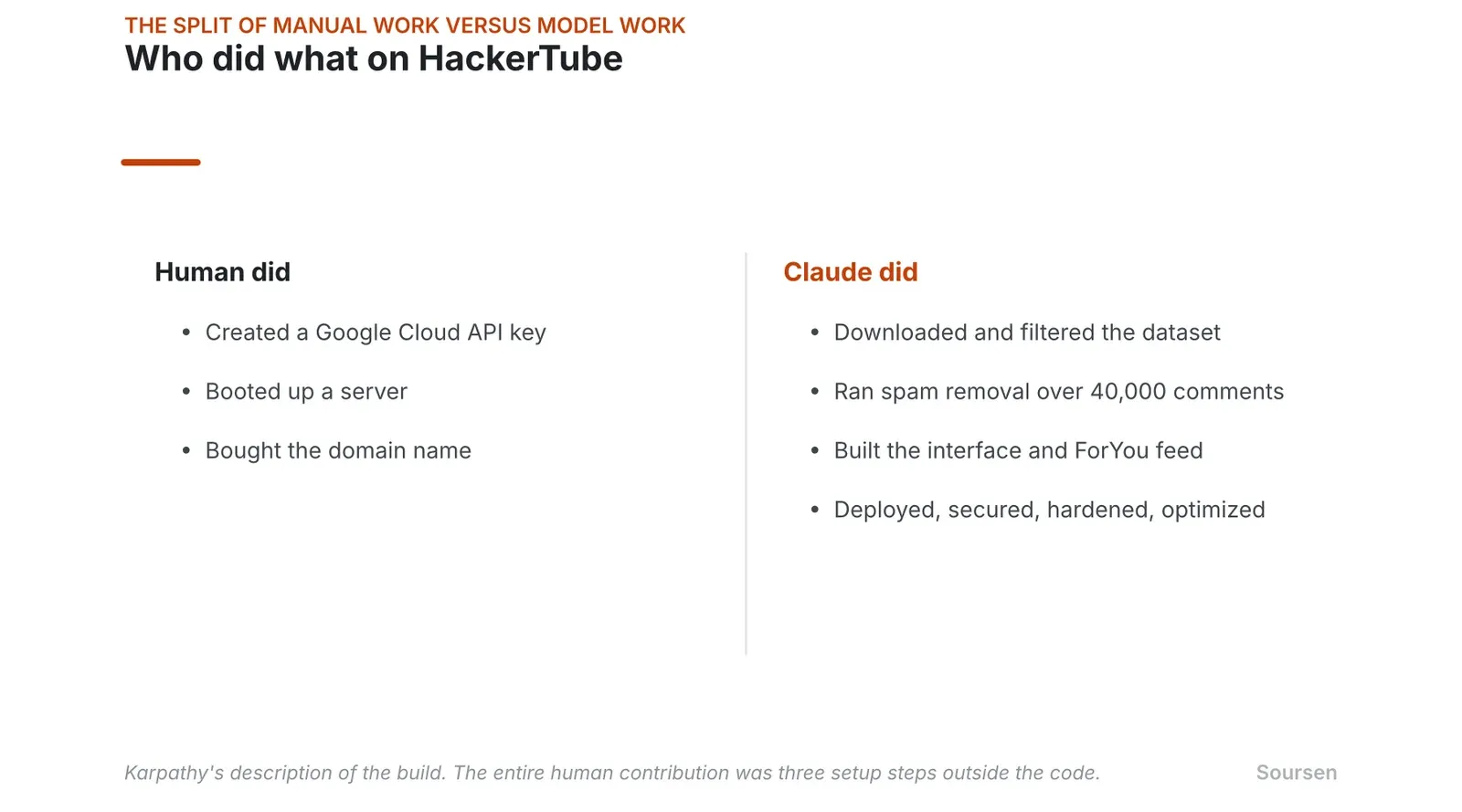
The split of work on HackerTube. The human contribution was three setup steps outside the code itself. Source: Karpathy,karpathy.bearblog.dev, Oct 2026
He built the tool with Claude Code in the desktop app on a Mac, running Opus 5.5 on medium effort as his default. The spam filtering ran Sonnet over the comment dataset inside a Claude Code Workflow to strip out junk. The whole build, he says, now takes about 2 hours.
Why 2 hours is the number to stare at
Strip away the YouTube angle and what you have is a real data pipeline feeding a real web application, deployed and hardened on a live server. Downloading and cleaning a large public dataset, running a model over tens of thousands of records to classify them and strip the spam, building a frontend with a recommendation system and session state, provisioning infrastructure, and securing it. A few years ago that is a small team working for a week or two. Karpathy did it solo, mostly by describing what he wanted, in a morning.
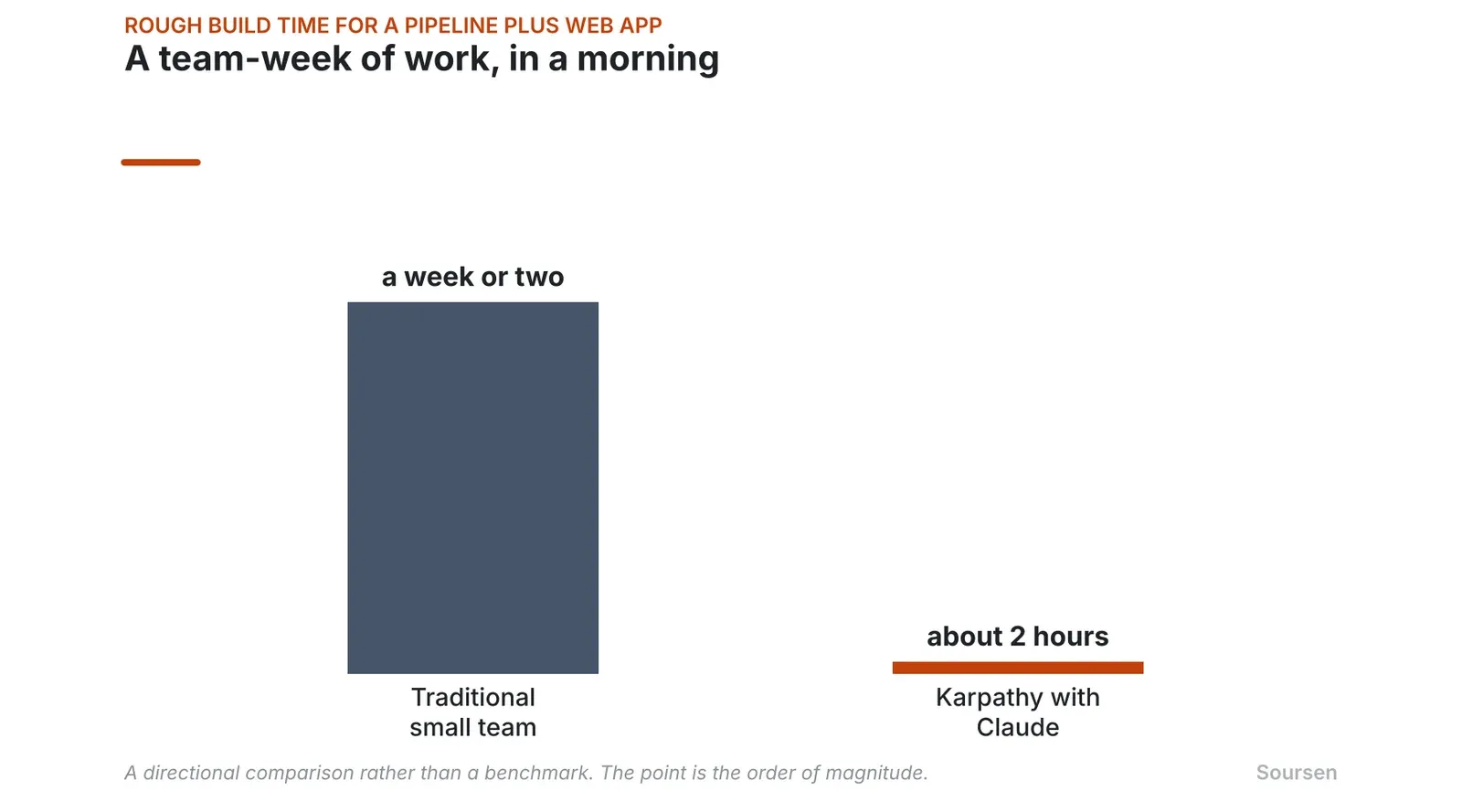
A directional comparison of build time. The point is the order of magnitude it collapsed by. Source: Karpathy, karpathy.bearblog.dev, Oct 2026
This matters beyond one famous person flexing, because the bottleneck moved. The hard part of software used to be the implementation, turning an idea into working code. For a growing class of projects, the implementation is close to free now, and the scarce input is knowing what to ask for and being able to judge whether the result is good. Karpathy still made every real decision here, the data source, the 50% thumbnail trick, the design with no accounts, the export feature. The model did the typing.
Where the easy case ends
I want to be careful not to oversell it. HackerTube is a read only site built on a public dataset with no users to protect, no payments, no regulatory surface, and no legacy codebase to avoid breaking. That is close to the easiest possible case for an agent to handle end to end. A banking backend or a 10 year old codebase with 2,000 interlocking tests is a different problem, and anyone telling you those are also 2 hour jobs is selling something.
What it does prove is that the easy case has gotten very easy, and the set of projects that fall into the easy case keeps growing. The person demonstrating it is not a hype account. He helped build the models doing the work, he coined the term for this way of working, and he is now using it as his default rather than as a party trick. When someone with that resume says he has stopped writing code by hand for projects like this, the honest response is to figure out which of your own projects just moved into that category.
Sources
- Andrej Karpathy’s HackerTube announcement and build process, karpathy.bearblog.devkarpathy.bearblog.dev. Accessed 2 November 2026.
- HackerTube, the live sitehackertube.org. Accessed 2 November 2026.
- Hacker News comment dataset used to source the recommendations, Hugging Facehuggingface.co. Accessed 2 November 2026.
- Coverage of the HackerTube build and figures, FourWeekMBAfourweekmba.com. Accessed 2 November 2026.
- Andrej Karpathy background and the origin of vibe coding, Wikipediaen.wikipedia.org. Accessed 2 November 2026.
Related stories
Developer tools
Cisco Gave One 27 Year Old Unlimited AI Tokens to Refactor 98% of Its Code
Cisco’s president gave a 27-year-old engineer unlimited AI tokens and 24 months to refactor 98% of the company’s legacy code, with 4 weeks to prove it can work at all. I think the headline number is a motivational target rather than an engineering estimate, and the more interesting story is what it says about who companies now trust with the keys.
Developer tools
220,000 Developers Starred a Text File.
Let me tell you about the most-starred AI repository of 2026.
Security
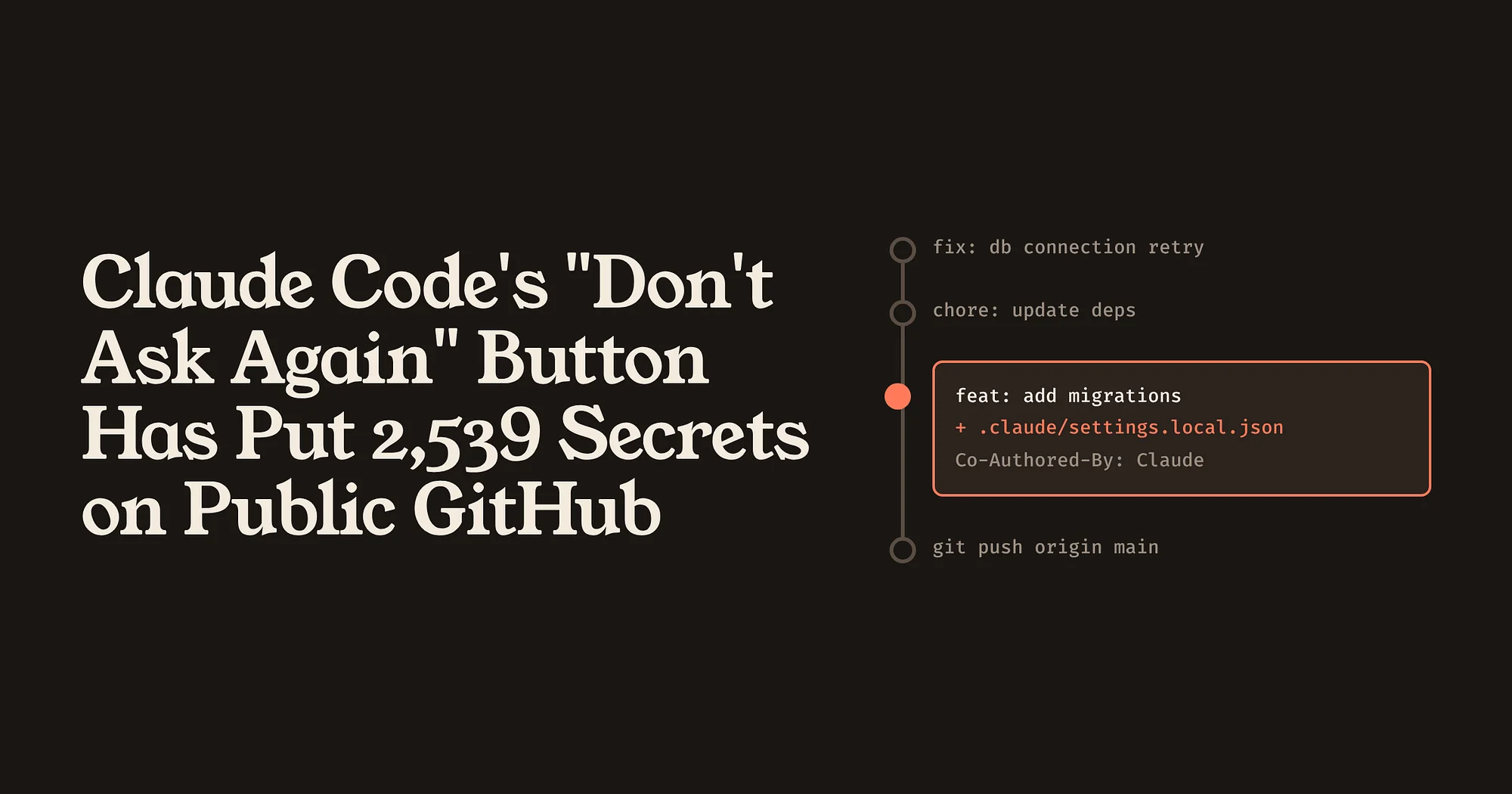
Claude Code’s “Don’t Ask Again” Button Has Put 2,539 Secrets on Public GitHub
A permission shortcut saves the exact command you approved, password included, into a project file that often gets committed. The bigger lesson is that AI coding agents have created new places for secrets to hide, and the usual scanners are not looking there.