OpenAI Lost $20.9
Audited 2025 figures show a company tripling revenue while burning cash faster than any startup ever has. The loss is only half the story. The other half is a loop of deals that turns the same dollars into growth at three companies at once, and a bill that has four ways of reaching you.
Last verified Also on Medium
On this page
Every week, more than 900 million people type something into ChatGPT. They fix code with it, plan meals, settle arguments about history. By almost any measure it is one of the most successful consumer products ever built, and it costs about $20 a month. The company behind it lost roughly $20.9 billion running it in 2025. I want to walk through how a product that popular loses money that fast, because the answer is not what the hype or the doom headlines tell you, and the mechanics underneath are genuinely strange.
Audited figures, independently verified by the Financial Times and first reported in detail by Ed Zitron, give us hard numbers to work with for once. So I am going to stick to those, and tell you where a figure is a real cash loss versus an accounting artifact, because that distinction matters a lot here.
The numbers, straight
In 2025, OpenAI’s revenue jumped from $3.7 billion to $13.07 billion. Tripling sales in a year would be the decade’s highlight for almost any company. The problem is the other side of the ledger. Total costs and expenses hit $34 billion, which left an operating loss of $20.92 billion. For every dollar ChatGPT and its sister products brought in, OpenAI spent about $2.60 to earn it.
You will also see a scarier number, a net loss of $38.53 billion. I want to be careful with that one, because most of the gap between the $20.92 billion operating loss and the $38.53 billion net loss is not cash leaving the building. It comes from a $41.55 billion non-cash charge tied to changes in the fair value of convertible interests, a paperwork consequence of OpenAI converting to a for-profit structure in October 2025. So the honest figure for how much real money the business burned is the operating loss, around $20.9 billion, and it is bad enough on its own.
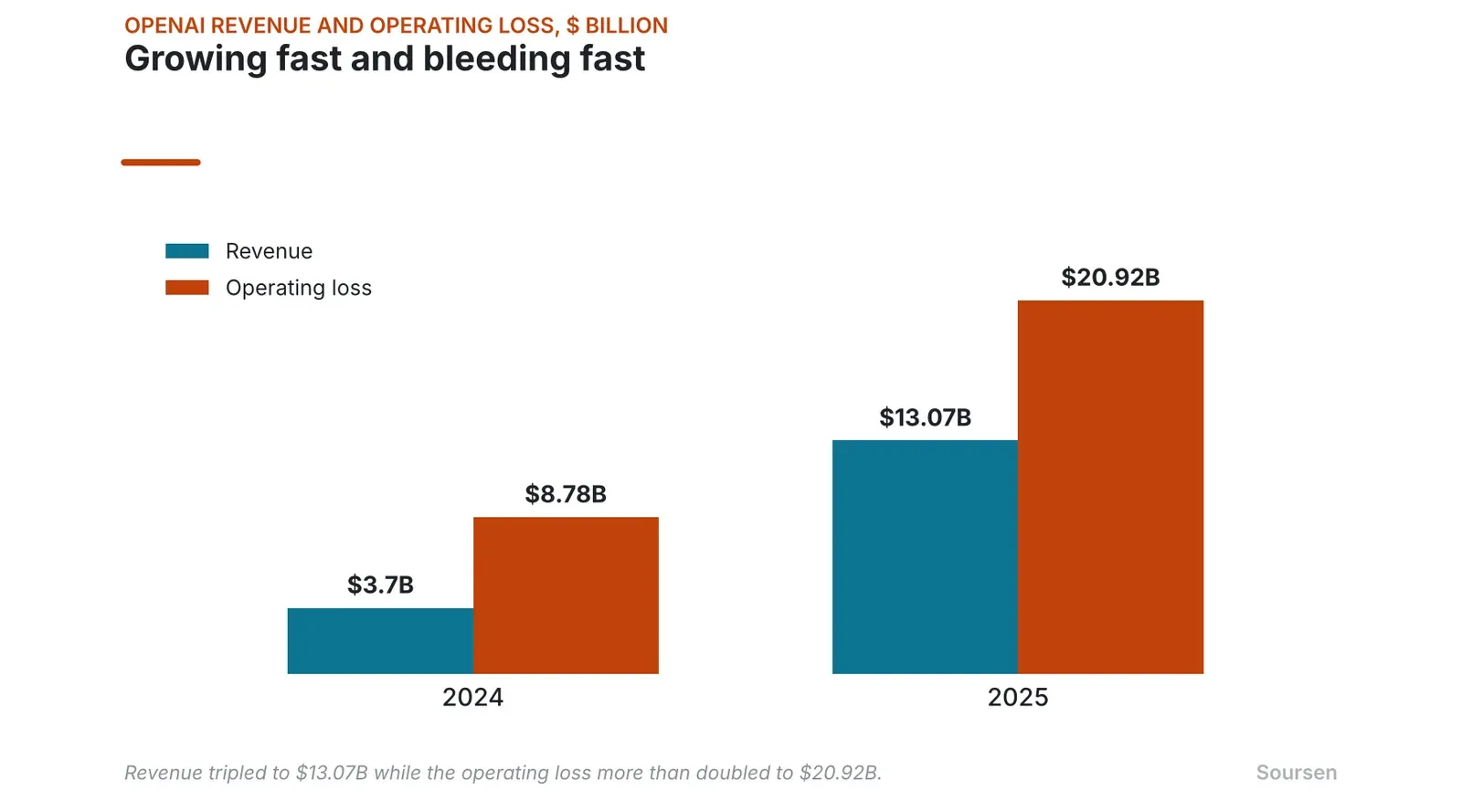
Revenue tripled, and the operating loss more than doubled alongside it. Growing fast and bleeding fast at the same time. Source: OpenAI audited figures via Financial Times andwheresyoured.at
To see how unusual this is, line it up against the company everyone reaches for as the excuse. Defenders say OpenAI is running the Amazon playbook, lose money now to own the market later. Amazon’s worst single year was 2000, when it lost about $1.4 billion, per its own annual filing. OpenAI’s 2025 operating loss alone is roughly 15 times that. No company in history has run losses anywhere near this size, and that is before you look at what it has promised to spend next.
Where $34 billion a year goes
The spending breaks down into a few huge lines. Research and development ran to $19.18 billion, more than half of all costs. Sales and marketing jumped to $5.73 billion. OpenAI also paid Microsoft $17.2 billion in total expenses, including $10.59 billion for research and infrastructure, while Microsoft paid OpenAI just $303 million back. That last pair of numbers tells you how dependent OpenAI still is on a partner that also competes with it.
The structural problem sits underneath all of it. With ordinary software, serving one more customer costs almost nothing, which is why software companies print money at scale. Every ChatGPT answer runs on expensive chips inside power-hungry data centers. More users means more revenue, and it also means more servers, more electricity, more cooling, more chips, and those costs climb right alongside usage instead of flattening out. Growth does not fix the losses here. It feeds them.
The spending nobody can pay for alone
Here is where the figures stop looking like a normal company and start looking like a national infrastructure program. In September 2025, OpenAI committed to building at least 10 gigawatts of AI data centers running on Nvidia systems, roughly the output of 10 large nuclear reactors. Nvidia CEO Jensen Huang has said building a single gigawatt of AI data center capacity costs up to $60 billion.
By late 2025, OpenAI had racked up around $1.4 trillion in data center and computing commitments. Set that against $13.07 billion of revenue and you get roughly $70 in long-term promises for every dollar the company actually earned. Internal projections cited in reporting put OpenAI’s expected spend on computing and infrastructure at about $856 billion by the end of 2030. That single figure is larger than the annual economic output of most countries on Earth. No company pays for that out of its own revenue, which is why the financing got creative.
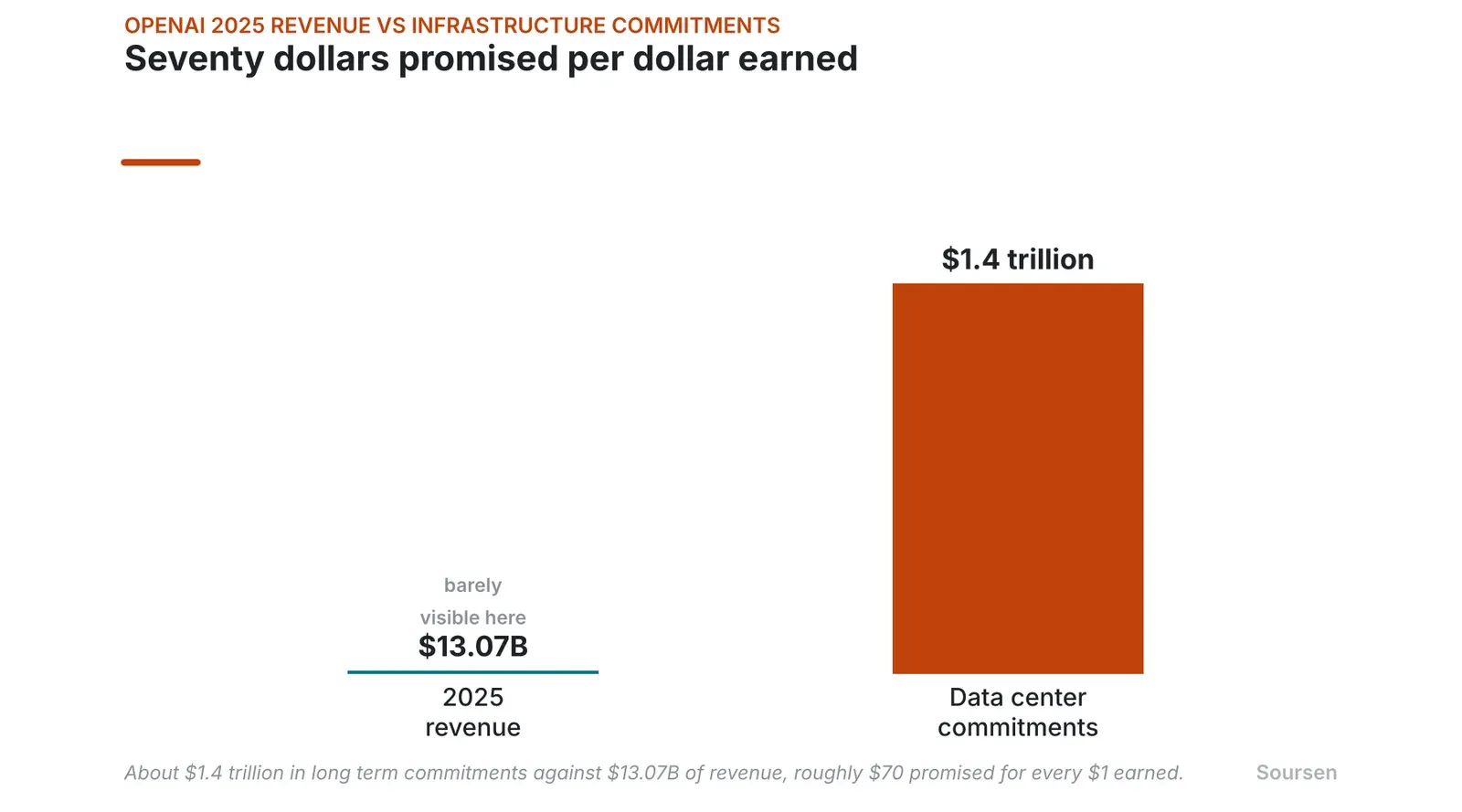
OpenAI’s infrastructure commitments dwarf its revenue. About $70 in promises for every dollar earned. Source: CNBC, company reporting, 2025
The loop
Picture a hardware store. A contractor walks in wanting to build a mansion he cannot afford. So the store lends him the money on one condition, that every dollar gets spent in the store. He buys the store’s lumber with the store’s cash, and at quarter’s end the store reports record sales. Nothing was actually sold to the outside world, but everyone’s numbers look great.
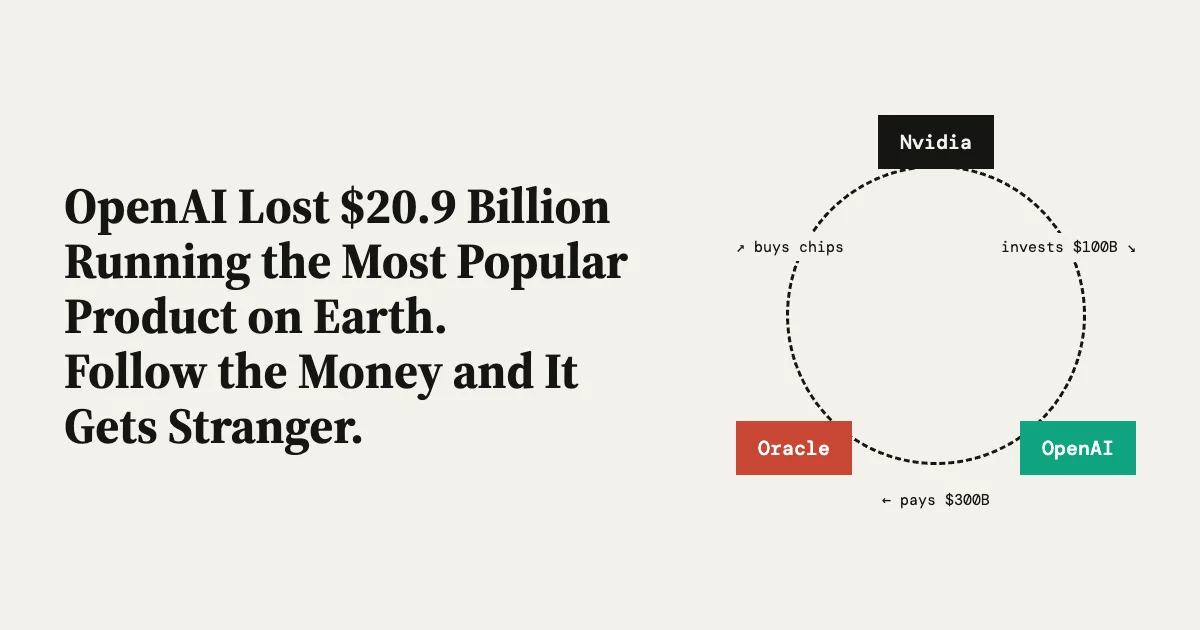
That is close to what sits at the center of the AI boom. In September 2025, Nvidia announced plans to invest up to $100 billion in OpenAI, released in stages as OpenAI switched on new Nvidia-powered data centers. Around the same time, OpenAI agreed to spend $300 billion over 5 years on Oracle’s cloud. Oracle’s stock soared 36% in a day on the news, adding about $251 billion in market value. Oracle cannot run that cloud without Nvidia chips, so it buys them from Nvidia.
Trace the circle. Nvidia invests in OpenAI. OpenAI pays Oracle. Oracle buys chips from Nvidia. The money leaves Nvidia and comes back to Nvidia, and on the way around it shows up as growth at all three companies at once, chip revenue at Nvidia, a booming order backlog at Oracle, and infrastructure backing OpenAI’s forecasts. The same dollars get counted as three different companies’ good news.
OpenAI is not the only one doing this. By 2026, analysts had flagged more than $800 billion in circular arrangements across the AI supply chain. Even Anthropic, OpenAI’s biggest rival, runs a similar structure with Google and Amazon. The loop has become the industry’s default financing move, repeated across the whole supply chain.
Not everyone sees a problem. Nvidia CEO Jensen Huang has called the circular financing label “ridiculous,” arguing the deals reflect real demand for real chips that customers genuinely need. On the other side, Michael Burry, the investor who shorted the 2008 housing bubble, posted a Bloomberg diagram in August 2026 tracing roughly $46 billion in direct equity stakes and about $879 billion in multi-year purchase commitments among the hyperscalers, AI labs, and chipmakers, with Nvidia at the center. His summary was that the money is circling, not multiplying. He also pointed out that Nvidia’s 5 year credit default swap spread, the market’s price for insuring against a Nvidia default, roughly doubled over two months.
I lean toward Burry’s read, because the tell is not the existence of the deals but how the same dollar gets booked as good news in several places at once. A chip sale funded by the seller’s own investment in the buyer is not the same quality of revenue as a chip sale to an unrelated customer paying with its own money.
When the supplier becomes the lender
The strangest turn came when the chipmaker started guaranteeing its customer’s rent. OpenAI does not have an investment-grade credit rating, which makes sense for a company losing more than $20 billion a year. Lenders price loans on whether the borrower can pay, and on paper OpenAI cannot, not yet. So Nvidia stepped in as the backstop.
An SEC filing disclosed that Nvidia is guaranteeing up to about $105 billion to cover the land, power, and buildings for roughly 4.25 gigawatts of OpenAI data centers at a campus in southern Ohio, as reported by Data Center Knowledge. That is just the real estate. The chips going inside could add another $350 billion or so.
If this feels familiar, it should. In the late 1990s, Lucent, Nortel, and Cisco lent billions to cash-strapped internet startups so those startups could buy the vendors’ own gear. When the dot-com bubble burst, the startups went under, the loans went bad, and the vendors went down with them. Nvidia is a far stronger company than Lucent ever was. Its data center business alone brought in $193.7 billion in 2026. The structure is the same, though. The supplier’s fortunes and the customer’s ability to pay are now tied together, and if OpenAI cannot cover its rent, Nvidia loses its biggest customer and inherits the bill.
The insiders already took money off the table
While the losses pile up, the people closest to the company have already turned paper wealth into cash. In October 2025, current and former OpenAI employees sold about $6.6 billion of stock to a group of investors including Thrive Capital, SoftBank, Dragoneer, Abu Dhabi’s MGX, and T. Rowe Price. That deal valued OpenAI at $500 billion, the most valuable private company in the world at the time, up from the $300 billion valuation set just months earlier in a SoftBank-led round. The timing is worth sitting with. Insiders cashed out part of their holdings at the top, before the public ever got a chance to buy in.
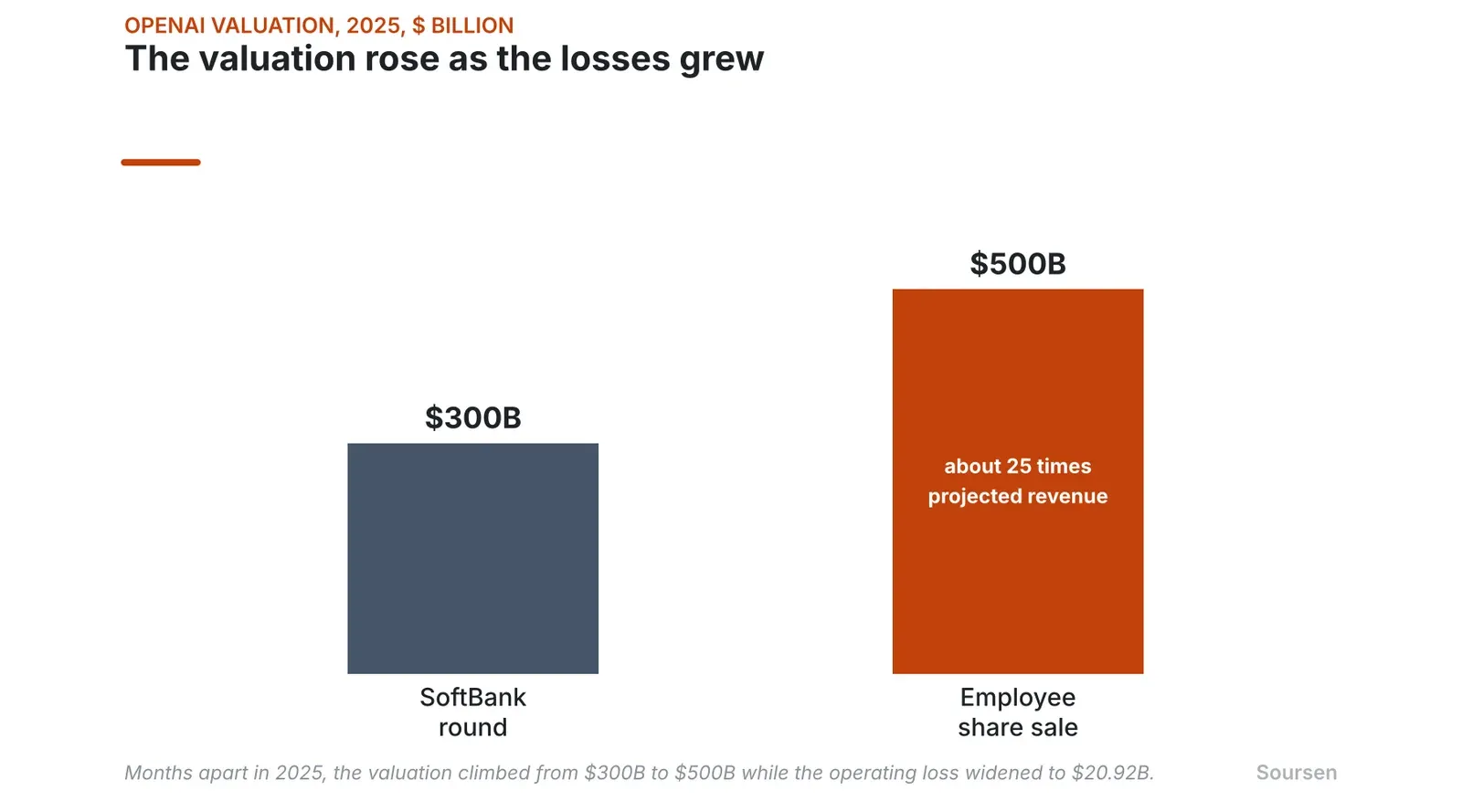
In 2025 OpenAI’s valuation climbed from $300 billion to $500 billion in a matter of months, even as the operating loss widened. Source: Reuters, company reporting, 2025
Why would investors keep paying more for a company losing more? At $500 billion, OpenAI was valued at roughly 25 times its projected annual revenue. Most established software companies trade somewhere between 5 and 15 times. Investors are paying for what they believe OpenAI becomes, the company that builds the most powerful AI first and then owns the market, which is a bet on the future rather than a price on current earnings. In AI, that belief carries a price tag, because every jump in valuation is the fuel for the next multi-billion dollar round, which buys the next round of compute. The valuation and the spending are the same story told twice.
The 4ways the bill reaches you
A loss this big does not vanish. Someone absorbs it, and if these bets go wrong, the someone is often not the people who made them. I count four paths to ordinary people.
The first is your retirement account. In its filing for the quarter ending 30 September 2025, Microsoft disclosed that its share of OpenAI’s losses cut its net income by $3.1 billion in a single quarter, knocking 41 cents off earnings per share, as The Register detailed. That implies an OpenAI quarterly loss somewhere around $11.5 billion. Most 401(k) and pension money tracks the S&P 500, and by late 2025 the largest companies in that index, Nvidia, Microsoft, Amazon, Alphabet, Broadcom, Meta, and others, are all heavily exposed to AI. When OpenAI’s valuation rises, a big slice of the index gets lifted. If it stumbles, the shock hits savers who never chose to bet on AI at all.
The second path is your electricity bill. AI data centers draw staggering amounts of power, and the grid was not built for them. PJM, which runs the largest wholesale power market in North America across 13 states and Washington DC, holds an annual auction to secure future capacity. For 2024–25 the price cleared at $28.92 per megawatt-day. For 2026–27 it cleared at $329.17, more than 11 times higher, per IEEFA’s analysis of PJM data. PJM’s own independent market monitor found data centers were responsible for 63% of the increase in the prior auction. That flows through to households as bills rising something like $16 to $21 a month in affected zones. When a family pays more to keep an AI campus running, they do not get a share of the data center. They just get the bill.
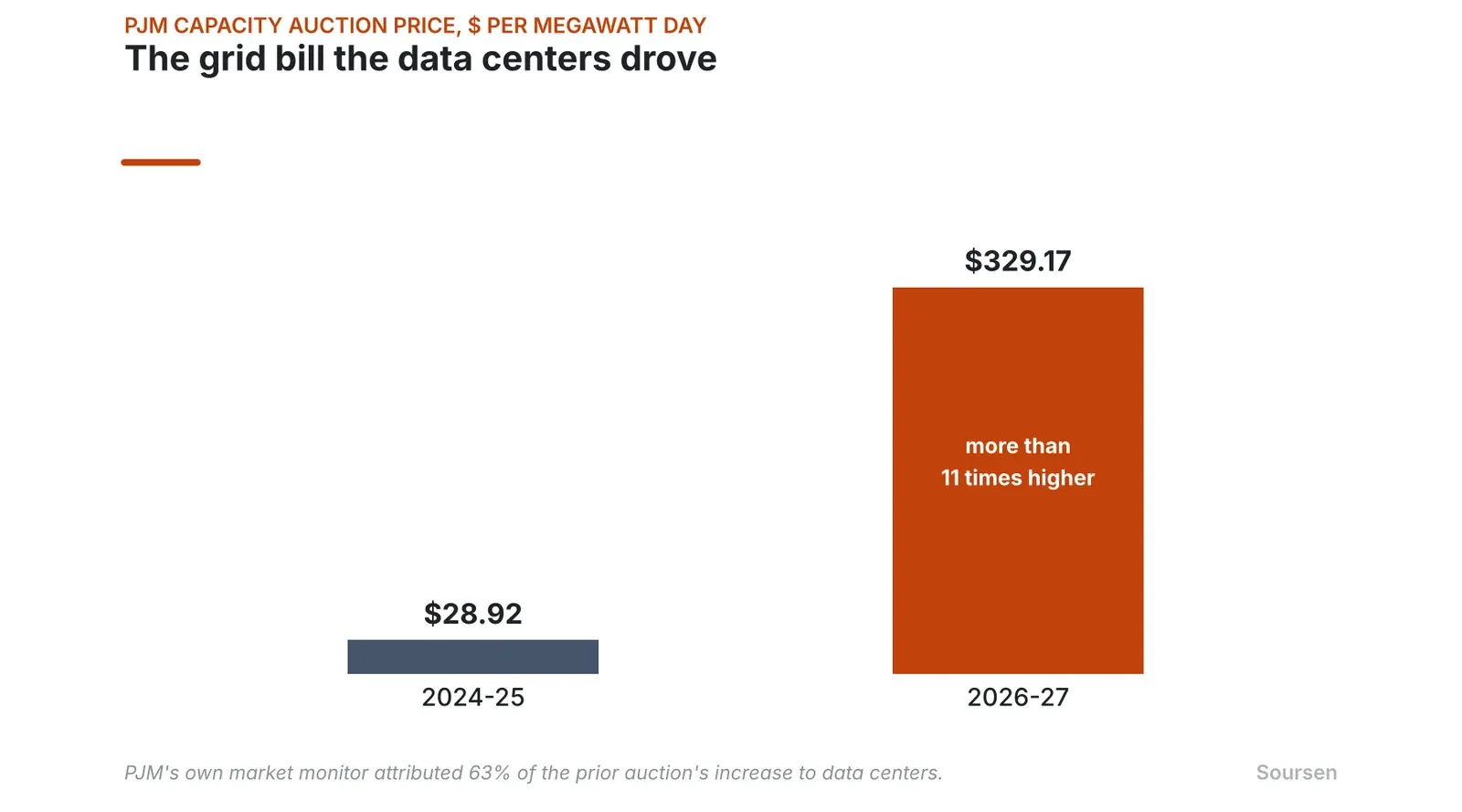
PJM’s capacity price jumped more than 11 times in two years. Its market monitor pinned 63% of the prior rise on data centers. Source: IEEFA, PJM Monitoring Analytics
The third path is taxes, the one OpenAI has worked hardest to deny. On 5 November 2025, CFO Sarah Friar suggested at a Wall Street Journal event that a government guarantee could make financing AI chips cheaper. Asked directly whether she meant a taxpayer backstop, she agreed. The uproar was instant, and that same night she walked it back on LinkedIn, writing that OpenAI is not seeking a government backstop. White House AI official David Sacks said there would be no federal bailout, and Sam Altman said taxpayers should not bail out companies that make bad business decisions. Shortly before those comments, though, OpenAI had lobbied the White House to extend chip-manufacturing tax credits to AI data centers, suggesting the government deploy grants, cost-sharing, loans, or loan guarantees. Senator Elizabeth Warren wrote to Altman in January 2026 warning of an old pattern, where companies take on huge debt, make risky bets, and demand a public rescue when the bets sour.
Then in July 2026, Altman floated giving the US government a 5% stake in OpenAI, worth about $42.6 billion, pitched as letting ordinary Americans share in the upside. Read it the other way. Once the public owns 5% of OpenAI, a collapse stops being a purely private loss and becomes a loss on an asset held in the public’s name. That is pre-selling the downside while keeping the upside private for as long as possible.
The fourth path is an eventual IPO landing straight in your index fund. OpenAI confidentially submitted a draft S-1 to the SEC on 8 June 2026, and while Altman said it would not list in 2026, a 2027 listing looks likely. Meanwhile the market plumbing has shifted. In 2026 Nasdaq introduced a fast-entry rule letting a newly listed company big enough to rank among the top 40 of the Nasdaq-100 be forced into the index within 15 trading days of its IPO, rather than waiting the usual 3 months. More than $30 trillion in global wealth tracks these indexes, so the moment OpenAI goes public and uses the fast lane, index funds and pension accounts become automatic buyers, whether their holders want the exposure or not. The insiders who got in cheap finally have someone to sell to.
The part that complicates the doom story
I do not think OpenAI is doomed, and I want to be fair about that. Back in 2019, before ChatGPT existed, Altman joked that OpenAI had no revenue plan, that once it built a truly intelligent system it would just ask the AI how to make money. Seven years later it earns billions and serves close to a billion people a week. If it really does hit something like $350 billion in annual revenue by 2030, today’s losses will look like one of the boldest bets in business history, and everyone holding a piece will be glad they did.
The size of the bet has changed who is making it. This is no longer a few venture capitalists rolling dice on a startup. It is chipmakers guaranteeing leases, cloud giants booking paper profits, utilities passing costs to households, a government being offered a stake, and index funds waiting to buy in on day 15. Every one of those players has a reason to believe, because each books the upside early. The group that never got asked is the one at the end of the line, the people with a 401(k), an electricity bill, and a tax return. The real question is not whether OpenAI can build the future. It is who pays for it if the future arrives late.
Sources
- OpenAI 2025 audited financials, revenue, losses, and spending, wheresyoured.atwheresyoured.at. Accessed 2 November 2026.
- OpenAI 2025 financials, revenue and cost breakdown, Crypto Briefingcryptobriefing.com. Accessed 2 November 2026.
- Guide to $1 trillion of AI deals between OpenAI, Nvidia, Oracle, and others, CNBCcnbc.com. Accessed 2 November 2026.
- Nvidia guarantees up to $105 billion for OpenAI’s Ohio data center lease, Data Center Knowledgedatacenterknowledge.com. Accessed 2 November 2026.
- Microsoft’s share of OpenAI losses cut net income by $3.1 billion, The Registertheregister.com. Accessed 2 November 2026.
- PJM capacity prices jumped tenfold, data centers responsible for 63% of the rise, IEEFAieefa.org. Accessed 2 November 2026.
- Amazon FY2000 annual report showing its worst annual loss, SECsec.gov. Accessed 2 November 2026.
- OpenAI hits $500 billion valuation after employee share sale, Fox Businessfoxbusiness.com. Accessed 2 November 2026.
- Michael Burry flags AI circular financing with Nvidia at the center, Yahoo Financefinance.yahoo.com. Accessed 2 November 2026.
Related stories
AI & GPU compute
Nvidia’s Board Backed Jensen Huang on Sunday. By Thursday He Was Gone.
Four days after Nvidia’s board said it had confidence in its CEO, Jensen Huang resigned. A short seller had flagged the Megaspeed connection 6 months earlier, and most of the story rests on anonymous US officials, so I separate the filed facts from the allegations.
AI & GPU compute
Microsoft Filed a Patent to Rewrite What You Say Live and Redraw Your Lips
Application US 2026/0341309 A1 describes swapping words in live video within 1 to 10 seconds, tailored to each viewer’s profile. The main claim says nothing about telling viewers, no patent has been granted, and nearly every piece of the idea already ships somewhere.
AI & GPU compute
Elon Musk Predicted a Die Off for 200 AI Neoclouds. CoreWeave’s Bonds Had Already Hit 15%.
Musk says debt markets have shut on companies that only rent out AI chips. The bond market reached that view before he posted it, and the bigger lesson is how much of the AI boom now runs on rented chips and borrowed money.