Anthropic Just Posted $16.8
The numbers coming out of the AI industry are the biggest in the history of technology, and a growing group of analysts thinks that is the problem. I went through the real figures behind the bubble debate, Anthropic’s revenue, the infrastructure commitments, the debt, the falling cost of intelligence, and who is actually paying, because the case for a correction and the case against it both rest on the same facts.
Last verified Also on Medium
On this page
- The number that started the panic
- The valuation that has to come true
- The money being spent is the part that cannot be undone
- The gap between what is being spent and what is coming back
- The cost of intelligence is falling off a cliff
- Almost nobody is actually paying yet
- What a bubble actually means
- Why the whole market is watching 1 company
- What would actually settle it
In the middle of October 2026, the Financial Times got hold of a number Anthropic had shared with potential investors at a private meeting, and it set off a week of nerves across the AI industry. The number was not bad. It was enormous. Anthropic told investors its revenue for the third quarter reached $16.8 billion, a figure Reuters and Bloomberg both matched soon after. For a company this young, that is close to unprecedented. The nervousness is not about the size of the number. It is about its shape, because the quarter before, the growth rate was far higher, and in the AI industry a merely gigantic number that is decelerating reads as a warning.
I want to walk through the actual figures on both sides of the bubble argument, because this is a case where the bulls and the bears are looking at the same data and drawing opposite conclusions, and the only way to think clearly about it is to see the numbers plainly.
The number that started the panic
Here is the sequence that has people talking. Per Reuters, Anthropic’s revenue went from roughly $4.7 billion in the first quarter of 2026 to about $11.6 billion in the second, then to $16.8 billion in the third. That is growth of around 147% from Q1 to Q2, then about 45% from Q2 to Q3. Both are extraordinary rates most companies would never see. The issue is the drop between them. A business the whole AI narrative leans on going from 147% to 45% quarterly growth, in a single step, is the kind of thing that makes a market built on the promise of endless acceleration start asking questions.
That is the core of the bear case, and it is a mathematical one. The analyst Alberto Romero put it cleanly in his writing on the subject, it only takes some finite amount of time to turn a proud exponential into a disappointing sigmoid, an S shaped curve that rises fast and then flattens. Every exponential eventually hits a binding constraint and bends over. The question for Anthropic is whether what we just saw is noise in a still steep curve or the first visible bend.
The counterpoint is just as real. Reuters reported that investors who attended the meeting actually came away upbeat about the growth and the path to profit, and Anthropic told them the quarter was cash flow positive, a milestone most frontier AI labs have not reached. A deceleration from a once in history growth rate is not the same as a collapse. Both things are true at once, and which one matters more is exactly what the market is trying to price.
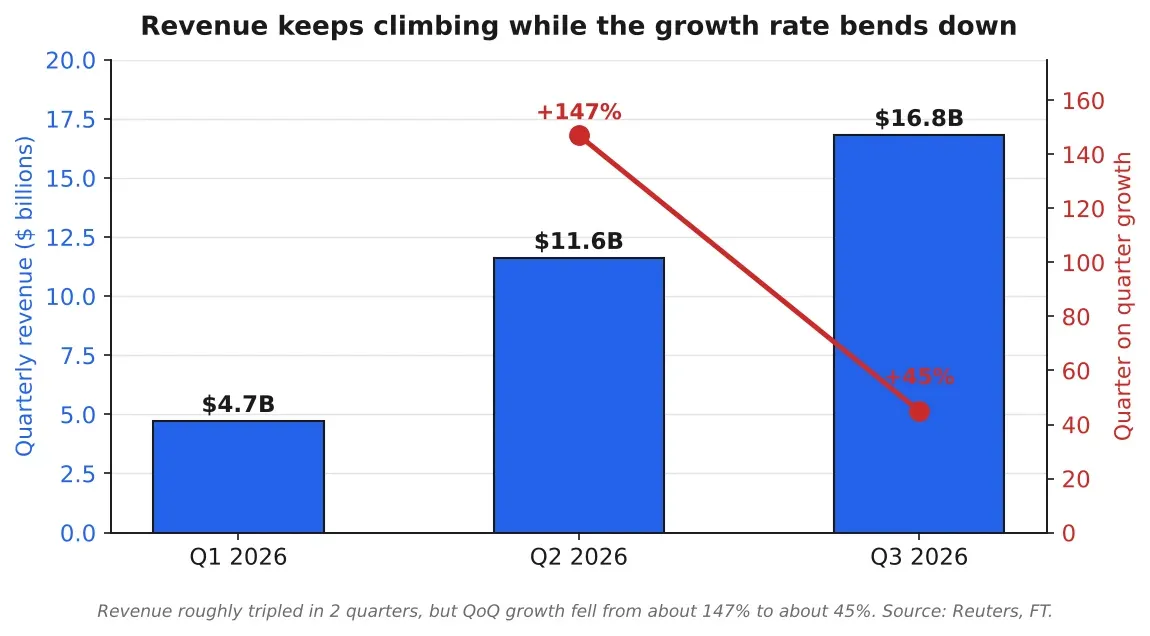
Figure 1. Anthropic’s quarterly revenue in 2026, with the growth rate falling even as the absolute numbers climb. The revenue roughly tripled in 2 quarters, and the quarter on quarter growth rate dropped from about 147% to about 45%. Source: Author chart based on Reuters and Financial Times reporting
The valuation that has to come true
The reason the growth rate matters so much is the price tag attached to it. Bloomberg reported that some prospective investors see a fair valuation for Anthropic in the range of $1.8 trillion to $2 trillion ahead of a possible IPO. To grow into a number like that, the company cannot just stay huge, it has to keep compounding at rates that only make sense if AI revenue keeps expanding into enormous new markets. Anthropic recorded an operating loss of more than $8 billion in 2025 on revenue of roughly $4.6 billion, which is normal for a lab spending to reach the frontier, and it is also a lot of ground to make up. A valuation near $2 trillion is a bet that the compounding does not stop.
The money being spent is the part that cannot be undone
Set the revenue aside and look at the spending, because that is where the risk gets concrete. Building AI means building data centers, and data centers cost real money on fixed timelines whether or not the customers show up. A data center that costs $10 billion still costs $10 billion if the AI payoff arrives a decade late. The construction workers, the energy companies, the landowners, and the lenders all want dollars, not tokens, and they want them on schedule.
The lenders are where the strain is showing first. Take CoreWeave, a company that rents out GPUs to AI firms after pivoting from crypto mining. It has taken on roughly $52 billion in debt obligations, and in mid October 2026 the bond market turned on it. Its 2032 notes hit a 15% yield intraday on 13 October, and the stock fell as much as 16% the next day. A 15% yield is what investors demand to hold debt they consider risky, and this is for a company at the center of the supposedly most promising industry in history. Its interest bill, around $640 million in the second quarter alone, now runs ahead of its adjusted operating income. CoreWeave is an extreme case, but it is not an isolated one.
The pressure reaches the giants too. Oracle raised $43 billion in debt in a recent fiscal year and ended with negative free cash flow. Even Alphabet, one of the most stable companies on earth, generated about $39 billion in cash from operations in a single quarter and spent about $45 billion on infrastructure, turning its free cash flow negative for the first time since it went public in 2004. When Google has to borrow to keep building, the scale of the commitment is clear.
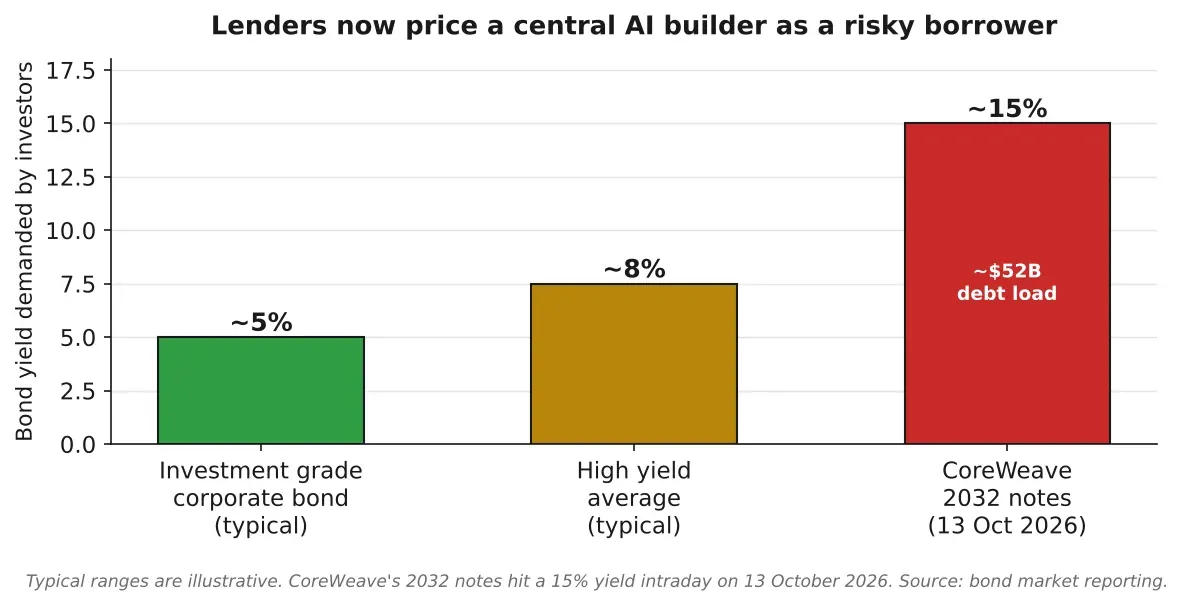
Figure 2. The debt stress is showing up first at the companies financing the buildout. CoreWeave’s bond yields climbing toward 15% signal that lenders now treat a central AI infrastructure company as a risky borrower. Source: Author chart based on CoreWeave bond market reporting, October 2026
The gap between what is being spent and what is coming back
The single clearest way to frame the bubble question comes from Sequoia’s David Cahn, who has been tracking it since 2023. He started by asking how much revenue the industry needed to justify its infrastructure spending, and called it AI’s $200 billion question. By 2026 his updated math puts AI infrastructure spending for the year at about $1.5 trillion, and the revenue the industry would need to earn to justify those chips and data centers at around $3 trillion, a figure he thinks is probably an underestimate. Set that against where the industry actually is, and the distance is the whole argument.
Gartner put a number on the downside. It estimated that more than $3.5 trillion in AI infrastructure spending could face impairment by 2030, meaning written down as worth less than what was paid for it, if the current investment pace holds. The firm also projected that data centers will generate trillions of dollars less in revenue by 2030 than they would need to justify their cost and deliver expected returns. These are forecasts, not facts, and forecasts about 2030 are easy to wave away. The bear case is that markets do not wait for 2030. If investors become convinced today that the returns will not arrive on time, they sell today.
The cost of intelligence is falling off a cliff
Here is the figure I find hardest to argue with, and it cuts against every AI company at once. Per Epoch AI, the cost of achieving a fixed level of AI performance has been falling about 47% every quarter since 2023. That works out to roughly a thirteenfold reduction every year. The capability you spent billions to build this year gets dramatically cheaper for someone else to reproduce next year.
That is wonderful for anyone using AI and hard for anyone selling it at a premium. Google’s models improve, Meta has caught up from behind, Chinese labs ship capable models at low prices, and open weight alternatives handle the ordinary tasks for free. OpenAI sits toe to toe with Anthropic in the same markets, code, agents, and enterprise. When the thing you sell gets 13 times cheaper to make every year and several well funded competitors sell something similar, holding a premium price is genuinely difficult. The bull reply is Jevons paradox, that cheaper intelligence drives so much more usage that total revenue grows anyway. That can be true, and rising usage still does not guarantee rising profit when competition is this fierce and the product is drifting toward a commodity.
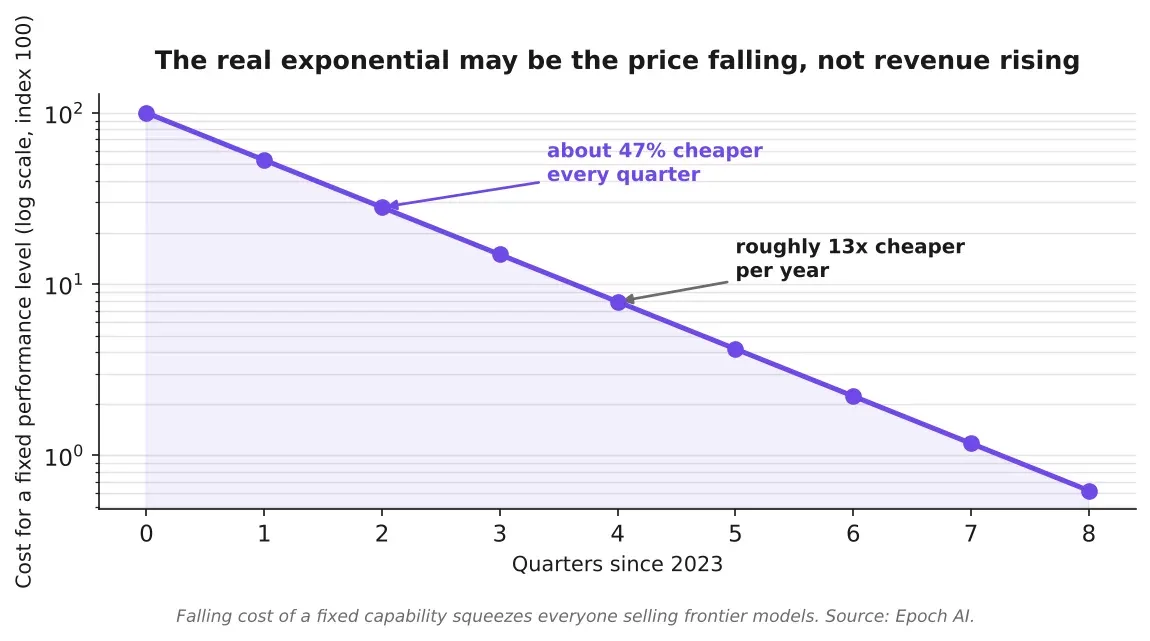
Figure 3. The true exponential in AI may be the price collapse. Per Epoch AI, the cost of a fixed level of performance has fallen about 47% per quarter since 2023, roughly 13 times cheaper each year, which squeezes everyone selling frontier models. Source: Author chart based on Epoch AI data
Almost nobody is actually paying yet
For all the money moving, the customer base is thinner than the valuations imply. Andreessen Horowitz, in its State of Markets report, found that only about 2% of US households were paying for any AI service as of April 2026. After this much progress and this much capability, 2% is a strikingly small share. On the enterprise side the picture is broad but shallow, nearly 30% of S&P 500 companies reported some AI impact, while only about 2% reported a tracked, quantifiable metric. Adoption is wide and usage is light.
There are early signs of belt tightening too. Reporting on Anthropic’s own customers suggests some of its largest corporate accounts have trimmed their spending as they build their own tools, and a few companies have capped what employees can spend on AI each month. None of this is fatal on its own. It does complicate the story that enterprise demand is an unstoppable escalator.
What a bubble actually means
A bubble is one of the most misunderstood words in this debate, so it is worth being precise about what it means. A bubble does not mean the technology is fake, or that every company goes bust, or that AI fails to change the world. It means the core premise behind the industry’s valuations has been inflated beyond what reality can support in the expected timeframe. The internet was real and world changing, and the dot com bubble still popped, because the prices had run ahead of the business. A bubble is a correction mechanism, not a verdict on the technology.
That distinction is why smart people land on opposite sides. You can believe AI is the most important technology of the century and also believe its current valuations are too high, those are not contradictory positions. The companies are, by most measures of product and growth, among the best startups ever built. The argument is about price and timing, not about whether the tools work.
Why the whole market is watching 1 company
The reason this is not a niche tech story is that the stock market has become unusually concentrated on AI. Reuters noted that the S&P 500 rose about 14% in a recent stretch even though more than 40% of its stocks were down, meaning a handful of large AI linked names carried the whole index. The Kobeissi Letter pointed out that the correlation between the equal weighted S&P 500 and the standard index had fallen to its lowest level on record, lower than during COVID and lower than the dot com peak. A market held up by a few names is a market with a thin margin for disappointment.
That is what ties Anthropic’s revenue growth to your retirement account. The financial engineering underneath is getting elaborate too. A UBS analysis described deals where investors buy chips from Google, lease them to Anthropic, and Google backstops parts of the arrangement, so several companies’ financial health depends on the same stream of future AI revenue showing up. There is nothing inherently wrong with structuring deals that way, and it does mean a shortfall in one place can ripple through many balance sheets at once.
What would actually settle it
Both sides agree on the test, they just disagree on the result. It comes down to whether run rate revenue, the annualized version of a recent strong month or quarter, turns into durable actual revenue, people and companies paying enough, for long enough, to justify the spending. If Anthropic reaccelerates in the fourth quarter, reaches its run rate targets, and enterprise adoption deepens, the bears will have been early and wrong. If growth keeps flattening while the infrastructure bills come due on schedule, the case for a correction gets stronger each quarter.
I do not know which way it breaks, and anyone who tells you they do with certainty is selling something. What I can say is that the numbers to watch are specific and public. Watch Anthropic’s next quarter for whether growth stabilizes or keeps sliding. Watch the bond yields at companies like CoreWeave for whether lenders calm down or tighten further. Watch the share of households and enterprises actually paying, not just experimenting. Those figures, not the rhetoric, are where this gets decided.
Sources
- Anthropic tells investors Q3 revenue reached $16.8bn, The Next Webthenextweb.com. Accessed 22 October 2026.
- Anthropic revenue rises to $16.8 billion as IPO approaches but growth slows, Yahoo Financeuk.finance.yahoo.com. Accessed 22 October 2026.
- Can AI answer the $3 trillion question, David Cahn, TechCrunchtechcrunch.com. Accessed 22 October 2026.
- Gartner warns $3.5 trillion in AI infrastructure spending could face impairment by 2030, Crypto Briefingcryptobriefing.com. Accessed 22 October 2026.
- CoreWeave shares plunge as bond yields near 15%, Crypto Briefingcryptobriefing.com. Accessed 22 October 2026.
- The price of intelligence is falling rapidly, Epoch AI via Marginal Revolutionmarginalrevolution.com. Accessed 22 October 2026.
- Only about 2% of US households pay for AI services, a16z finds, Crypto Briefingcryptobriefing.com. Accessed 22 October 2026.
Related stories
AI & GPU compute
The AI Subscription Era Is Ending. Here Is What Replaces It.
There is a specific moment happening in AI pricing right now that is worth understanding clearly, because it is the first real signal of how the economics of this entire industry are likely to shift over the next few years.

AI & GPU compute
I Quit AI Tools for 30 Days. What It Revealed About My Own Thinking Scared Me.
It started with an email.
AI & GPU compute
The AI Industry Built a $5 Trillion Debt Pile on One Bet. That Bet Is Not Paying Off.
Something shifted in the AI narrative over the past few months, and it is worth paying attention to. The CEOs who spent years telling anyone who would listen that AI would eliminate entire categories of human work have gone quiet on that point.