I Quit AI Tools for 30 Days. What It Revealed About My Own Thinking Scared Me.
It started with an email.
Last verified Also on Medium

On this page
- What the Research Says About Brains That Always Have an Easy Answer Available
- The Attention Problem Is Already Here, AI Is Just Accelerating It
- What Actually Happened During the 30 Days
- The Resolution Failure Rate and What It Actually Measures
- The Uncomfortable Truth About What Wins Over Time
- What to Actually Do With This
It started with an email.
Not a complicated one. A short, professional message to a colleague I had worked with for years. Something I would have written in 3 minutes without a second thought two years ago. But I sat there, cursor blinking, and felt something I had not felt in a while the slight panic of not knowing where to start without a prompt box in front of me.
That moment made me run an experiment. 30 days. No AI writing tools. No AI research shortcuts. No using a chatbot to draft, outline, summarise, or structure anything. Just my own brain, the one I had spent years developing and then, gradually, quietly outsourced.
What I found over those 30 days was not just personal. It maps almost exactly onto what researchers studying AI dependence have been documenting since 2024, and the picture they are drawing is uncomfortable for anyone who has built their workflow around these tools.
What the Research Says About Brains That Always Have an Easy Answer Available
There is a term researchers now use for what I experienced with that email. It is called cognitive offloading: the transfer of mental processes to an external system. The concept itself is not new. We have always used tools to extend our cognitive capacity. Writing things down rather than memorising them is cognitive offloading. A calculator is cognitive offloading. What a 2025 study of 666 participants by researcher Michael Gerlich found, however, is that frequent AI usage shows a significant negative relationship with critical thinking capabilities, with cognitive offloading serving as the mediating factor. In other words, the more you use AI to do your thinking, the less capable you become at doing it yourself.
A separate research framework published in the journal npj Artificial Intelligence in 2026 described it as follows: passive, uncritical reliance on AI may weaken activity-dependent brain plasticity and erode cognition. Researchers at The Algorithmic Bridge who compiled dozens of these studies summarised the consensus as this: when AI becomes a cognitive prosthetic, the underlying cognitive muscles weaken from disuse. This is not a metaphor. It is a description of how neural pathways actually function.
The Wharton School ran three preregistered experiments in early 2026 with 1,372 participants, studying what they called cognitive surrender, the tendency to accept AI-generated answers without evaluation. A Boston Consulting Group study published in Harvard Business Review surveyed nearly 1,500 full-time employees and found that a meaningful share reported symptoms they called AI brain fry: mental fog, slower decision-making, and a strange sense that their thinking had become crowded. Workers described spending more time managing AI outputs than they had previously spent simply doing the underlying work.
The Anthropic Economic Index’s January 2026 report identified something it called deskilling risk: the gradual decline of occupational competence in categories where AI absorbs the most cognitively demanding tasks. The report noted that this effect appears not just in educational settings but at industry scale, affecting workers who consistently outsource complex cognitive tasks to AI before developing sufficient judgment on those tasks themselves.
This is the thing that the productivity content around AI does not tell you. The tools are genuinely useful for specific tasks. The problem is not the tasks. It is the cumulative effect of never doing the hard part yourself, over months and years, across hundreds of small decisions that together constitute your ability to think.
The Attention Problem Is Already Here, AI Is Just Accelerating It
Before AI tools entered the picture, there was already a significant and well-documented crisis in sustained attention. Layering AI dependency on top of a population that was already struggling to focus is not a neutral act.
Data compiled by DemandSage in 2026 shows the average American checks their phone 96 times per day. That is once every 10 minutes during waking hours. The average person spends 6 hours and 54 minutes on screens daily, with Americans averaging closer to 7 hours. A YouGov survey from late 2025 found that 45% of adults under 30 believe their phone has a mostly negative impact on their attention span, while 41% say it has damaged their ability to focus.
A meta-analysis of attention studies cited by SQ Magazine found that the average social media user’s focus on a single piece of content has dropped from 12.1 seconds in 2015 to 8.25 seconds in 2025. Heavy users spending five or more hours daily on social media are 33% more likely to experience attention fragmentation symptoms. Exposure to short-form video content before studying reduced students’ reading attention span by 31%.
What this means in practice is that most people are arriving at their work with fragmented attention, then immediately reaching for an AI tool to compensate for that fragmentation rather than rebuilding the focus capacity that the fragmentation has eroded. The AI does the thinking. The scrolling occupies the gap. The muscle of sustained independent thought never gets used, so it does not get stronger. Over time, it weakens.
We do not think anymore. We fetch. The question worth asking is what happens to the fetching mechanism when the server goes down.
What Actually Happened During the 30 Days
The first week was genuinely uncomfortable in a way I had not expected. The discomfort was not the absence of convenience. It was the confrontation with how dependent my cognitive workflow had become on getting a quick first draft, a quick summary, a quick framework, before I was willing to engage with a problem myself.
I had to write a strategy document on day 4 sitting with a blank page for the first 20 minutes without opening a prompt box felt physically strange, like trying to remember a word that has moved just out of reach. My instinct was not to think harder. It was to look for a shortcut. That instinct, appearing that quickly and that insistently, was the data point that made me take the experiment seriously.
By the end of week 2, something had shifted. Problems I would previously have handed to an AI for initial framing were starting to resolve themselves in the background, the way a word you have been trying to remember surfaces an hour later when you have stopped actively searching for it. The synthesis of existing knowledge, the connections between things I already understood, started becoming available again in a way they had not been for months.
Week 3 brought what felt like a qualitative improvement in the texture of my thinking. Solutions that had been feeling complex started revealing simpler structures. I was not getting smarter. I was getting less interrupted, including by myself.
Week 4 felt like returning to a version of my working brain from several years earlier. Not better overall, but more capable of sustained engagement with a single problem without wanting to hand it off.
The neuroscience behind this progression is documented. Psychology Today’s review of the cognitive offloading research describes how deep focus causes neural pathways to myelinate, becoming faster and more efficient over time. Skills that begin as effortful become automatic. Flow states become more accessible. Learning compounds. Distraction has the opposite effect: pathways never solidify, everything stays effortful, you never escape the beginner phase of a skill because you never push through the difficulty that produces growth.
The Resolution Failure Rate and What It Actually Measures
June is the most useful time to think about this because it is the moment when millions of people simultaneously attempt to change their habits try hard and then discover they cannot. Research cited across multiple studies identifies January 10 as what some researchers call Quitter’s Day, the point at which 91% of New Year’s resolutions have already been abandoned. By February, only about 36% of people are still pursuing whatever they committed to on January 1. By the following December, fewer than 9% have completed what they set out to do.
This failure rate is usually framed as a motivation problem or a goal-setting problem. That framing is convenient because it locates the failure in personal character rather than in the environment that produced the character. The more accurate framing is an attention problem. Most people cannot sustain effort toward a single goal for an extended period because the nervous system they are operating has been trained, through years of short-cycle reward loops, to require constant novelty and stimulation. Sustained effort toward a single goal is the opposite of what that training produces.
A 2025 CHI Conference study on generative AI and critical thinking surveyed knowledge workers and found self-reported reductions in cognitive effort specifically in contexts where AI was available. Workers were not choosing to think less hard because they were lazy. They were responding to an environment that offered an easier path, and the brain, which is energy-efficient by design, took it. The same mechanism drives resolution failure: the environment offers the easier path constantly, and sustained effort requires actively choosing the harder one every single time.
The reason a 30-day AI detox produced a meaningful cognitive shift is the same reason resolution failure is so consistent. Thirty days is long enough for the environment to change. When the easier path is not available, the harder one becomes the only path, and you either take it or nothing happens at all. Most people discover, within a few days of having the easier path removed, that they are more capable than the easier path had been giving them credit for.
The Uncomfortable Truth About What Wins Over Time
The most counterintuitive finding from both the research and from personal experience is how low the bar has become for sustained, focused effort.
A 2025 study on attention fragmentation found that individuals who use social media during work or study sessions are 2.2x more likely to make attention-related errors. Prolonged exposure to rapid content streams decreases working memory efficiency by 11%. 95% of people, according to attention researchers, cannot sustain ninety minutes of genuinely uninterrupted focus on a single complex problem.
That 95% figure is the relevant competitive context. You are not competing with the most focused people in your industry. You are competing with everyone in your industry, most of whom are operating with significantly degraded attention capacity and compensating for it with AI tools that are introducing their own reliability problems. The gap between what most people can do and what a person with reclaimed sustained focus can do has widened, not narrowed, as AI tools have proliferated.
The reason this is counterintuitive is that AI tools feel like they are levelling the playing field. The ScienceDirect review of AI cognitive effects calls this the levelling effect: performance equalisation across individuals with different baseline competencies, because AI compensates for skill gaps. In the short term, someone with weaker writing ability can produce a stronger email using AI. In the medium term, the gap between that person and the person who has continued to develop their writing ability independently widens, because the person using AI is getting no practice while the person not using AI is getting all of it.
One year of genuinely focused effort on a single skill or domain, in the environment that currently exists, produces outcomes that would have been considered exceptional a decade ago simply because so few people are doing it. Not because the bar for exceptional has changed. Because the percentage of people capable of clearing it has dropped.
What to Actually Do With This
The conclusion here is not that AI tools are bad and should be abandoned. That is not what 30 days showed me. What 30 days showed me is that the pattern of use matters far more than the tool itself.
The distinction that the npj Artificial Intelligence research identified is between passive reliance and active co-creation. Passive reliance means handing a problem to the AI before you have engaged with it yourself. Active co-creation means doing the thinking first, forming your own view, developing your own draft or analysis, and then using AI to pressure-test, extend, or improve what you have already produced. The first pattern atrophies the skill. The second develops it.
The practical version of this is simpler than it sounds. Before opening a prompt box, sit with the problem for twenty minutes. Write a rough version yourself, even if it is imperfect. Form a view before asking for one. Then use the tool. The cognitive work the first twenty minutes require is the work that builds the capacity. The AI assistance that follows is genuinely useful rather than a substitute for developing the judgment to evaluate it.
The attention piece requires a separate intervention. Researchers who study focus restoration consistently find that sustained improvement in attention capacity requires periods of genuine disconnection: no notifications, no tab switching, no phone within reach. The University of Texas study found that the mere presence of a smartphone on a desk reduces cognitive capacity even when it is face down and silent. Attention is not just about what you are looking at. It is about what your brain knows is available.
90 minutes of genuinely uninterrupted focus per day, sustained over a year, produces compounding results that are difficult to model in advance because so few people have done it in the current environment. The people who have done it tend to describe the experience the same way: the work started feeling different somewhere around the three-month mark, easier in a way that did not feel like it was getting simpler, more like moving through familiar territory with better navigation.
The year that feels like discipline at the start becomes the decade that feels like freedom at the end. The compounding is real. So is the delay before you can see it.
The 30 days I ran were not about proving that AI is bad. They were about recovering something I had not noticed losing. The experiment worked. The capacity came back. What I know now that I did not know before starting is that it can come back, faster than you would expect, once the environment stops making the easier path available every six seconds.
The question is not whether you are capable of focused, independent thought. You are. The question is whether the environment you have built around yourself makes that capacity easy to access or systematically undermines it.
That question is worth answering honestly before deciding how to use the tools available to you.
Sources
- ScienceDirect: AI-Overdependence and Human Cognitive Decline: Hazards, Evidence, and Mitigation Strategies, May 2026 — Gerlich 2025 study of 666 participants finding negative relationship between AI usage and critical thinking. AI-chatbot-induced cognitive atrophy (AICICA) framework.sciencedirect.com. Accessed 25 June 2026.
- The Algorithmic Bridge: What the Studies Say About How AI Affects Your Brain, May 2026 — Comprehensive compilation of AI cognitive effect research. npj Artificial Intelligence 3R principle. Wharton cognitive surrender experiments with 1,372 participants.thealgorithmicbridge.com. Accessed 25 June 2026.
- Psychology Today: Your Brain on AI: Cognitive Offloading, Debt, and Atrophy, May 2026 — Neural myelination through deep work. Focus restoration research. University of Texas smartphone presence and cognitive capacity study.psychologytoday.com. Accessed 25 June 2026.
- George Mason University College of Public Health: AI and the Rise of Cognitive Overload, March 2026 — Boston Consulting Group study of 1,500 employees on AI brain fry: mental fog, slower decision-making, crowded thinking.publichealth.gmu.edu. Accessed 25 June 2026.
- arXiv: The Cognitive Divergence: AI Context Windows, Human Attention Decline, and the Delegation Feedback Loop, 2026 — Anthropic Economic Index January 2026 on deskilling risk. Kim et al. on students who outsource writing to AI showing measurable independent performance decline.arxiv.org. Accessed 25 June 2026.
- Polytechnique Insights: Generative AI and the Risk of Cognitive Atrophy, 2025 — CHI 2025 survey of knowledge workers on self-reported reductions in cognitive effort when AI is available.polytechnique-insights.com. Accessed 25 June 2026.
- DemandSage: Average Screen Time Statistics 2026 — Americans check phone 96 times per day. Average screen time 6 hours 54 minutes. 2.22% increase from Q3 2024.demandsage.com. Accessed 25 June 2026.
- YouGov: Americans and Smartphone Habits, December 2025 –45% of adults under 30 say phone negatively impacts attention span. 41% say it has damaged ability to focus. Survey of 1,129 US adults.yougov.com. Accessed 25 June 2026.
- SQ Magazine: Social Media Attention Span Statistics 2026 — Average focus on content dropped from 12.1 seconds in 2015 to 8.25 seconds in 2025. Heavy users 33% more likely to experience attention fragmentation. Meta-analysis of 38 studies on TikTok and prefrontal cortex responsiveness.sqmagazine.co.uk. Accessed 25 June 2026.
Related stories
AI & GPU compute
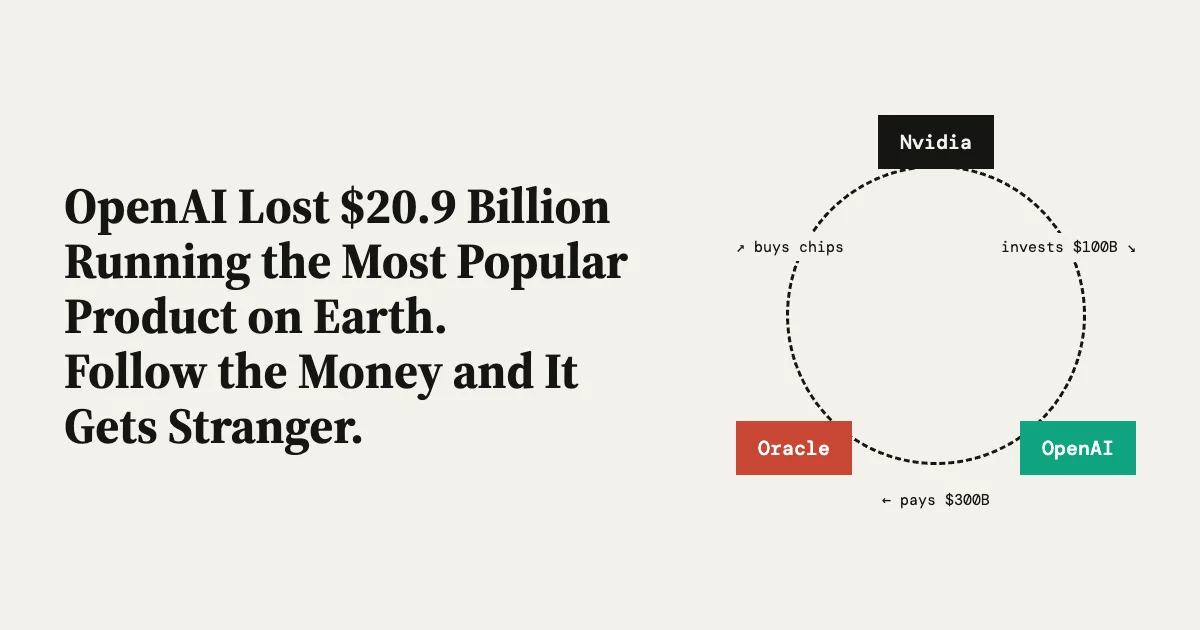
OpenAI Lost $20.9
Audited 2025 figures show a company tripling revenue while burning cash faster than any startup ever has. The loss is only half the story. The other half is a loop of deals that turns the same dollars into growth at three companies at once, and a bill that has four ways of reaching you.
AI & GPU compute
Anthropic Just Posted $16.8
The numbers coming out of the AI industry are the biggest in the history of technology, and a growing group of analysts thinks that is the problem. I went through the real figures behind the bubble debate, Anthropic’s revenue, the infrastructure commitments, the debt, the falling cost of intelligence, and who is actually paying, because the case for a correction and the case against it both rest on the same facts.
AI & GPU compute
The AI Industry Built a $5 Trillion Debt Pile on One Bet. That Bet Is Not Paying Off.
Something shifted in the AI narrative over the past few months, and it is worth paying attention to. The CEOs who spent years telling anyone who would listen that AI would eliminate entire categories of human work have gone quiet on that point.