The AI Industry Built a $5 Trillion Debt Pile on One Bet. That Bet Is Not Paying Off.
Something shifted in the AI narrative over the past few months, and it is worth paying attention to. The CEOs who spent years telling anyone who would listen that AI would eliminate entire categories of human work have gone quiet on that point.
Last verified Also on Medium
On this page
- The Debt and the Bet It Created
- The Jobs Are Not Going Anywhere, and Here Is the Evidence
- Why AI Keeps Failing at the Tasks That Would Justify the Bet
- The Pricing Crisis That Exposed the Subsidy
- The Financial Condition of the Companies Making the Bet
- The IPOs and What They Tell You
- What This Means in Practice
Something shifted in the AI narrative over the past few months, and it is worth paying attention to. The CEOs who spent years telling anyone who would listen that AI would eliminate entire categories of human work have gone quiet on that point. The companies charging flat monthly subscriptions for AI tools have abruptly switched to usage-based pricing. The most valuable AI companies in history are rushing toward IPOs while their own financial documents show losses that do not narrow as they grow.
These are not random coincidences. They are connected events, all flowing from the same underlying problem. The AI industry built itself on a specific financial bet, poured trillions of dollars into that bet, and is now confronting the fact that the bet is not working out the way it needed to.
This piece is an attempt to trace that logic clearly, from the debt to the failed premise to the cost crisis to the IPO scramble, because understanding the connection between these things matters more than tracking any single headline in isolation.
Note: This article reflects my analysis of publicly available data and should not be taken as financial advice.
The Debt and the Bet It Created
Start with the money, because the scale of it is not widely appreciated. JPMorgan analysts reported in late 2025 that AI-related debt had reached $1.2 trillion in investment-grade markets alone, making it the single largest segment in that market, surpassing even US banks. That was just one slice. JPMorgan subsequently raised its total AI infrastructure investment forecast to $5.5 trillion by 2030, noting that approximately $4.1 trillion of that total is expected to come from debt financing, with loans covering an average of 85 percent of project costs.
Morgan Stanley and JPMorgan jointly project that the technology sector will need to issue as much as $1.5 trillion in new debt over the next few years to finance AI and data centre infrastructure alone. UBS analysts forecast $900 billion in new debt from global companies in 2026 specifically. Since late 2025, global bond issuance related to AI and data centres has already exceeded $300 billion. Nvidia completed a $25 billion bond offering that drew $850 billion in demand, its first bond issuance in five years.
This debt does not sit on a spreadsheet in silence. It has to be serviced. To service even a fraction of the outstanding AI-related debt at typical market rates over a ten-year period requires generating hundreds of billions of dollars in profit annually. That is not a modest ask. It is larger than the annual profit of almost every company in the world.
To meet that requirement, AI cannot be a useful productivity tool or a consumer subscription product. It has to replace human labour at a scale that fundamentally restructures the economy. The math does not work any other way. This is the bet buried inside the debt: that AI will generate a displacement of human workers so large and so fast that the revenue replacing those wages becomes sufficient to service what has been borrowed.
Geoffrey Hinton, the researcher widely credited as one of the founding figures of modern AI, has publicly stated that the debt the industry has accumulated on the premise of mass labour replacement poses a genuine systemic risk if the technology fails to deliver on that premise at sufficient scale.
That is the context for everything that follows. Not hype. Not consumer enthusiasm. A specific financial bet, made at a specific scale, that requires a specific outcome to avoid a very large problem.
The Jobs Are Not Going Anywhere, and Here Is the Evidence
The honest read of the available data on AI and employment is not what the narrative of the past three years has suggested. Oxford Economics published a detailed analysis in January 2026 concluding that companies do not appear to be replacing workers with AI on any significant scale. The firm’s test for this was direct: if AI were genuinely replacing labour, output per remaining worker should be surging. It is not. Economy-wide productivity growth has actually decelerated, tracking cyclical economic patterns rather than any technological disruption.
Oxford highlighted data from Challenger, Gray and Christmas showing that while AI was cited as the reason for approximately 55,000 US job cuts in the first eleven months of 2025, that figure represented just 4.5% of total reported job losses. Standard market and economic conditions accounted for four times as many. The report concluded that AI-related job losses remain statistically limited. The International Center for Law and Economics reviewed the wider academic literature in early 2026 and reached the same conclusion, finding essentially zero measurable effects on earnings or employment hours in multiple large datasets through 2024 and 2025.
On the corporate deployment side, a survey of 6,000 C-suite executives across multiple countries found that nearly 90% reported AI had no measurable impact on employment or productivity over the past three years. Companies including Starbucks and Pizza Hut attempted to deploy AI systems to replace customer-facing workers and were forced to reverse those decisions when performance issues made the systems unusable in production. A study by Sinch surveying 2,500 AI decision-makers found a 74% rollback or shutdown rate for AI customer communications agents, a category widely considered the most immediately replaceable by current AI systems.
Oxford Economics posed the question directly: if jobs are being replaced, where is the productivity surge? It has not appeared. That absence is not a minor data point. It is the central empirical challenge to the premise on which multiple trillions of dollars of debt has been issued.
Why AI Keeps Failing at the Tasks That Would Justify the Bet
There is a specific reason the productivity surge is not appearing, and it is worth being precise about it because the popular explanation, that the technology just needs more time or better deployment, does not match what the research actually shows.
The core problem is reliability. Stanford HAI’s 2026 AI Index Report documented that hallucination rates across 26 leading AI models range from 22% to 94% depending on the task type. GPT-4o’s accuracy on certain tasks dropped from 98.2% to 64.4% under more realistic testing conditions. The AI Incident Database recorded 362 documented failures in production deployments in 2025, a 55% increase from 233 in 2024.
In software development, the domain where AI investment has been most concentrated, the reliability picture is particularly clear. Research from METR published in 2026 studied experienced open-source developers using AI coding tools and found that AI assistance actually increased task completion time by 19%. Developers estimated the tools would save them 20% of their time. The measured outcome ran in the opposite direction. The explanation was consistent across participants: more time was spent debugging and correcting AI-generated errors than was saved in initial generation.
Research from Veracode found that 45% of AI-generated code contains security vulnerabilities. A separate study found AI-generated code carries 70% more bugs than human-written code. OpenAI’s own internal research found that simply increasing computing power or providing more training data cannot reduce AI hallucinations below current levels. The 2026 International AI Safety Report, written by over 100 domain experts, independently confirmed this finding: AI systems remain prone to basic errors of fact and logic in ways that do not resolve with more capability investment.
This matters enormously for the financial argument, because it rules out the most obvious escape route. If the reason AI is not replacing workers is deployment problems or insufficient capability, more investment could theoretically fix it. If the reason is that the systems have an inherent reliability ceiling that cannot be engineered away within current architectural approaches, the premise of the bet cannot be rescued by spending more money on it.
The Pricing Crisis That Exposed the Subsidy
The most recent development in this story is the one that has brought the underlying economics into sharpest focus. Over the past several months, AI companies have moved away from flat subscription pricing toward usage-based token pricing. The consequences have been immediate and severe.
GitHub Copilot switched to token-based billing on June 1, 2026, replacing its flat subscription model with a credit system where each AI request draws down a finite monthly allowance. Heavy users of agentic and repository-wide features immediately reported bills surging from $39 per month to over $800. Some documented cases showed increases of more than twenty times the previous cost. This was not a price increase in the conventional sense. It was the removal of a subsidy that had been making the tool appear cheaper than its actual operating cost.
Uber’s CTO told The Information that the company had burned through its entire 2026 AI budget in four months, primarily from AI coding tools including Claude Code. He described going back to the drawing board on AI spending entirely. Fortune reported that a Goldman Sachs research note concluded that companies are overrunning their initial AI inference budgets by orders of magnitude. An Nvidia vice president stated publicly that the cost of compute for his team now exceeds the cost of the employees that compute is supposed to augment.
Senior leaders at Uber made the implication explicit: AI is now more expensive than the human workers it was supposed to replace, and unlike human workers, AI usage does not correlate to delivering new features. Microsoft cancelled its internal Claude Code licences for the same reason, citing cost as prohibitive. Reports surfaced of a single company accumulating a $500 million bill with Anthropic in a single month.
This pricing shift reveals something important. The flat subscription prices that most users had been paying were not prices at all. They were marketing investments, designed to embed AI tools deeply into workflows before the real cost of operating them was disclosed. Now that the subsidised phase is ending, the actual economics of AI at scale are visible for the first time, and they do not support the case for AI replacing human labour.
If AI costs more than human workers and does not reliably produce better output, the industrial logic of the replacement narrative collapses entirely. This is almost certainly why the executives who built careers on that narrative have gone unusually quiet about it in recent months.
The Financial Condition of the Companies Making the Bet
Against this backdrop, the financial condition of the leading AI companies becomes more significant. OpenAI’s Q1 2026 financials, reported by The Information, showed revenue of $5.7 billion alongside an operating margin of negative 122%, meaning the company lost $1.22 for every dollar of revenue it generated. Sacra’s analysis of OpenAI’s projected cash burn puts the 2026 figure at approximately $27 billion, rising to approximately $63 billion in 2027. The company does not reach cash-flow positive until 2030 on its own projections.
OpenAI’s total net loss for 2025 was approximately $39 billion, up from $5 billion in 2024. The company has committed to $665 billion in long-term computing procurement, nearly twenty times its total 2025 expenditures. These commitments are not yet on the balance sheet but represent a very real future obligation. OpenAI filed confidentially with the SEC for an IPO on June 8, 2026, targeting a valuation exceeding $1 trillion, having raised $122 billion at an $852 billion post-money valuation in March 2026.
Anthropic’s position is presented as more favourable, with claims of approaching non-GAAP operating profitability in Q2 2026. Ed Zitron’s analysis of those figures argues that the profitability claim depends on accounting adjustments and a specific two-month compute cost reduction rather than underlying operational improvement, and that both Anthropic and OpenAI benefit from heavily discounted compute supplied by their major backers, meaning their stated losses already understate the true cost of operations.
The model these companies have been running is now clearly visible. Raise equity from major tech companies and venture capital. Offer services at a loss to build user base and dependency. Switch to debt markets when equity sources slow down. Now that debt markets are also under strain as AI debt has saturated the corporate bond market and borrowing costs have risen, the remaining option is to access public market capital through IPOs before the financial picture deteriorates further.
The IPOs and What They Tell You
OpenAI’s confidential S-1 filing and Anthropic’s parallel preparation for public markets are best understood in this context. Financial analysis from FutureSearch estimates OpenAI’s 2026 GAAP losses at $25 to $26 billion, approximately 80% higher than the widely cited non-GAAP figure. The projected market cap of roughly $860 billion at IPO is almost exactly the current private valuation, suggesting public markets are being asked to validate a price that private markets already set rather than providing genuine price discovery.
The cash that a successful IPO generates is meaningful but finite. MarketWise’s analysis notes that OpenAI’s Q1 2026 cash burn consumed a large fraction of its then-available cash in a single quarter. At current burn rates, IPO proceeds provide runway measured in years rather than a path to sustainability. Both companies are also reportedly considering significant token price cuts to compete for enterprise market share, a move that would widen already substantial losses further.
This is the classic pattern of a company that needs a liquidity event before its financial trajectory becomes publicly visible. The IPO is not evidence of success. It is a mechanism for distributing the risk of the current financial position across a broader base of investors before the question of whether the underlying bet pays off is resolved.
Whether these IPOs succeed or fail matters for reasons beyond the companies themselves. AI debt now represents the largest single segment in the investment-grade bond market, exceeding US banks. The financial systems that price and hold that debt are exposed to the same underlying question: does AI generate enough economic value at sufficient scale to service the obligations written against it?
What This Means in Practice
The picture that emerges from laying these pieces together is not one of a technology that failed. It is one of an industry that borrowed against a specific future and is now learning that the future is arriving more slowly and more expensively than the borrowing assumed.
AI is genuinely useful in many contexts. It changes how specific tasks get done and accelerates certain kinds of work in certain conditions. The research supporting meaningful productivity gains in narrow, well-defined tasks is real. None of that requires disputing.
What the evidence does not support is the premise that funded the debt that AI would replace human labour at the scale and speed required to generate the returns needed to service it. Oxford Economics found no displacement at scale. METR found AI slows down experienced developers on complex tasks. The companies that bet hardest on near-term replacement, from Starbucks to various enterprise software vendors, have quietly rehired the workers they let go. Meanwhile the actual cost of operating AI at scale, now becoming visible as the subsidy era ends, is higher than the human labour it was supposed to replace.
The U-turns on the jobs narrative, the token-based pricing shift, the IPO timing, the desperate search for government infrastructure contracts and backing: these are not separate stories. They are responses to the same underlying problem.
The question that matters now is not whether AI is impressive. It is whether the industry structured around it can generate enough real economic value to service the debt written against a premise that the evidence has not validated. That question does not yet have a clear answer, and the next eighteen months will likely define it.
The most honest position is uncertainty. AI may find the use cases that justify the investment. The technology may improve in ways that change the reliability picture. The companies may find paths to profitability that current projections do not capture. All of those remain possible.
What is no longer possible is the claim that the bet is paying off on the original timeline. It is not, and the people who made it are now telling you so through their actions, even as their words continue to describe a different story.
Sources
- Bloomberg: JPMorgan Says $1.2 Trillion Debt Tied to AI Tops Bank High Grade, October 2025 — AI debt surpasses US banks as largest segment in investment-grade bond market.bloomberg.com. Accessed 23 June 2026.
- KuCoin: JPMorgan Upgrades AI Infrastructure Investment Forecast to $5.5 Trillion — $4.1 trillion to be financed through debt at 85% loan coverage of project costs.kucoin.com. Accessed 23 June 2026.
- Mellon Investments: Record-Breaking AI-Related Debt Issuance in 2025 — Morgan Stanley and JPMorgan projecting $1.5 trillion in new AI-related debt issuance. UBS forecasting $900 billion in 2026.mellon.com. Accessed 23 June 2026.
- CryptoBriefing: JPMorgan AI CapEx Data Center Debt Analysis — $300 billion in AI and data centre bond issuances since late 2025. Nvidia $25 billion bond offering details.cryptobriefing.com. Accessed 23 June 2026.
- Fortune: Oxford Economics on AI Layoffs as Corporate Fiction, January 2026 — Oxford Economics finding companies are not replacing workers with AI at significant scale. Productivity growth decelerated.fortune.com. Accessed 23 June 2026.
- Workplace Insight: Oxford Economics Report on AI Job Loss Evidence, January 2026 — Sinch 2,500 decision-maker survey finding 74% rollback rate for AI customer communications agents.workplaceinsight.net. Accessed 23 June 2026.
- International Center for Law and Economics: AI, Productivity, and Labor Markets Review, February 2026 — Comprehensive academic literature review finding essentially zero aggregate employment effects through 2024 and 2025.laweconcenter.org. Accessed 23 June 2026.
- Stanford HAI: 2026 AI Index Report, Responsible AI Section — Hallucination rates 22% to 94% across 26 models. 362 documented AI incidents in 2025, up 55% from 2024.hai.stanford.edu. Accessed 23 June 2026.
- METR: Measuring the Impact of AI on Experienced Open-Source Developer Productivity, 2026 — AI tools increased developer task completion time by 19%. Experts predicted 20% reduction. Opposite result observed.arxiv.org. Accessed 23 June 2026.
- International AI Safety Report 2026 — Over 100 domain experts confirming AI systems remain prone to basic errors that do not resolve with more compute or data.internationalaisafetyreport.org. Accessed 23 June 2026.
- TechCrunch: GitHub Copilot Token-Based Billing Spurs Consternation, May 2026 — GitHub Copilot switches to usage-based billing June 1, 2026. Users reporting bills jumping from $39 to $750+ per month.techcrunch.com. Accessed 23 June 2026.
- Fortune: Nvidia Executive Says Cost of AI Is Greater Than Cost of Employees, April 2026 — Uber CTO on burning through entire 2026 AI budget in four months. Goldman Sachs on companies overrunning AI inference budgets by orders of magnitude.fortune.com. Accessed 23 June 2026.
- UsageBox: GitHub Copilot Usage-Based Billing 2026 — Microsoft cancelling internal Claude Code licences due to cost. Full pricing structure breakdown.usagebox.com. Accessed 23 June 2026.
- Ed Zitron / Where’s Your Ed At: OpenAI Q1 2026 Negative 122% Operating Margin, May 2026 — OpenAI Q1 2026 revenue $5.7 billion, operating margin negative 122%. Anthropic profitability claim analysis.wheresyoured.at. Accessed 23 June 2026.
- Sacra: OpenAI Revenue and Financial Forecast — Projected cash burn $27 billion in 2026, $63 billion in 2027. Cash-flow positive not until 2030. June 8 IPO filing details.sacra.com. Accessed 23 June 2026.
- TradingKey: OpenAI Q1 2026 Financial Analysis — $665 billion in computing procurement commitments. Q1 net loss $21.3 billion.tradingkey.com. Accessed 23 June 2026.
- MarketWise: OpenAI Losses Surge to $21 Billion — OpenAI 2025 total operating loss $20.9 billion. Q1 2026 cash burn $3.7 billion. Price war implications analysis.marketwise.com. Accessed 23 June 2026.
- FutureSearch: OpenAI Revenue, Losses, and IPO Valuation Forecasts — 2026 GAAP losses estimated $25 to $26 billion. Expected post-IPO market cap $860 billion.futuresearch.ai. Accessed 23 June 2026.
Related stories
AI & GPU compute
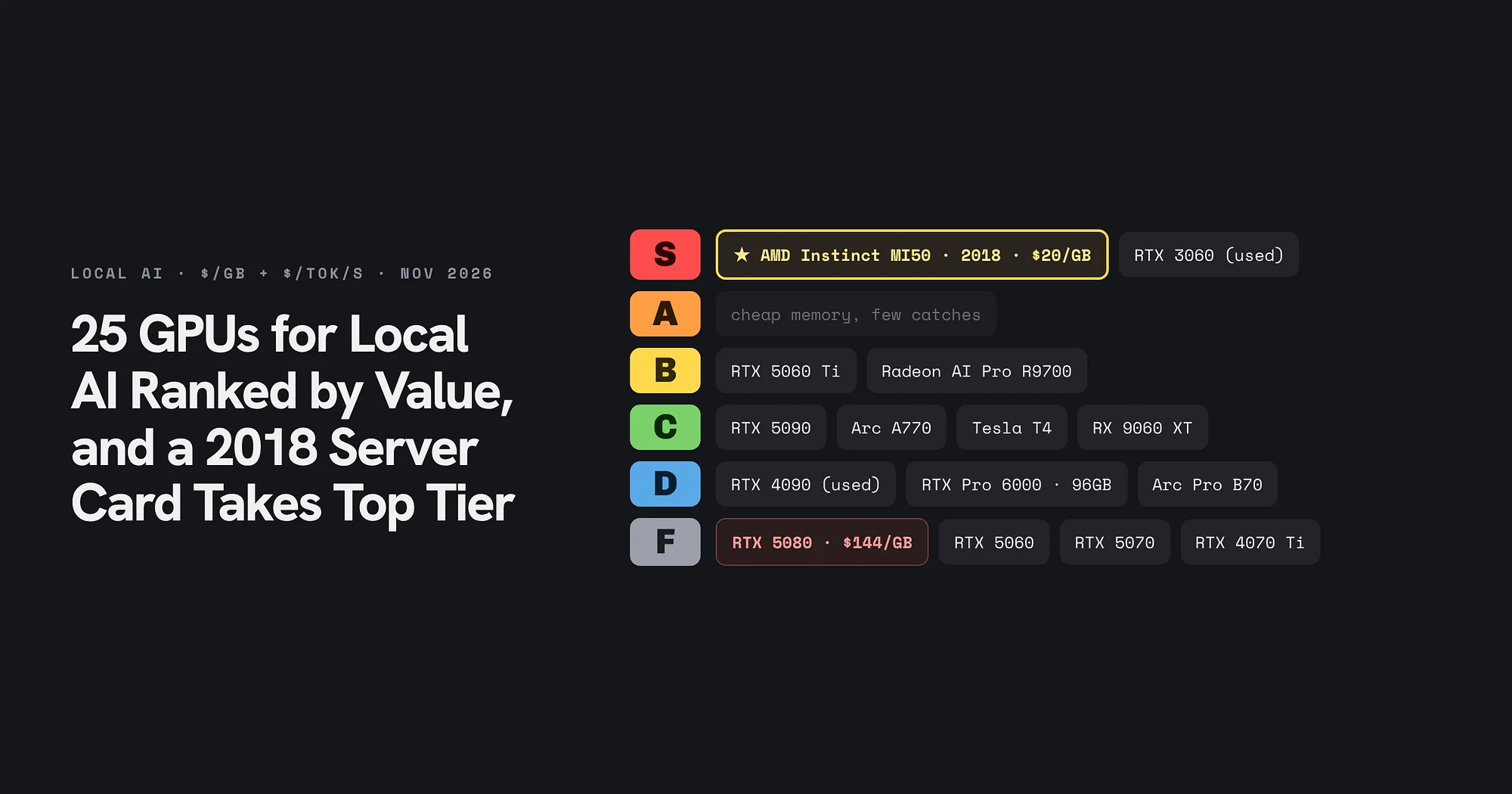
25 GPUs for Local AI Ranked by Value, and a 2018 Server Card Takes Top Tier
A November 2026 price snapshot grades 25 cards on dollars per gigabyte and dollars per token per second. The AMD Instinct MI50 and a used RTX 3060 take S tier, the RTX 5080 lands in F, and memory decides almost every grade.
AI & GPU compute
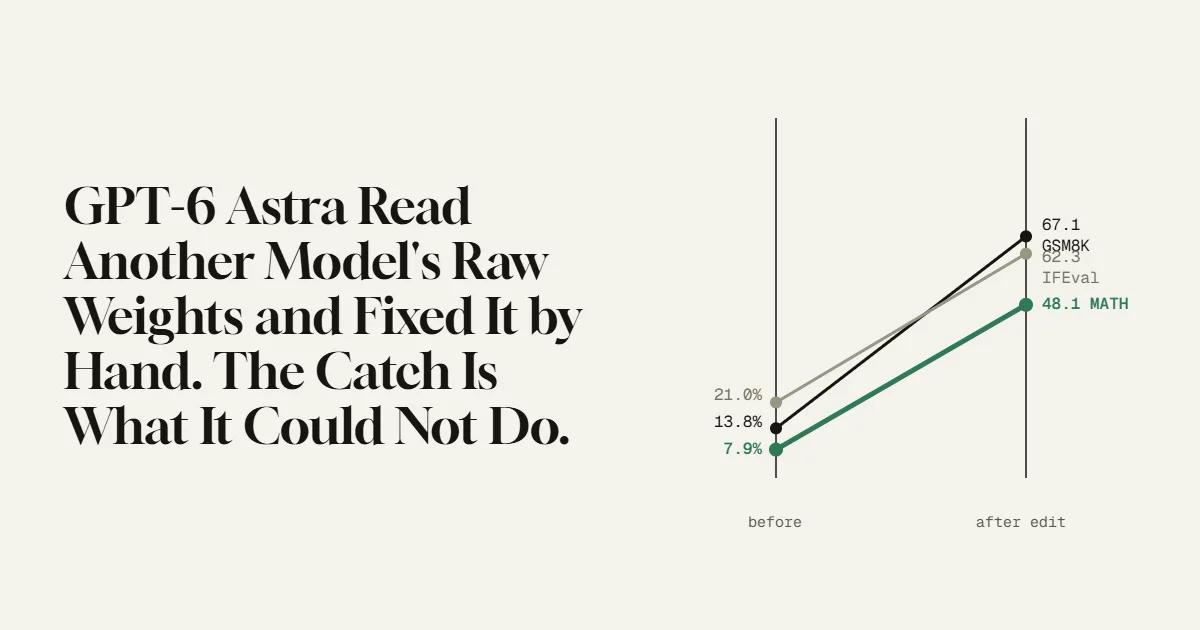
GPT-6 Astra Read Another Model’s Raw Weights and Fixed It by Hand.
MIT researchers had GPT-6 Astra edit 0.016% of a small model’s weights, with no training, and its math score jumped from 7.9% to 48.1%. The number is real and the method is strange. The limit they found in the same paper is the part worth understanding.
AI & GPU compute
Anthropic Just Posted $16.8
The numbers coming out of the AI industry are the biggest in the history of technology, and a growing group of analysts thinks that is the problem. I went through the real figures behind the bubble debate, Anthropic’s revenue, the infrastructure commitments, the debt, the falling cost of intelligence, and who is actually paying, because the case for a correction and the case against it both rest on the same facts.