$60 Billion in Corporate Bitcoin Value Has Vanished. The Mechanism Behind It Is Still Running.
There is a version of the corporate Bitcoin treasury story that sounds clean and permanent. Companies issue cheap debt, buy Bitcoin, hold it forever, absorb supply from the market, and create structural demand that puts a floor under the price.
Last verified Also on Medium

On this page
There is a version of the corporate Bitcoin treasury story that sounds clean and permanent. Companies issue cheap debt, buy Bitcoin, hold it forever, absorb supply from the market, and create structural demand that puts a floor under the price. Investors who cannot hold crypto directly can buy a NASDAQ stock instead and get the same exposure. The whole thing compounds on itself.
That was the pitch. The reality in 2026 looks considerably different.
Over $60 billion in treasury value has been erased across the corporate Bitcoin sector since Bitcoin peaked at $124,720 in October 2025. Strategy, the company that invented this model, quietly sold 32 Bitcoin in May 2026 after years of publicly committing never to sell a single coin. Marathon Digital, one of the largest corporate holders, sold 15,133 Bitcoin for $1.1 billion in March 2026. Several smaller companies have begun unwinding positions entirely.
The promise was permanent demand. What the structure actually created was leverage embedded into public markets, and leverage works in both directions.
How the Model Was Built and Why It Worked
To understand what is happening now, you need to understand the mechanics of what was built. The corporate Bitcoin treasury model was pioneered by MicroStrategy, now rebranded as Strategy, starting in 2020. The logic had three interlocking parts.
The first was the permanent demand premise. Corporate treasuries would act as long-term buyers of Bitcoin, locking coins away from circulation indefinitely. The never-sell doctrine was not just a policy. It was the psychological foundation of the entire model, the thing that made the demand feel structural rather than speculative.
The second was balance sheet leverage. Companies could issue debt at historically low interest rates and deploy that capital into Bitcoin, which was returning multiples of the borrowing cost. The math looked compelling as long as Bitcoin was rising.
The third was the Wall Street bridge. Institutional investors who could not hold Bitcoin directly due to regulatory, compliance, or mandate constraints could simply buy the stock of a company that held Bitcoin. Strategy became a regulated, publicly traded proxy for Bitcoin exposure on a US exchange.
The mechanism that made all 3 pillars self-reinforcing was what the market called the flywheel. Strategy would issue stock at a premium to the value of its Bitcoin holdings, use the proceeds to buy more Bitcoin, watch its Bitcoin-per-share metric climb, which pushed the premium higher, which allowed it to issue more stock at an even higher premium, which funded more Bitcoin purchases. The loop repeated.
At its peak in late 2024, Strategy’s market cap reached nearly 3.89 times the value of its Bitcoin holdings. Metaplanet, the Japanese company that became Asia’s version of Strategy, peaked at an extraordinary 22.5 times its Bitcoin value. Investors were not buying Bitcoin. They were buying the story that Bitcoin would keep going up and that the companies holding it would keep compounding. When the story is the product, the product can collapse far faster than the asset underneath it.
The Metric That Controls Everything: MNAV
There is one number that determines whether this entire model functions or fails. It is called MNAV, which stands for market net asset value. The calculation is simple: divide the company’s market capitalisation by the current dollar value of its Bitcoin holdings. The result tells you whether investors are paying a premium or a discount for exposure to the underlying Bitcoin.
Above 1x, everything works. The company can issue new shares at a premium, use the cash to buy more Bitcoin, and each share becomes worth a larger fraction of more Bitcoin. The flywheel spins forward.
Below 1x, the entire mechanism reverses. Issuing new shares at a discount to Bitcoin value destroys value for existing shareholders rather than creating it. The primary tool the company used to grow its Bitcoin position becomes a tool that shrinks it. The flywheel stops.
Strategy’s MNAV peaked at 3.89x and has now collapsed to approximately 0.8x by some measures. The 70% decline in the MSTR share price between August 2025 and early 2026 reflected two things compounding simultaneously. Bitcoin falling directly reduced the value of the holdings. The MNAV compression added a second layer of decline on top of that. Investors were not just losing the Bitcoin return. They were also losing the premium they had paid to access that return through a corporate structure.
This double compression is what makes leveraged Bitcoin treasury companies structurally more dangerous to hold than Bitcoin itself during a drawdown. They are not a way to own Bitcoin with upside leverage. They are a way to own Bitcoin with downside leverage on every move below the MNAV threshold.
The Fixed Obligations That Do Not Move With the Price
What makes the MNAV problem particularly consequential is what sits underneath it. Strategy is carrying approximately $6.7 billion in convertible notes plus billions in perpetual preferred stock. JP Morgan estimates the company’s annual dividend and debt service obligations at roughly $1.7 billion per year. Those obligations are fixed. They do not shrink when Bitcoin falls. They do not negotiate when the stock trades at a discount.
The convertible notes compound the problem. Their conversion price sits around $672 per share while the stock trades near $123. As CoinDesk reported in January 2026, notes that are this far out of the money cannot convert into equity. They must be repaid in cash. Strategy currently has approximately $2.25 billion in cash reserved for dividend payments, which covers a limited runway of obligations at current rates.
The 32 Bitcoin sold in May 2026 to cover a preferred stock dividend was financially trivial relative to Strategy’s total holdings. From a symbolic standpoint it was significant. For five years, the company had made never selling a cornerstone of its identity and its investor proposition. Selling any Bitcoin, for any reason, demonstrated that the fixed obligations have priority over the doctrine.
Strategy’s CEO Phong Le subsequently made the conditions for further selling explicit in a public interview. As reported by Yahoo Finance in late 2025, Le confirmed that if the MNAV falls below 1x and the company is simultaneously unable to raise new capital through equity or debt markets, Bitcoin sales become part of the operational toolkit. That is the first explicit acknowledgement in five years that selling Bitcoin is possible. It is also a precise description of the conditions that could force it.
The Doom Loop and How It Fires
The mechanism that turns a falling Bitcoin price into a forced selling spiral is worth tracing carefully, because it is not obvious from the outside.
Step one: Bitcoin falls. The value of all Bitcoin holdings drops in direct proportion to the price decline.
Step two: The stock falls by more than Bitcoin. The MNAV compression means that investors devalue the corporate structure on top of the underlying asset decline. A 47% fall in Bitcoin can translate into a 70% fall in the stock.
Step three: With MNAV below 1x, the flywheel cannot spin forward. Issuing new shares to buy Bitcoin now destroys value per share rather than creating it. The company loses its primary capital-raising mechanism at exactly the moment it most needs capital.
Step four: The fixed obligations still arrive on schedule. Dividends are due. Debt service is due. With the flywheel stopped and capital markets effectively closed due to the stock discount, the remaining options are diluting shareholders further or selling Bitcoin.
Step five: Selling Bitcoin into a market where trading volume has already contracted pushes the price down further. That reduces the NAV further. That feeds back into step one. The loop closes.
This is not theoretical. Marathon Digital sold 15,133 Bitcoin for $1.1 billion between March 4 and March 25, 2026, using the proceeds to repurchase $1 billion in convertible notes at a 9% discount to par. The company explicitly revised its digital asset management policy on March 3, 2026, the day before the sales began, to permit selling Bitcoin from its treasury holdings beyond newly mined coins. That policy change eliminated the never-sell commitment that had been central to Marathon’s investor proposition.
Other companies followed. Bitcoin Magazine’s April 2026 tracker documented Nakamoto Holdings selling 284 Bitcoin for $20 million, Empery Digital selling 370 Bitcoin to repay term loans and release collateral, Riot Platforms reducing holdings citing liquidity needs, and Genius Group beginning a partial unwind. The pattern is consistent: companies that built their identity on permanent accumulation are quietly reversing that position when balance sheet pressure arrives.
Why Strategy’s Size Makes This a Market-Wide Problem
Strategy holds approximately 843,738 Bitcoin as of mid-2026, representing roughly 4% of all Bitcoin in existence. That concentration is what transforms a corporate balance sheet problem into a market-wide event if forced selling materialises at scale.
Bitcoin trading volume has already contracted by close to 50% from peak levels. If the largest single corporate holder of Bitcoin is pushed into selling a meaningful portion of its stack into a market with half its normal liquidity, the price impact is not proportional to the size of the sale. Strategy would not just be taking a loss. It would become the dominant force in the market for an extended period, and the direction it is pushing in would be down.
The 195 corporate Bitcoin treasury companies tracked by Bitcoin Treasuries collectively hold between 1.2 and 1.4 million Bitcoin. Galaxy Digital analyst Alex Thorn has identified $60,000 as the price level where capital markets effectively close for these firms, making new equity and debt issuance structurally impossible. Below that threshold the flywheel cannot restart and fixed obligations must be met through Bitcoin sales. Thorn has modelled a more severe scenario centred around $40,000 to $46,000 where panic selling across the sector could reinforce itself.
There is also an index dimension that has not received much coverage. If major index providers remove corporate Bitcoin treasury companies from their benchmarks, passive funds that track those indexes are forced to sell mechanically, regardless of Bitcoin’s price or their own view on the underlying asset. The forced selling would be structural rather than sentiment-driven, meaning it could accelerate at moments when the market is already under pressure from other sources.
The Bull Case Is Specific and Worth Taking Seriously
Laying out the mechanics of the doom loop without acknowledging the counterarguments would be incomplete. There are legitimate reasons why the worst case may not materialise, and they are worth stating precisely.
Benchmark Capital’s Mark Palmer argues that Strategy’s shift toward perpetual preferred stock rather than convertible notes reduces refinancing risk. Perpetual preferred has no maturity date, which eliminates the refinancing cliff that makes debt-heavy structures vulnerable at specific moments. Bitwise analyst Andre Dragosch notes that Strategy’s recent convertible debt buybacks removed significant uncertainty around near-term repayment obligations.
TD Cowen maintains a buy rating on Strategy with a $400 price target, arguing that the death spiral narrative understates the company’s structural flexibility. The company still has over $25 billion in authorised stock issuance capacity in reserve, and as CoinDesk documented Strategy’s 712,647 unencumbered Bitcoin and flexible debt management options mean it faces no forced selling under current conditions. The debt is long-dated. There is no margin call due next week.
The most important point in the bull case is the simplest one. If Bitcoin price recovers meaningfully, the entire analysis changes. The MNAV climbs back above 1x, the flywheel restarts, capital markets reopen, the fixed obligations become manageable relative to the asset base, and the doom loop becomes a distant memory. Every bear scenario described above is conditional on Bitcoin staying low for long enough. Bitcoin has a history of surprising people who bet on it staying low.
What to Watch From Here
The honest position is that both scenarios remain genuinely possible, and the outcome depends on a relatively small number of identifiable variables.
The most important is Strategy’s MNAV. Saylor Tracker provides live MNAV data updated in real time. If MNAV stabilises above 1x, the flywheel can potentially restart and the acute pressure eases. If it stays below 1x for an extended period, the company’s capital-raising options become structurally constrained.
The second variable is the cash runway. Strategy has approximately $2.25 billion reserved for dividend payments against annual obligations of roughly $1.7 billion. That covers slightly over a year of payments. If the company cannot raise fresh capital before that reserve is depleted, Bitcoin sales become more likely.
The third is whether smaller corporate treasury companies continue selling. Each sale from a secondary holder adds incremental supply to the market and signals to other holders that the never-sell commitment has a practical limit. Bitcoin Magazine’s treasury tracker is documenting this in real time. A wave of smaller company sales before any large-scale pressure on Strategy would be a meaningful warning signal.
The fourth variable, which nobody can model precisely, is the broader macro environment. Long-term, the structural case for Bitcoin as a scarce hard asset in a world of expanding government debt does not go away. Central banks continue to expand money supply. Governments continue to run deficits. The thesis that drove the original corporate treasury adoption is not invalidated by a price drawdown. It is delayed.
Corporate Bitcoin treasuries were designed to be the most patient buyers in the market. The stress test they are now undergoing is revealing which of them are genuinely patient and which of them were leveraged optimism dressed up as strategic conviction.
The companies that survive this drawdown with their holdings intact and their balance sheets under control will likely be in a strong position when the cycle turns. The companies that are forced to sell into a down market will have demonstrated the limit of the model they were selling. That distinction matters enormously for investors trying to assess which of the 195 corporate holders represent genuine long-term alignment and which represent a liability waiting to be disclosed.
The floor is not as permanent as the pitch suggested. The ceiling, if Bitcoin recovers, may be higher than the bears are currently pricing. Where exactly it all lands depends on whether Bitcoin moves first or the obligations come due first.
Sources
- Decrypt: What Is Strategy, the Bitcoin Treasury Company — Full history of Strategy’s MNAV collapse from 3.89x to below 1x. 70% stock decline from August 2025 to February 2026. $12.4 billion Q4 2025 loss.decrypt.co. Accessed 25 June 2026.
- CoinDesk: Strategy’s Bitcoin Stack Officially Underwater, January 2026 — $2.25 billion cash reserve. 712,647 unencumbered Bitcoin. Convertible debt flexibility analysis.coindesk.com. Accessed 25 June 2026.
- Yahoo Finance: MicroStrategy Admits a Bitcoin Sale Is Possible — CEO Phong Le confirming Bitcoin sale trigger conditions: MNAV below 1x combined with capital markets being closed.finance.yahoo.com. Accessed 25 June 2026.
- Bitcoin Magazine: Bitcoin Treasury Companies Are Dumping Their Bitcoin, April 2026 — Marathon selling 15,133 BTC, Nakamoto selling 284 BTC, Empery Digital selling 370 BTC, Riot and Genius Group reducing holdings.bitcoinmagazine.com. Accessed 25 June 2026.
- Bitcoin Magazine: MARA Dumps $1.1 Billion in Bitcoin to Repurchase Convertible Notes — Full details of Marathon’s March 2026 Bitcoin sale and $1 billion convertible note repurchase at 9% discount.bitcoinmagazine.com. Accessed 25 June 2026.
- Memeburn: Corporate Bitcoin Treasury Full Tracker 2026 — Current holdings for all major corporate Bitcoin treasury companies. Strategy at 843,738 BTC, Marathon at 38,689 BTC.memeburn.com. Accessed 25 June 2026.
- BeInCrypto: MicroStrategy Collapse Could Be Next Black Swan for Crypto — Galaxy Digital’s Alex Thorn on $60,000 as the level where capital markets close. $40,000 to $46,000 panic scenario analysis.beincrypto.com. Accessed 25 June 2026.
- TradingKey: Strategy MSTR Analysis and MNAV Risk — Bitwise analyst Andre Dragosch on debt buyback reducing 2028 repayment wall risk. Annual obligations of $800 million.tradingkey.com. Accessed 25 June 2026.
- KuCoin: MicroStrategy’s Bitcoin Holdings Drop $6.12 Billion Year-to-Date 2026 — Year-to-date treasury value erosion data and Peter Schiff analysis of capital structure risk.kucoin.com. Accessed 25 June 2026.
- CCN: Strategy MSTR Down 66%, Bitcoin Below 75k Risk Analysis — MSCI index removal consultation. Strategy holding 3.2% of total Bitcoin supply. Index exclusion mechanics.ccn.com. Accessed 25 June 2026.
- Bitget: Why Is MicroStrategy Stock Going Down — Explanation of amplified downside mechanics. MSTR produces larger losses than Bitcoin itself during sharp selloffs.bitget.com. Accessed 25 June 2026.
- Saylor Tracker: Live MNAV and Holdings Data — Real-time tracking of Strategy’s MNAV, Bitcoin holdings, and cost basis.saylortracker.com. Accessed 25 June 2026.
Related stories

Crypto & markets
Richard Heart Beat the SEC on a Technicality, Then His Own Tax Office Caught Up With Him in…
On 14 October 2026, Turkish police arrested the founder of Hex and PulseChain on an Interpol red notice issued for Finland, which suspects him of gross tax evasion. He had walked away from a $1 billion SEC case 18 months earlier, not because a court cleared him, but because the judge found no US jurisdiction. I went through the whole arc, the sacrifice mechanism, the allegations, the dismissal that was not an acquittal, and a blockchain whose biggest customer was its own founder.
Crypto & markets
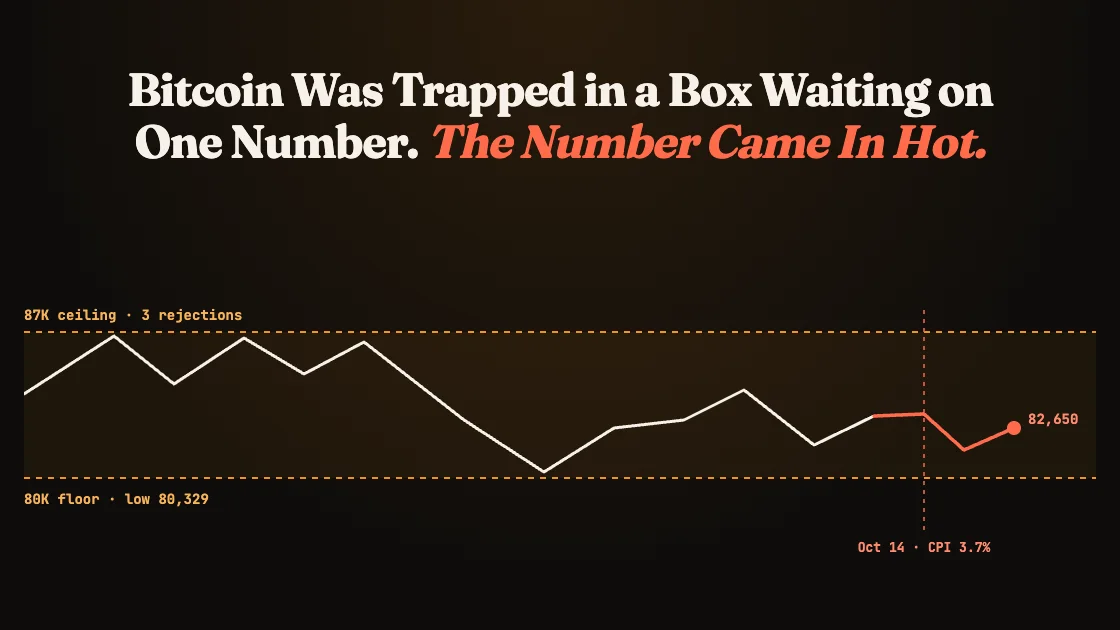
Bitcoin Was Trapped in a Box Waiting on One Number. The Number Came In Hot
A ceiling near 87K, a floor near 80K, and $800 million of liquidations in between. Then the September CPI ran hot, yields jumped, and Bitcoin slid under 82K. Here is how the range was built and how it broke. None of this is financial advice. Prices and levels in this piece are as of October 14, 2026. Bitcoin and bond yields move daily.

Crypto & markets
Wall Street Filed an Automatic Bitcoin Buyer. It Runs on Stock Dividends.
On June 18, 2026, Franklin Templeton, a $1.5 trillion asset manager founded in 1947, filed registration statements with the SEC for 2 exchange-traded funds built around one of the oldest and most boring ideas in finance. A dividend reinvestment plan. The twist is where the dividends go.