The AI Subscription Era Is Ending. Here Is What Replaces It.
There is a specific moment happening in AI pricing right now that is worth understanding clearly, because it is the first real signal of how the economics of this entire industry are likely to shift over the next few years.
Last verified Also on Medium
On this page
There is a specific moment happening in AI pricing right now that is worth understanding clearly, because it is the first real signal of how the economics of this entire industry are likely to shift over the next few years.
Claude Fable 5, Anthropic’s most capable publicly released model, launched on June 9, 2026 as the first model in the company’s new Mythos-class tier. It was suspended just 3 days later, on June 12, under a US export-control directive, after researchers found a way to get the model to identify and demonstrate exploit code. The controls were lifted on June 30 and Fable 5 returned to global availability on July 1 with a new, considerably stricter safety classifier.
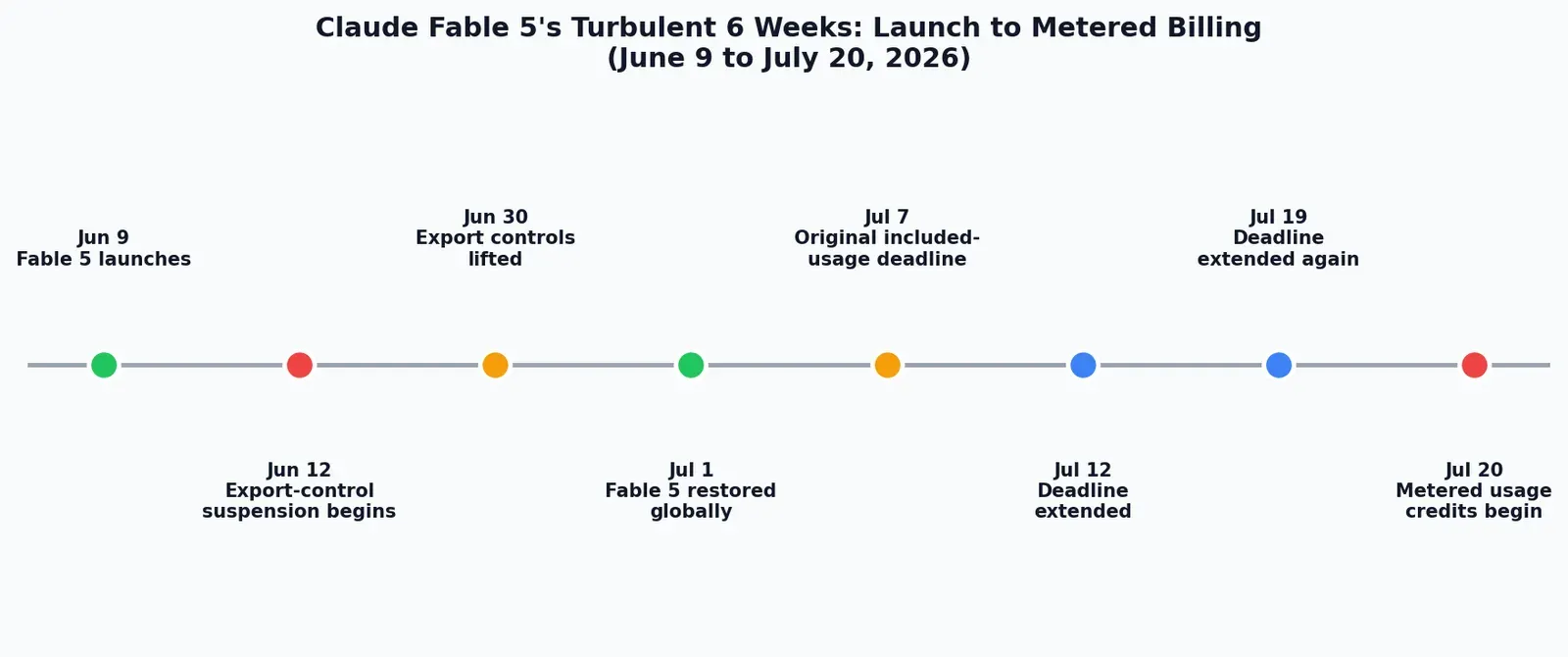
Claude Fable 5’s first 6 weeks: launch, suspension, restoration, and the shift to metered billing. Source: Anthropic announcements and reporting from ClaudeFast, DigitalApplied, and TechTimes, July 2026.
That restoration came with a deadline attached. Fable 5 was included for up to 50% of weekly usage limits on Pro, Max, Team, and select Enterprise plans, but only until a cutoff date. Anthropic has pushed that deadline back twice, first from July 7 to July 12, then to July 19. Metered usage credits, billed at API rates, now begin July 20, 2026. Whatever the exact date turns out to be when this settles, the direction is clear: Fable 5 is moving out of the subscription and into pay-per-token billing.
The Numbers That Make This Significant
Fable 5 lists at $10 per million input tokens and $50 per million output tokens on Anthropic’s official pricing page. That is exactly double Claude Opus 4.8’s rate of $5 and $25, making Fable 5 the single most expensive model Anthropic has ever priced for general use. For comparison, Claude Sonnet 5, which launched June 30 as the new default for Free and Pro plans, runs at an introductory rate of $2 input and $10 output through August 31, 2026, after which it rises to $3 and $15.
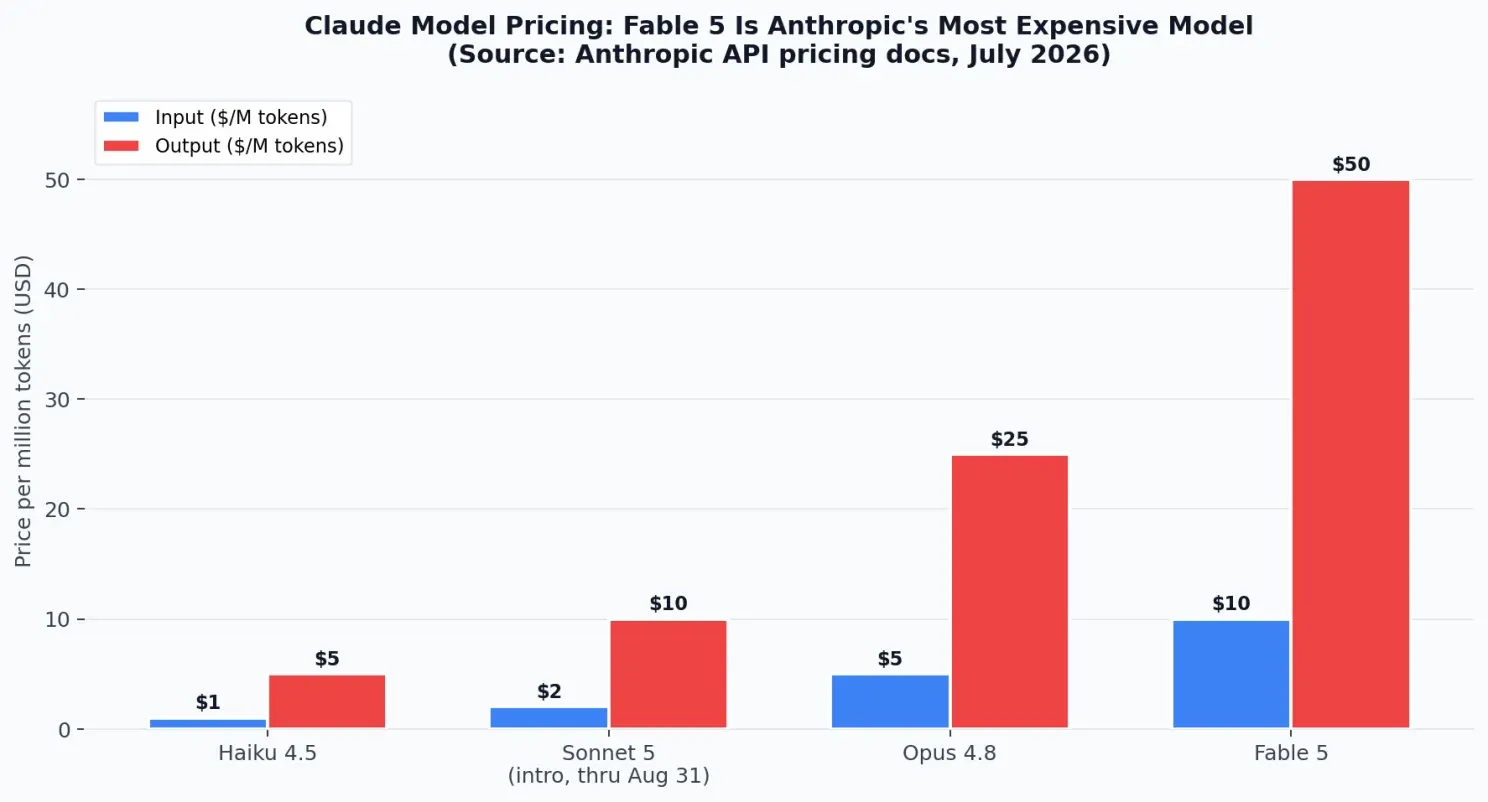
Fable 5’s per-token pricing against the rest of Anthropic’s current model lineup. Source: Anthropic API pricing documentation, retrieved July 2026.
There are cost-reduction levers built into how Fable 5 is billed, and they matter if you are actually managing a budget around this model. The Batch API halves both rates to $5 and $25, effectively bringing Fable 5 down to Opus 4.8-equivalent pricing for any workload that can tolerate asynchronous processing. Prompt caching drops the input price by 90%, down to roughly $1 per million tokens for repeated content such as system prompts or stable file context. For long agentic sessions in Claude Code, where the same codebase scaffolding gets re-read on every turn, caching is genuinely the single most effective lever available. Usage credits also carry a $2,000 per day spending cap as a safety mechanism.
Fable 5 is exactly double the price of Opus 4.8 and 5 times Sonnet 5’s introductory rate. It is the most expensive model Anthropic has ever priced for general use.
Is This a Permanent Shift or a Temporary Squeeze?
Here is where it gets genuinely more complicated than a simple story about prices only going up. Thariq Shihipar, an engineer on the Claude Code team, stated publicly on X that Anthropic intends to restore Fable 5 to standard subscription plans once server capacity allows. Anthropic itself has said the metered-billing shift is intended to be temporary, not a permanent repricing of the model.
Whether that holds is genuinely uncertain, and it is worth being honest about that uncertainty rather than assuming the worst-case outcome is the only possible one. Running a model with a full 1 million token context window at the scale Fable 5 was designed for is expensive to serve. The suspension and restoration cycle Fable 5 went through in its first weeks likely compressed the timeline Anthropic had for scaling capacity to meet demand. It is entirely plausible that the current metered period reflects a genuine, temporary capacity constraint rather than a deliberate long-term strategy to migrate users off subscriptions.
It is also true that independent testing has found the new safety classifier introduced alongside Fable 5’s restoration to be, in the words of evaluation platform BridgeMind, incredibly aggressive, according to reporting from Android Headlines. Whether that reflects genuine safety necessity following the export-control episode or an overcorrection is a separate and legitimate question from the pricing question, and the 2 should not be conflated even though they arrived at the same time.
The Broader Economic Question Underneath the Pricing
Whatever happens with Fable 5 specifically, the pricing structure exposes something true about the entire subsidised-AI-subscription model that has defined the past 3 years of this industry. Every flat-rate AI subscription is a bet that the average user costs less in compute than the subscription price charges. That bet becomes harder to sustain as models get more capable and as usage patterns shift toward longer, more agentic sessions that consume dramatically more tokens per interaction than a simple chat message.
Sam Altman made a version of this argument explicit at BlackRock’s Infrastructure Summit in Washington, DC on March 11, 2026. “We see a future where intelligence is a utility, like electricity or water, and people buy it from us on a meter, and use it for whatever they want to use it for,” Altman said, as reported by Business Insider.
He tied this directly to compute economics: if AI companies do not build enough capacity to meet demand, prices rise or access gets rationed. The comment drew significant public criticism, generating over 1,700 comments in 48 hours on Reddit’s r/singularity, with many describing the framing as dystopian given OpenAI’s founding mission was explicitly to advance AI unconstrained by the need to generate financial return.
What the Actual Data Says About AI ROI Right Now
The pricing question only matters if AI usage is actually generating measurable value for the people paying for it, and here the data is genuinely sobering. MIT’s NANDA initiative published research in 2025 based on 150 executive interviews, a survey of 350 employees, and analysis of 300 public AI deployments. The finding: approximately 5% of generative AI pilots achieve measurable, rapid impact on revenue or profit and loss. The remaining 95% stall, delivering little to no measurable financial impact.
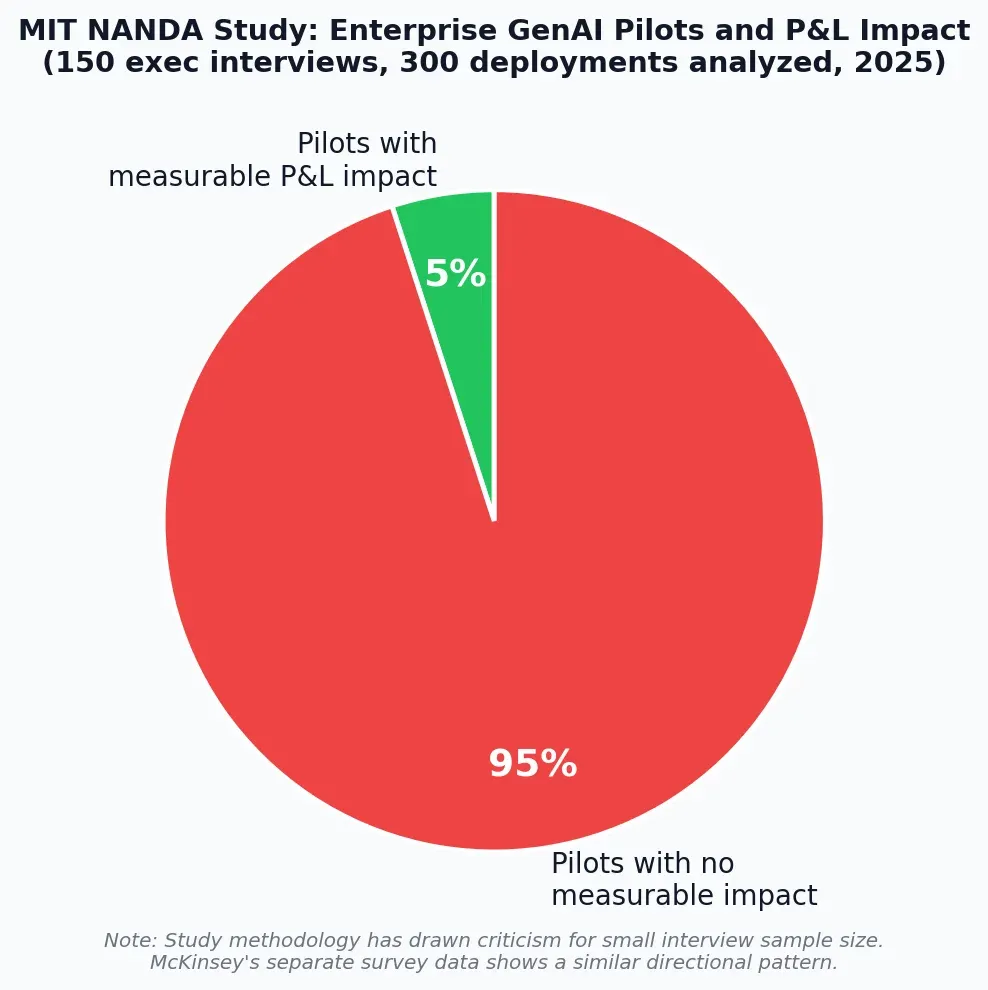
MIT NANDA’s 2025 finding on enterprise generative AI pilot outcomes. The study’s methodology, based on a relatively small interview sample, has drawn some criticism, but the directional pattern is echoed in separate McKinsey survey data.
It is worth being precise about what this study actually found rather than repeating the headline uncritically, because the number has been widely cited and occasionally misrepresented. The report’s lead author, Aditya Challapally, told Fortune that the core issue is not model quality but what the report calls a learning gap, meaning organisations have not integrated these tools into workflows in a way that produces measurable outcomes. Generic tools like ChatGPT succeed for individual productivity precisely because of their flexibility, but that same flexibility is what causes them to stall in enterprise deployments that need consistent, repeatable outcomes.
Separately, McKinsey’s own survey data, cited widely alongside the MIT figures, found that nearly 80% of companies report using generative AI, while just as many report no significant bottom-line impact from that usage. The methodology of the MIT study specifically has drawn genuine criticism, including from Marketing AI Institute, which noted the zero-return finding rested on just 52 interviews the report itself describes as directionally accurate rather than based on official company reporting. The critique is fair and worth noting. The broader directional pattern, that most enterprise AI pilots are not yet producing clear financial returns, shows up across multiple independent sources rather than resting on one contested number.
MIT’s research found roughly 5% of generative AI pilots achieve measurable P&L impact. The other 95% stall. The core problem, according to the study’s lead author, is organisational integration, not model capability.
What makes this relevant to the Fable 5 pricing story is straightforward. If prices for the most capable models rise while the majority of enterprise deployments are not yet proving out a clear financial return, the gap between AI spending and AI value widens rather than narrows. That is not an argument that AI has no value. Back-office automation, where MIT’s research found the highest actual returns despite receiving less than half the typical AI budget, is a clear counterexample. It is an argument that the easy, exploratory phase of AI adoption, where trying things at low cost made sense because the downside was small, is becoming a smaller window as the most capable models get more expensive to run.
Where Local Models Actually Stand Right Now
One reasonable response to rising frontier model costs is to ask whether local, self-hosted models can fill the gap. The honest answer in mid-2026 is partially, for specific workloads, and not yet for the kind of long, coherent, agentic work that models like Fable 5 are built for.
Local models running on consumer-grade hardware, even well-specified setups with 64GB or more of RAM, currently handle structured tasks well: parsing data against precise instructions, generating summaries from defined inputs, and similar bounded jobs where the model does not need to maintain coherence across a long, exploratory session. These tasks work particularly well in asynchronous pipelines, where a local model can run for many hours with several instances checking each other’s outputs, trading wall-clock time for the cost savings of not paying per-token API prices.
What local models are not yet reliably capable of is sustained, agentic coding work across long sessions with the kind of judgement and context retention that the frontier proprietary models currently offer. The gap is closing, and some industry observers have suggested Fable-level capability could run on consumer hardware within roughly 2 years, though that specific timeline is a prediction rather than a confirmed roadmap from any lab, and should be read with appropriate scepticism given how often specific AI capability timelines have proven optimistic in the past.
What This Actually Means for How You Use These Tools
Setting aside the uncertainty about whether Fable 5’s pricing shift is temporary or permanent, there are practical implications worth acting on regardless of which way it resolves.
Match the model to the task rather than defaulting to the most capable option for everything. Fable 5’s advantage shows up specifically in long-horizon coherence and its full 1 million token context window. For most day-to-day work, including code review, routine content generation, and shorter interactive sessions, Sonnet 5 at its current introductory pricing delivers close to Opus-level performance at a fraction of the cost. Save the most expensive model for the tasks where its specific capabilities are actually load-bearing to the outcome.
If you are running agentic workflows, invest time in prompt caching and context management rather than treating it as an optional optimisation. The difference between a cached and uncached input token is a 90% cost reduction, and that difference compounds significantly across long sessions where the same context gets re-read on every turn.
Treat AI spending the way you would treat any other measurable business input; track what specific tasks are producing quantifiable value and which ones are not. Given that the majority of enterprise AI pilots are not yet demonstrating clear returns according to the available research, the discipline of measuring before scaling matters more now than it did when trying things at near-zero marginal cost carried little risk.
The subscription-subsidised era of frontier AI access may or may not be ending permanently. What is verifiably true right now is that the most capable models are being priced and metered more precisely than before, the evidence for enterprise AI value remains genuinely mixed, and the tools for managing cost, caching, batching, and careful model selection, matter more than they did 6 months ago. Whatever comes next, understanding the actual mechanics rather than reacting to the headline is the more useful position to be in.
Sources
- Anthropic: Claude Platform Pricing Documentation — Official pricing for all Claude models. Fable 5 at $10/$50 per million tokens confirmed. Batch API 50% discount. Sonnet 5 introductory pricing through August 31, 2026.platform.claude.com. Accessed 14 July 2026.
- ClaudeFast: Claude Fable 5 Usage Credits Explained — June 9 launch, June 12 export-control suspension, June 30 lift, July 1 restoration timeline confirmed.claudefa.st. Accessed 14 July 2026.
- DigitalApplied: Claude Fable 5 Usage-Credits July 7 Pricing Guide — Deadline extensions from July 7 to July 12 to July 19. Metered credits beginning July 20, 2026.digitalapplied.com. Accessed 14 July 2026.
- TechTimes: Fable 5 Subscription Ends, Per-Token Costs and Who Gets Hit Hardest — Sonnet 5 as cost-efficient redirect. Thariq Shihipar’s public statement on restoring subscription access.techtimes.com. Accessed 14 July 2026.
- Android Headlines: Claude Fable 5 Drops Subscriptions for Pay-Per-Use Credits — BridgeMind’s independent safety classifier testing. Export control episode detail.androidheadlines.com. Accessed 14 July 2026.
- Upstash: How to Keep Claude Fable 5 Costs Under Control — Prompt caching mechanics, Batch API discount detail, cache invalidation rules.upstash.com. Accessed 14 July 2026.
- Business Insider via AOL: Sam Altman Says AI Will Eventually Be Sold Like Electricity and Water — Full quote and context from BlackRock Infrastructure Summit, March 11, 2026.aol.com. Accessed 14 July 2026.
- Robo Rhythms: Sam Altman Compared AI to Electricity — Reddit backlash detail, OpenAI founding mission context, 1,700 comment thread confirmation.roborhythms.com. Accessed 14 July 2026.
- Fortune: MIT Report, 95% of Generative AI Pilots at Companies Are Failing — Full methodology: 150 interviews, 350 employee survey, 300 deployments analysed. Aditya Challapally quote on the learning gap.fortune.com. Accessed 14 July 2026.
- Marketing AI Institute: That Viral MIT Study Claiming 95% of AI Pilots Fail — Methodology critique: 52 interviews described as directionally accurate rather than official reporting.marketingaiinstitute.com. Accessed 14 July 2026.
- Braden Kelley: McKinsey Is Wrong About AI ROI, Here’s the Real Data — McKinsey’s separate finding on the gap between AI usage and reported bottom-line impact.bradenkelley.com. Accessed 14 July 2026.
Related stories
Security
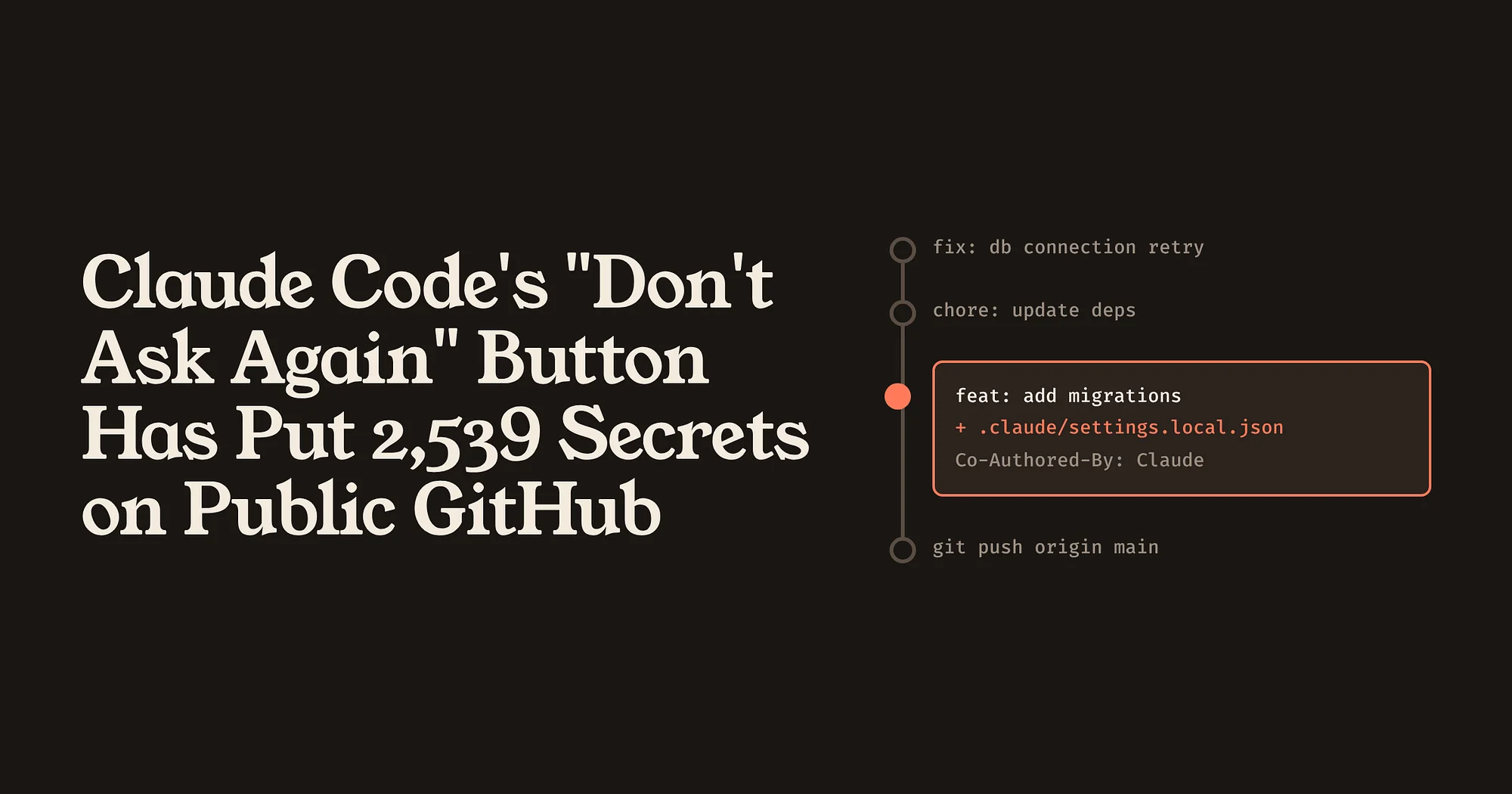
Claude Code’s “Don’t Ask Again” Button Has Put 2,539 Secrets on Public GitHub
A permission shortcut saves the exact command you approved, password included, into a project file that often gets committed. The bigger lesson is that AI coding agents have created new places for secrets to hide, and the usual scanners are not looking there.
AI & GPU compute
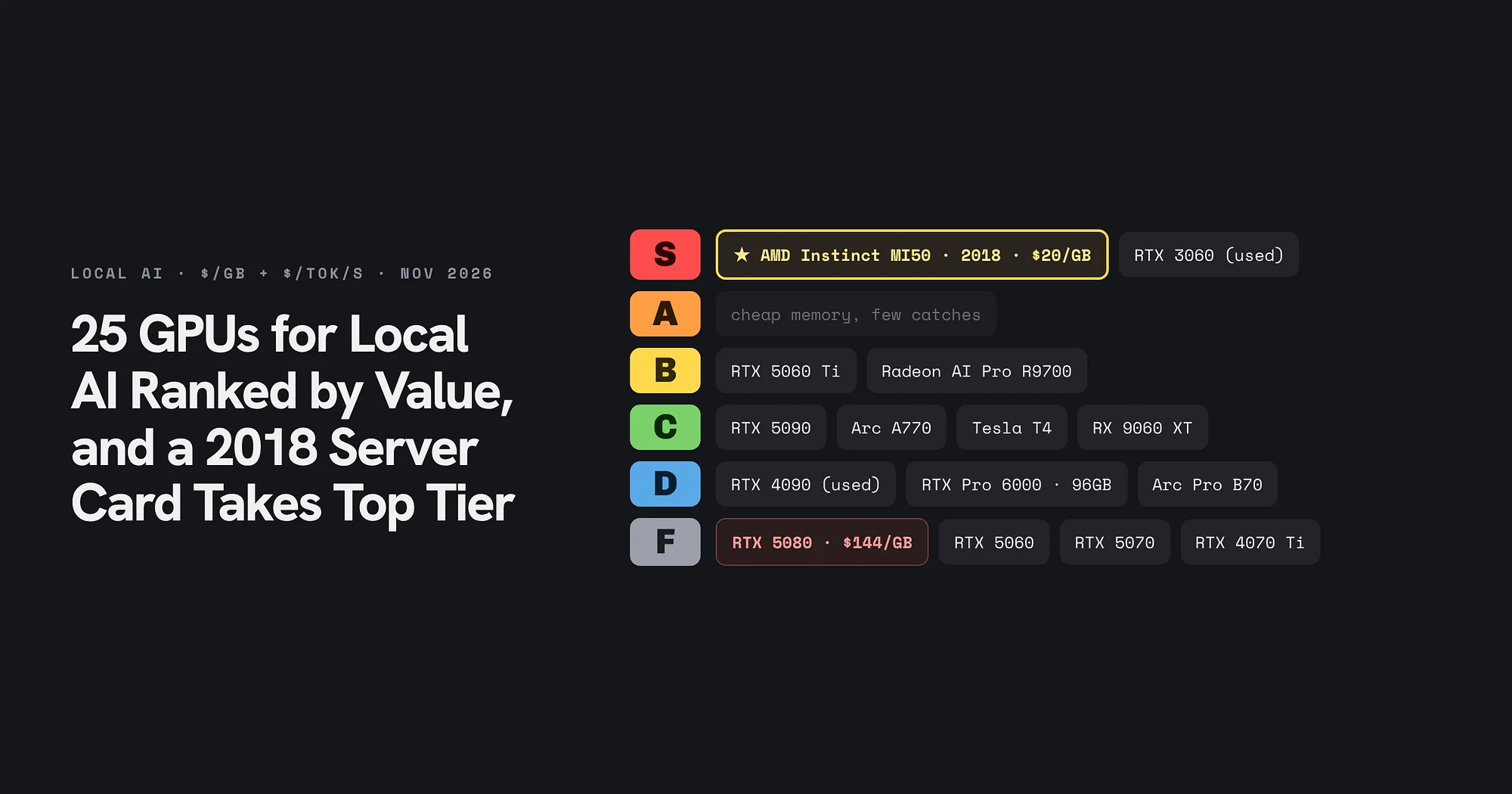
25 GPUs for Local AI Ranked by Value, and a 2018 Server Card Takes Top Tier
A November 2026 price snapshot grades 25 cards on dollars per gigabyte and dollars per token per second. The AMD Instinct MI50 and a used RTX 3060 take S tier, the RTX 5080 lands in F, and memory decides almost every grade.
AI & GPU compute
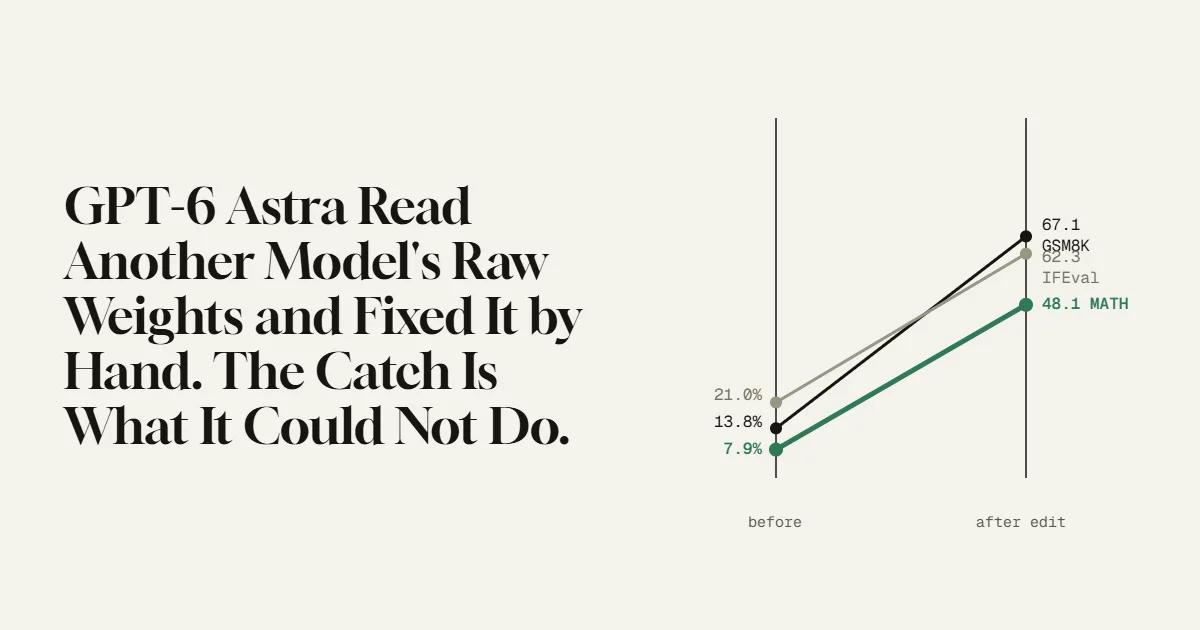
GPT-6 Astra Read Another Model’s Raw Weights and Fixed It by Hand.
MIT researchers had GPT-6 Astra edit 0.016% of a small model’s weights, with no training, and its math score jumped from 7.9% to 48.1%. The number is real and the method is strange. The limit they found in the same paper is the part worth understanding.