Are Data Centers a Good Deal for the Communities That Host Them?
We have been talking about the cloud as though it were an abstraction for years. Clean, invisible, frictionless, somewhere up there. The actual picture is less romantic.
Last verified Also on Medium
On this page
We have been talking about the cloud as though it were an abstraction for years. Clean, invisible, frictionless, somewhere up there. The actual picture is less romantic. Data centers are physical buildings in real places, consuming electricity measured in terawatt-hours, drawing water from local sources, competing for grid capacity, and collecting tax breaks that cost local governments billions of dollars annually. The AI boom has made all of this more urgent, more expensive, and harder to ignore.
The numbers are worth stating plainly. According to the International Energy Agency’s Energy and AI report, global data center electricity consumption is projected to roughly double from 415 TWh in 2024 to 945 TWh by 2030. That is approximately the entire current annual electricity consumption of Japan. AI-specific server electricity demand is growing even faster, at approximately 30% per year, well outpacing the 9% annual growth of conventional server demand. Electricity demand from data centers is now growing at about 15% per year, more than 4 times faster than the growth of total global electricity consumption from all other sectors combined.
In the United States, the trajectory is sharper still. The Brookings Institution’s April 2026 analysis draws on Department of Energy projections showing US data centers consumed about 4.4% of total US electricity in 2023, with projections ranging from 6.7% to 12% by 2028 in absolute terms, a rise from 176 TWh to potentially 580 TWh. By 2030, S&P Global reports that data centers in the US are expected to consume more electricity processing data than all energy-intensive manufacturing combined, including aluminium, steel, cement, and chemicals production. This is not a niche infrastructure question anymore.
The Promise vs the Reality of Local Economic Benefits
Countries, regions, and cities are racing to attract data centers the way they once raced to attract factories. The scale of investment is genuinely staggering. Tech companies spent an estimated $375 billion on AI infrastructure in 2025, most of it building and expanding data centers, with approximately twice that amount projected for 2026. When a hyperscaler announces a new campus, local officials hold press conferences and describe transformative economic benefits. The numbers look impressive in the headline. They look different when you examine what they actually deliver.
The core problem is one of labour intensity. Brookings published research in May 2026 analysing approximately 770 US data center facilities linked to county-level employment data from 2003 to 2024. The findings are sobering. In a typical county with 98,000 workers, a data center generates approximately 2,000 to 4,000 additional jobs after 6 years, and that figure depends on having multiple facilities in the same area. Single facilities produce modest employment gains. Meanwhile, the most automated hyperscale campuses can operate with as few as 20 to 30 permanent staff per 100 megawatts of capacity.
Good Jobs First, a nonprofit subsidy watchdog, has documented the subsidy cost per job across data center projects. The average cost of data center megadeals is $1.95 million per permanent job. In one extreme case, a New York data center promised 125 jobs in exchange for $1.4 billion in public subsidies, or $11 million per job. Compare that to $137,000 per job for economic development incentives in other sectors. Virginia, the largest data center market in the world, generates just 1 permanent job for every $13 million invested in data center infrastructure, according to a January 2026 analysis by Food and Water Watch.
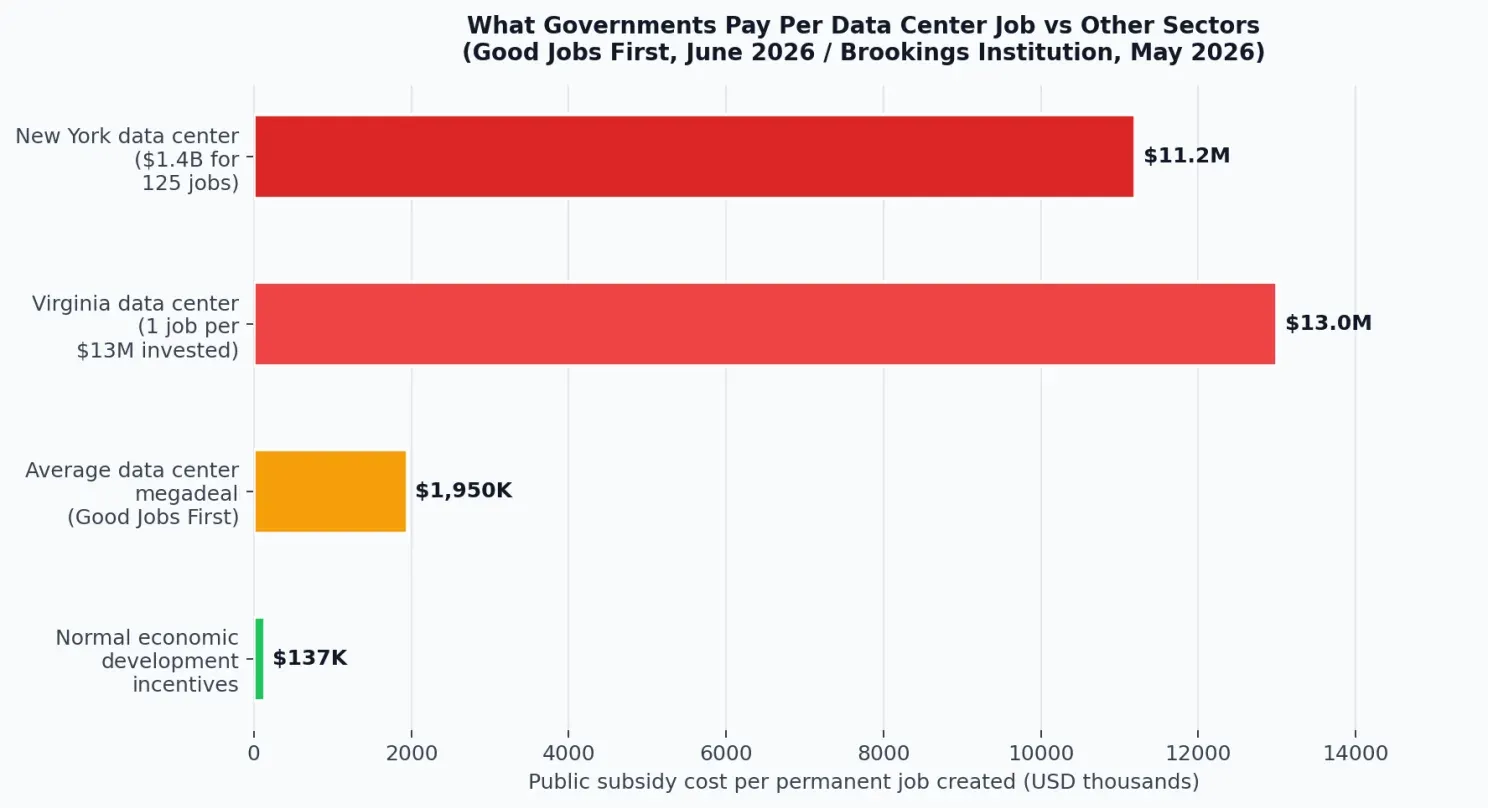
Public subsidy cost per permanent job created. Data center megadeals average $1.95M per job vs $137K for other economic development programmes. Source: Good Jobs First, June 2026 / Brookings Institution, May 2026.
The average data center megadeal costs $1.95 million per permanent job 14 times more than normal economic development incentives, often with no job creation requirement at all. By 2030, US data centers are expected to consume more electricity processing data than all energy-intensive manufacturing combined including aluminium, steel, cement, and chemicals. This is not a footnote. It is a policy emergency.
The construction jobs that accompany data center builds are real and meaningful. They are also temporary. The ribbon-cutting photo opportunity and the years of permanent employment that follow it are very different things, and the incentive packages being offered to hyperscalers are mostly calibrated around the former rather than the latter.
The Subsidy Numbers Nobody Wanted You to See
The opacity surrounding data center tax arrangements is not accidental. Good Jobs First’s November 2025 report found that at least 36 states have crafted specific subsidies for data center projects. Only 11 of those states disclose which companies receive those benefits. Virginia, the largest data center market on earth, forgoes close to $1 billion in state and local sales and use tax revenue every year without telling the public which companies benefit or how much each one receives. 14 states with relevant exemptions do not properly disclose their revenue losses at all.
The dollar amounts being forgone are not minor budget lines. Good Jobs First’s June 2026 report found that Virginia’s data center sales and use tax exemption cost $1.94 billion in fiscal year 2025. Texas projects annual losses exceeding $1.3 billion in FY 2026, rising from $1 billion in FY 2025, with cumulative losses potentially reaching $9 billion between 2025 and 2030. Ohio discovered in May 2026 that its data center tax exemption cost $1.6 billion in 2025, more than 10 times higher than its own earlier projection. Georgia raised its FY 2026 cost projection by 664%, to $2.5 billion. Indiana lost $700 million to data center tax exemptions in 2025, with more than 83% of that subsidy going to a single company.
The companies stacking these subsidies are not struggling startups. Amazon, Google, Microsoft, and Meta collectively spent an estimated $360 billion on capital expenditures in 2025, mostly building data centers. As the Brookings research confirmed, location decisions for hyperscale facilities are driven by power availability, land, and fibre infrastructure, not by tax breaks. The subsidies are not attracting investment that would not otherwise have come. They are subsidising investment that was already going to happen anyway.
The backlash to this dynamic is now visible. Brookings reports that more than 100 local communities have enacted moratoriums on data center construction. More than 300 state data center bills were filed in the first 6 weeks of 2026 alone. Virginia, Georgia, and Oklahoma, states that once competed to offer the largest tax incentives, are now reconsidering those programmes entirely. In the PJM grid region, which serves 65 million people across 13 states, power supply costs jumped from $2.2 billion to $14.7 billion in a single year, with data centers accounting for nearly two-thirds of that increase. Residential electricity rates nationally rose approximately 32% between July 2020 and July 2025. The bill is landing with people who did not agree to pay it.
The Content Question Nobody Is Asking Loudly Enough
There is a dimension to the data center expansion story that the energy and jobs debate tends to skip over. The AI models being trained and served inside these facilities did not arrive empty. They were built on the accumulated output of millions of writers, researchers, artists, programmers, journalists, and institutions who created that content without knowing it would be used as training material, and without receiving any compensation for it.
The same companies now requesting land, electricity, water, and fast-track regulatory approval from local governments are the ones that absorbed this content. The argument that AI represents a genuine public good becomes considerably harder to make when the raw material for that good was taken from the public without its consent, the physical infrastructure to exploit it is being subsidised by public budgets, and the value generated flows to a small number of shareholders in a handful of companies.
Cloudflare has begun addressing the traffic side of this with its new tools for controlling AI crawlers, described in its Your Site, Your Rules framework, and its pay-per-crawl proposal to allow content owners to charge AI crawlers for access. The principle is straightforward: the raw material of AI should not be treated as though it has no owner, no cost, and no rights. Whether that principle gets embedded into regulation or remains a technical opt-in mechanism will determine how equitable the AI economy actually becomes.
What Responsible Policy Actually Looks Like
The European Commission has a framework in place for the energy performance of data centers, linked to the Energy Efficiency Directive. Measurement is a necessary start. It is not sufficient. Setting conditions on what data centers must deliver in exchange for public support is a different, and harder, policy task.
The questions any government should be asking before approving a major data center project are not complicated. How much electricity capacity does this project consume, and what does that mean for local grid availability and residential rates? How much water does it require, and is that consistent with regional supply constraints? How many permanent jobs does it create, with what wages and under what employment conditions? What tax revenue does the local government forgo, and does that figure appear anywhere in a public document? If the renewable energy being directed to this facility could have been used to decarbonise local homes or industry, what is the opportunity cost of routing it to a proprietary AI system instead?
The Sanders and Ocasio-Cortez AI Data Center Moratorium Act, introduced in March 2026, proposed pausing all new large-scale AI data center construction until a federal review framework is in place. Whether or not that specific bill advances, the Brookings research makes the case for the underlying principle clearly. Policy is currently moving faster than evidence. Decisions about billions of dollars in public subsidies, grid capacity, and land use are being made on the basis of industry projections that overstate employment benefits by a factor of 3, according to the May 2026 academic research.
Good Jobs First’s recommendation is direct. States should sunset or substantially reform their data center sales tax exemptions, add caps on total subsidy exposure per company, require full disclosure of costs and benefits, and stop treating capital-intensive automation as equivalent to the manufacturing employment it superficially resembles. The 36-state subsidy framework for data centers was written for a different era. It was not designed to hand billion-dollar annual tax forgiveness to some of the most profitable companies in history.
AI can be a genuinely useful technology. Precisely for that reason, it should not be deployed under an extractive, opaque model subsidised by the public. If a company wants to train models using publicly created content, it should pay for that content. If it wants to build data centers in a community, it should cover the full costs. If it wants to consume water, electricity, and grid capacity, it should demonstrate that the social return justifies that consumption. That is not anti-innovation. It is the basic accounting that any other major industry is expected to provide.
The cloud has a geography. It consumes real resources in real places and creates real winners and losers. The communities asked to host it deserve a clear-eyed answer to a simple question: what do we actually get in return?
Sources
- IEA: Energy Demand from AI, Energy and AI Report, April 2026 — Data center electricity consumption 415 TWh in 2024, projected 945 TWh by 2030. AI-specific servers growing at 30% per year. 15% annual data center demand growth, 4x faster than all other sectors.iea.org. Accessed 14 July 2026.
- IEA: News Release on Data Center Energy Demand and AI, April 2026 — Data centers to drive more than 20% of electricity demand growth in advanced economies by 2030.iea.org. Accessed 14 July 2026.
- Brookings: Global Energy Demands within the AI Regulatory Landscape, April 2026 — US data centers at 4.4% of total electricity in 2023, projected 6.7% to 12% by 2028. 176 TWh to 325 to 580 TWh absolute range.brookings.edu. Accessed 14 July 2026.
- Brookings: New Evidence on Data Center Employment Effects, May 2026 –770 US facilities analysed. 2,000 to 4,000 jobs per county after 6 years. Employment estimates overstated by 3x without proper controls. 20 to 30 permanent staff per 100 MW. 100+ local moratoriums. PJM grid cost jump from $2.2B to $14.7B. 32% residential rate increase 2020 to 2025.brookings.edu. Accessed 14 July 2026.
- S&P Global: Global Data Center Power Demand to Double by 2030, April 2026 — US data centers to consume more electricity than all energy-intensive manufacturing combined by 2030.spglobal.com. Accessed 14 July 2026.
- Good Jobs First: Even Cloudier with a Greater Loss of Spending Control, June 2026 — Virginia $1.94B FY2025 loss. Texas $1.3B FY2026. Ohio $1.6B in 2025, 10x projected. Georgia 664% cost projection increase to $2.5B. Indiana 83% of subsidies to 1 company. 14 states non-disclosing.goodjobsfirst.org. Accessed 14 July 2026.
- Good Jobs First: Cloudy with a Loss of Spending Control, April 2025 — Texas revised FY2025 projection from $130M to $1B in 23 months. Virginia, Texas, Illinois all recording 1,000%+ loss spikes.goodjobsfirst.org. Accessed 14 July 2026.
- Good Jobs First: Cloudy Data, Costly Deals, November 2025 –36 states with data center subsidies. Only 11 disclose recipients. Virginia forgoes $1B without disclosing which companies benefit.goodjobsfirst.org. Accessed 14 July 2026.
- Quartz: AI Data Centers Employ Very Few People, May 2026 — $1.95M average cost per job in data center megadeals. New York case: $1.4B for 125 jobs = $11M per job. Virginia: 1 job per $13M invested. Almost half of 36 state subsidies require no job creation.qz.com. Accessed 14 July 2026.
- Data Center Dynamics: IEA Data Center Energy Consumption Set to Double by 2030, May 2026 — US consumption up 130%, 240 TWh increase. China up 170%. Europe up 70%.datacenterdynamics.com. Accessed 14 July 2026.
- Cloudflare: Your Site, Your Rules — AI Crawler Controls — Cloudflare framework enabling content owners to block or charge AI crawlers for site access.blog.cloudflare.com. Accessed 14 July 2026.
- European Commission: Energy Performance of Data Centers and the Energy Efficiency Directive — EU regulatory framework for data center energy measurement and reporting.energy.ec.europa.eu. Accessed 14 July 2026.
Related stories

Infrastructure
You Can Build a Serious Home Server for About $1,000, and It Solves a Problem Your Phone Cannot
A used enterprise server that cost a company thousands of dollars new sells for around $250 today, and with a few parts you have a private cloud that runs AI agents, stores your photos, records your cameras, and lets you walk through an airport with a phone that holds almost nothing. I went through the exact parts, the real prices in the current memory shortage, and what to actually run on it.

AI & GPU compute
Nvidia’s Board Backed Jensen Huang on Sunday. By Thursday He Was Gone.
Four days after Nvidia’s board said it had confidence in its CEO, Jensen Huang resigned. A short seller had flagged the Megaspeed connection 6 months earlier, and most of the story rests on anonymous US officials, so I separate the filed facts from the allegations.
AI & GPU compute
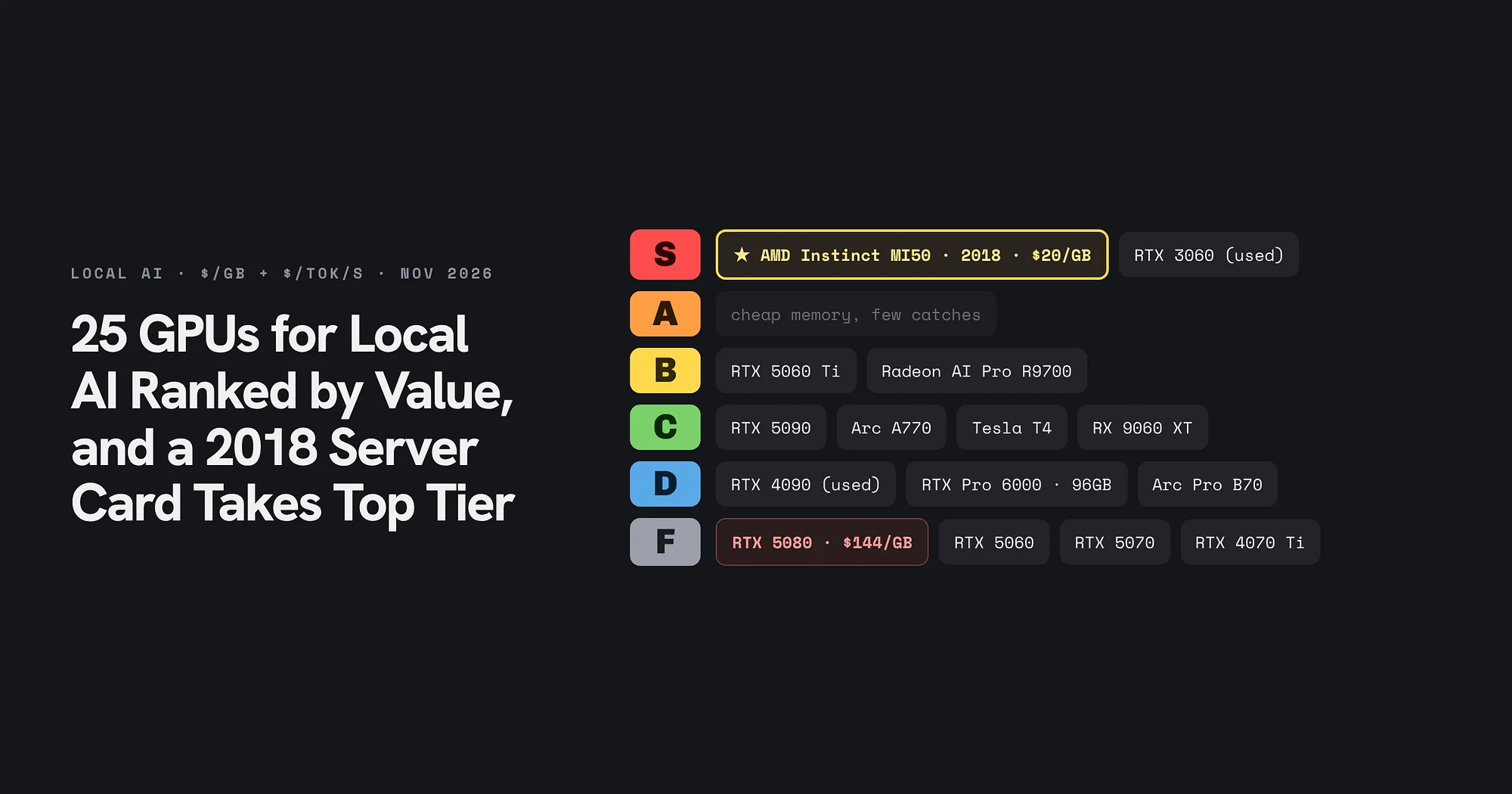
25 GPUs for Local AI Ranked by Value, and a 2018 Server Card Takes Top Tier
A November 2026 price snapshot grades 25 cards on dollars per gigabyte and dollars per token per second. The AMD Instinct MI50 and a used RTX 3060 take S tier, the RTX 5080 lands in F, and memory decides almost every grade.