Did SpaceX’s Rocky IPO Just Expose Cracks in the AI Bubble?
On June 12, 2026, SpaceX went public in what became the largest IPO in history, raising more than $85 billion and debuting at a valuation of roughly $2.77 trillion, briefly making Elon Musk the world’s first trillionaire on paper.
Last verified Also on Medium
On this page
- What an Economic Bubble Actually Means, and Why the Definition Matters Here
- Why SpaceX’s Stock Behaviour Might Not Mean What It Looks Like It Means
- OpenAI’s Financial Reality Is Now Public, and It Is Not Subtle
- Anthropic’s Very Different Position, and Why It Matters
- Update, July 14, 2026: Anthropic Disclosed Its First Profitable Quarter, and the Details Matter
- The Funding Sources That Have Kept AI Losses Afloat Are Narrowing
- What Actually Happens Next Depends on Several Open Questions
On June 12, 2026, SpaceX went public in what became the largest IPO in history, raising more than $85 billion and debuting at a valuation of roughly $2.77 trillion, briefly making Elon Musk the world’s first trillionaire on paper. Shares opened at $150 against an IPO price of $135, and within 4 days climbed to a peak of $225. Then the story changed.
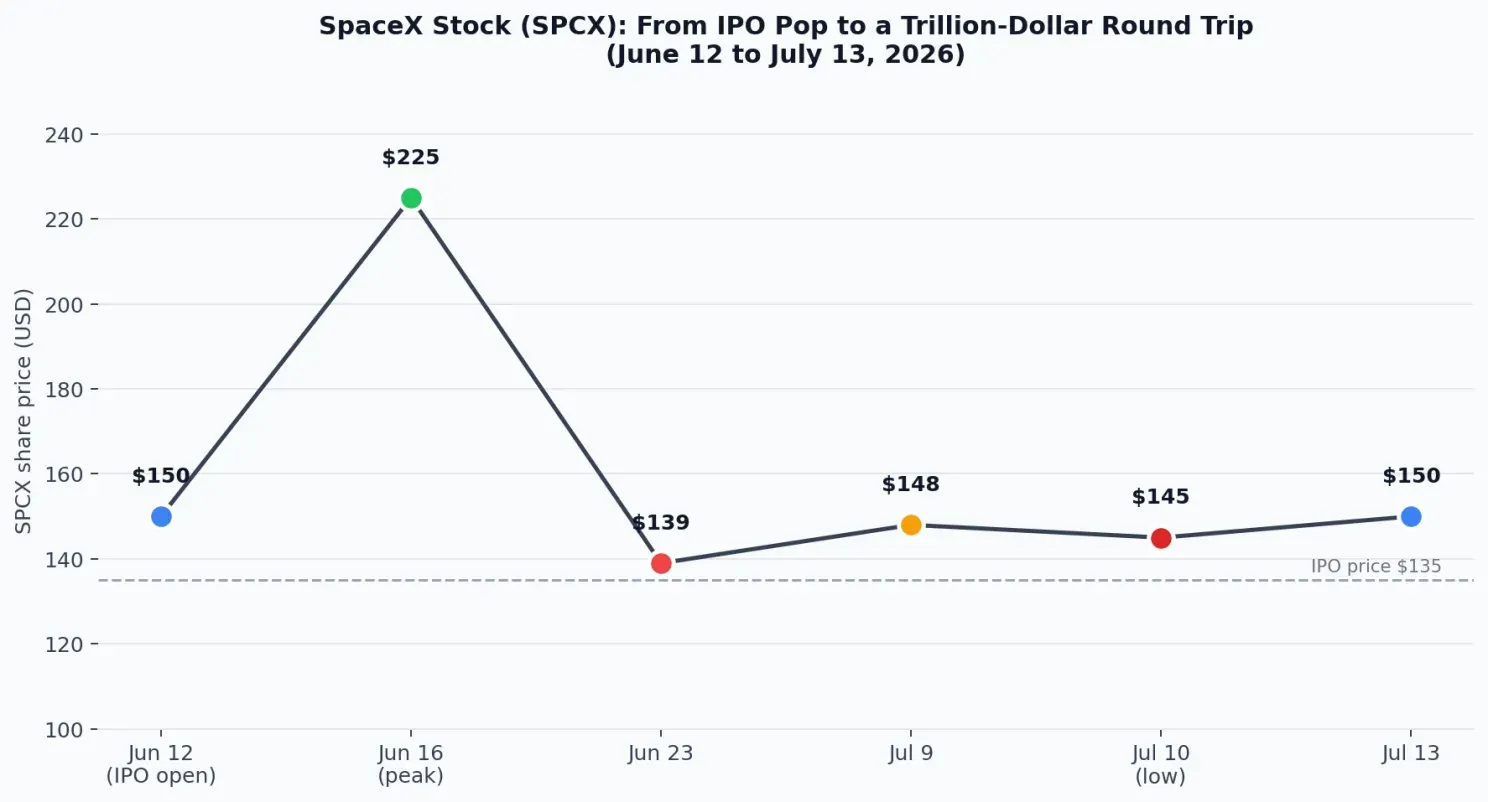
SpaceX’s stock journey from its June 12 debut through mid-July 2026. The stock briefly dipped below its IPO price before stabilising. Source: Yahoo Finance, Al Jazeera, CoinGabbar, TradingView.
By July 10, SpaceX had fallen to a new post-IPO low of $145.07, a decline of more than 36% from its peak in roughly 3 weeks, wiping out over $1 trillion in paper market capitalisation. On June 23 the stock briefly traded below its IPO price entirely before recovering, part of a broader tech sell-off that erased roughly $600 billion in value across the Nasdaq that same day.
Update as of July 14, 2026 is that the stock has continued sliding rather than stabilising. SpaceX closed at $139.14 on July 13, down 4.24% on the day, landing barely above its official $135 IPO price and more than $10 below where the stock opened on its first day of trading. That decline came the same week SpaceX priced a $25 billion bond offering that received investment-grade ratings from all 3 major rating agencies, a signal of underlying credit confidence that did not stop the equity from falling further. Wall Street’s response to the slide has been genuinely split. Evercore ISI initiated coverage on July 14 with an Outperform rating and a $230 price target, projecting SpaceX revenue and EBITDA compounding at 106% and 157% respectively through 2028. Other analysts, including a Motley Fool prediction published the same week, have argued the stock could trade down toward $100 by year-end given a roughly 51 times forward sales multiple that leaves little room for a valuation miss.
This matters far beyond SpaceX shareholders, because the AI industry has been watching this specific IPO as a bellwether for what happens when OpenAI and Anthropic eventually go public themselves. What happened to SpaceX’s stock in its first month is now shaping decisions at the very top of the AI industry.
What an Economic Bubble Actually Means, and Why the Definition Matters Here
Before going further, it is worth being precise about what the word bubble actually means in financial terms, because it gets used loosely in most AI commentary. Investopedia defines an economic bubble as a situation where assets trade at a price that greatly exceeds their intrinsic value, typically progressing through 4 recognisable stages: stealth, awareness, mania, and finally the panic stage where prices reverse and fall as quickly as they rose, with investors seeking to liquidate at any price as supply overwhelms demand.
Whether SpaceX, OpenAI, and Anthropic’s current valuations meet the greatly exceeds intrinsic value bar is a matter of genuine debate rather than settled fact. What is not in debate is that SpaceX’s post-IPO price action, a rapid speculative spike followed by a sharp and sustained pullback, is a pattern that shows up in the panic stage of Investopedia’s bubble framework. Whether that pattern generalises to the rest of the AI industry, or whether it is specific to SpaceX’s particular ownership structure and float mechanics, is the actual question worth examining.
Why SpaceX’s Stock Behaviour Might Not Mean What It Looks Like It Means
There is an important structural detail about SpaceX’s IPO that complicates any simple reading of its price action. SpaceX issued only 555 million shares in its IPO out of 13.1 billion shares outstanding, meaning less than 5% of the company was actually available for public trading at debut. The remaining 95%, held by employees and early investors, is subject to lock-up periods that begin expiring in stages over the following months. A stock with this small a float is mechanically prone to sharp price swings in both directions, since relatively small amounts of buying or selling pressure move the price disproportionately.
The lock-up schedule adds a specific reason for caution ahead. At least 20% of early-release shares, roughly 911 million shares, become eligible for public trading in late July or early August following SpaceX’s second-quarter earnings report, which would more than double the available float to around 1.5 billion shares. Additional tranches unlock at 70, 90, 105, and 120 days post-IPO. One analyst told Yahoo Finance that insiders could potentially sell as much as 44% of total shares by early September, an increase in float of roughly 900% from the current level. If a meaningful share of insiders choose to sell as those lock-ups expire, the stock could face renewed and substantial downward pressure regardless of how the underlying business is actually performing.
This is the detail that separates 2 very different interpretations of what has happened so far. One reading is that investors who bought into the IPO were speculative flippers looking for a quick gain, and the sharp reversal reflects a loss of genuine conviction in SpaceX’s valuation. The other reading is that this exact pattern, a small float, a rapid initial spike, and a subsequent correction as the market digests upcoming supply increases, is a mechanical consequence of the IPO’s structure that would occur regardless of investor sentiment about the underlying business. Both readings are consistent with the data available so far, and it will likely take the actual lock-up expiration events in August and September to determine which one is closer to correct.
OpenAI’s Financial Reality Is Now Public, and It Is Not Subtle
Whatever the correct reading of SpaceX’s stock is, its rocky debut appears to have had a direct and immediate effect on OpenAI’s own IPO planning. The New York Times reported that OpenAI is considering delaying its IPO until 2027, citing 3 people involved in the company’s internal deliberations, with SpaceX’s volatile debut cited as one factor influencing the decision. OpenAI had previously been preparing for a listing as early as this autumn.
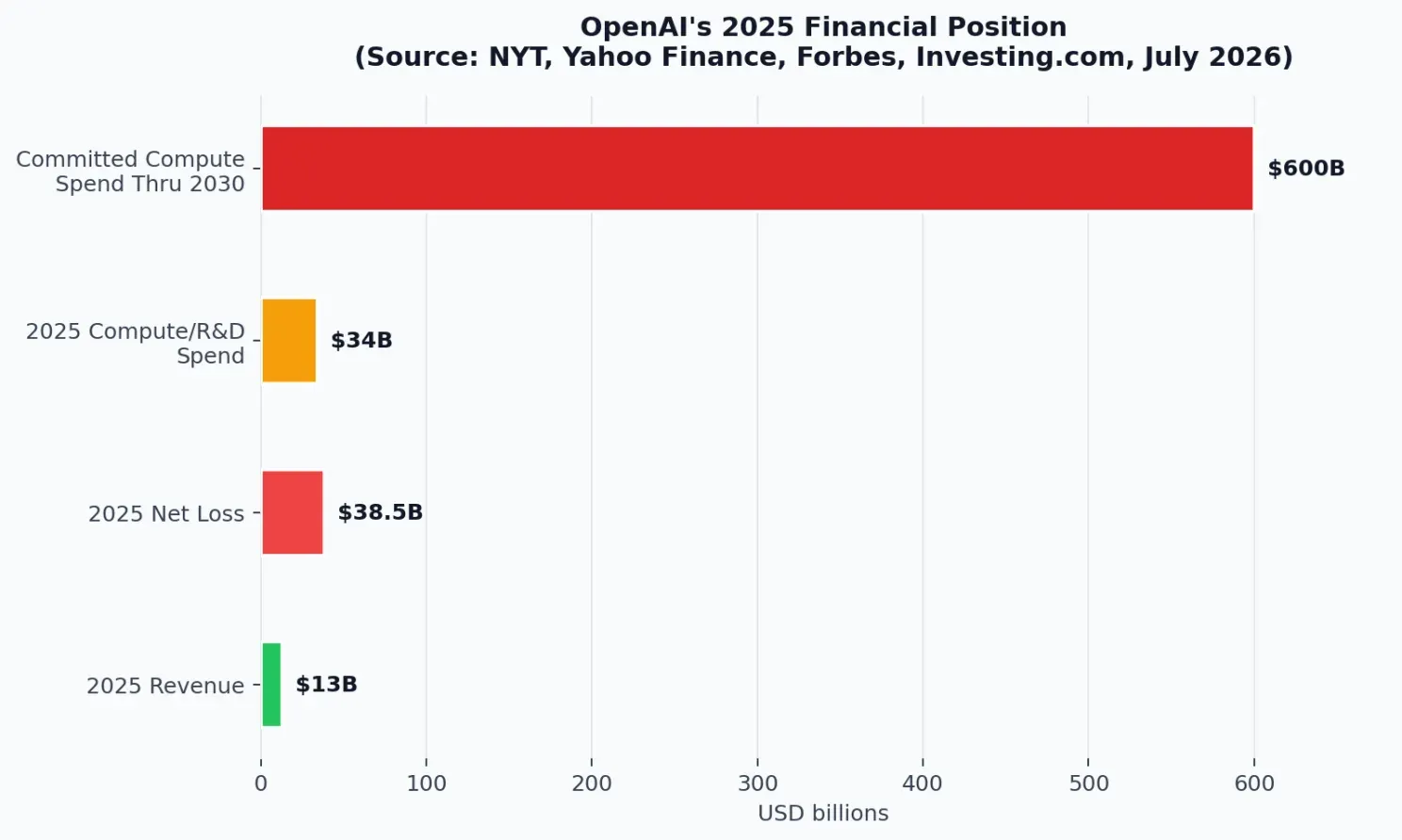
OpenAI’s disclosed 2025 financial position against its own future compute commitments. Source: New York Times reporting via Yahoo Finance, Investing.com, CoinCentral, and Quartz, June 2026.
The financial disclosures behind that hesitation are genuinely significant. OpenAI’s audited financial documents revealed a net loss of $38.5 billion for 2025 against revenue of approximately $13 billion, with total costs and expenses of $34 billion driven largely by computing infrastructure and research spending. The company has committed to roughly $600 billion in compute and hardware spending through 2030. OpenAI CEO Sam Altman has reportedly pushed advisers for a $1 trillion valuation at debut, calling any figure below that a nonstarter, according to Quartz’s reporting, which would represent a jump of roughly $270 billion above the company’s most recent private valuation of $730 billion.
OpenAI CFO Sarah Friar has reportedly favoured the more cautious 2027 timeline, citing the company’s substantial ongoing cash burn, its compute infrastructure commitments, and the operational burden of public company reporting requirements, creating some reported tension with Altman’s preference for a faster timeline. Regardless of which internal view prevails, the fundamental tension is straightforward: OpenAI is burning cash at a rate that public markets will scrutinise closely, at a moment when public market appetite for speculative growth stories has visibly cooled following SpaceX’s debut.
OpenAI posted a $38.5 billion net loss in 2025 on $13 billion in revenue, while committing to roughly $600 billion in compute spending through 2030. Its CEO has called anything below a $1 trillion IPO valuation a nonstarter.
Anthropic’s Very Different Position, and Why It Matters
Anthropic’s situation offers a genuinely useful contrast, because the company’s own leadership has been unusually candid about the specific financial risks facing the entire industry, including itself. Anthropic filed confidentially for its own IPO on June 1, 2026, a week before OpenAI’s own confidential filing, and was most recently valued at approximately $965 billion in a funding round in late May, briefly surpassing OpenAI’s private valuation at the time. Reports on the timing of Anthropic’s actual listing point toward late 2026, though as with OpenAI, no official date has been confirmed publicly.
In a February 2026 interview with podcaster Dwarkesh Patel, Anthropic CEO Dario Amodei gave one of the most direct public explanations any AI lab executive has offered of the financial tightrope these companies are walking. Asked why Anthropic was not matching the aggressive infrastructure spending of larger rivals, Amodei explained the core problem is a timing mismatch between committing to years of compute capacity and uncertain revenue growth. “If I’m just off by a year in that rate of growth, or if the growth rate is 5x a year instead of 10x a year, then you go bankrupt,” Amodei said, as reported by Fortune.
“If my revenue is not $1 trillion, if it’s even $800 billion, there’s no force on Earth, there’s no hedge on Earth that could stop me from going bankrupt if I buy that much compute,” Amodei continued.
He also criticised unnamed competitors, widely understood to reference OpenAI’s far larger compute commitments, for what he called YOLOing on spending. Anthropic’s own revenue reached an annualised run rate of approximately $14 billion in early 2026, growing roughly 10-fold per year since 2023, with the company reportedly on track for its first profitable quarter in 2026.
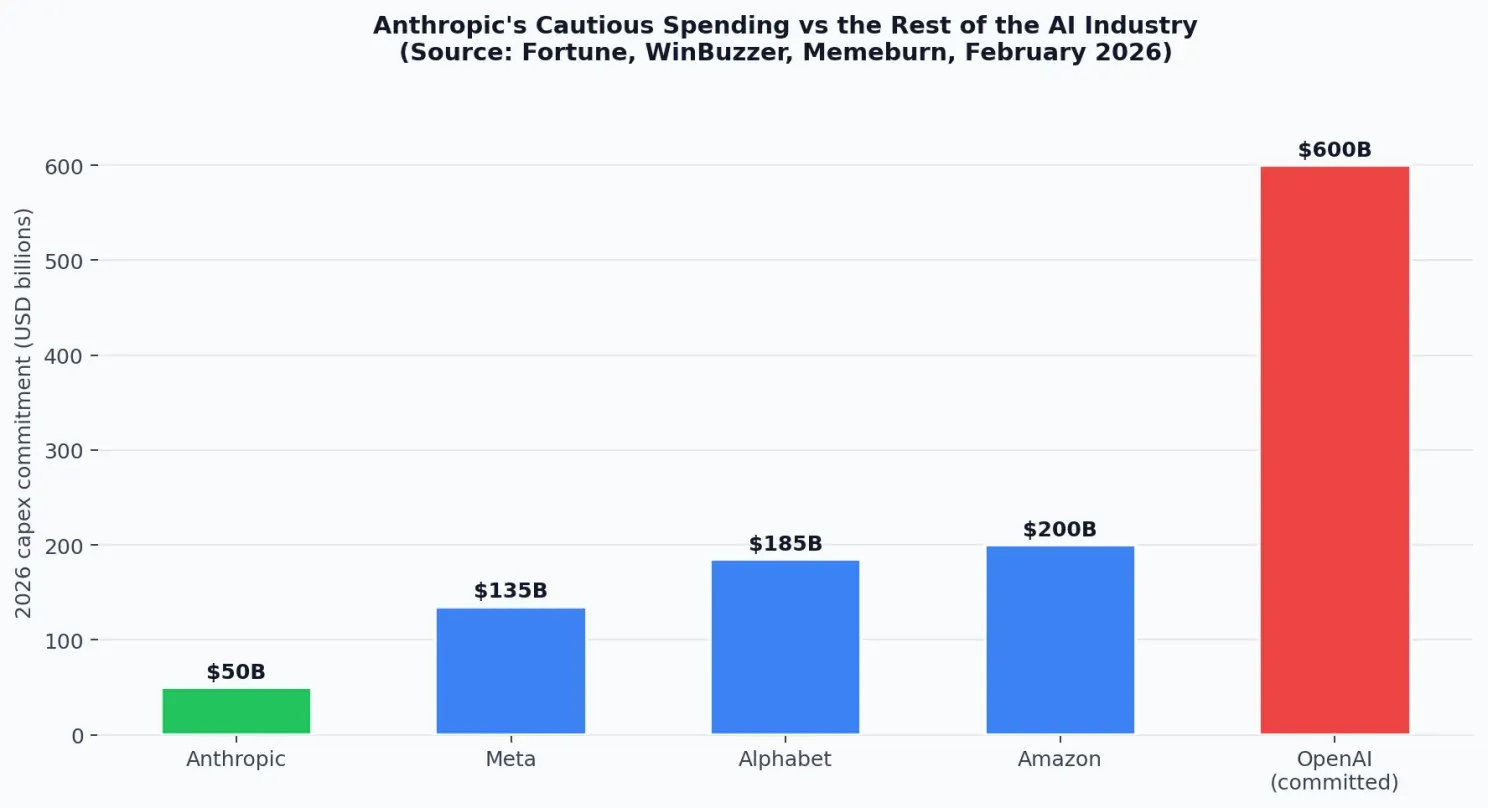
Anthropic’s 2026 infrastructure spending compared to the 3 largest hyperscalers and OpenAI’s compute commitments. Source: Fortune, WinBuzzer, and Memeburn reporting on Dario Amodei’s February 2026 Dwarkesh Patel interview.
The contrast is instructive. Anthropic has committed roughly $50 billion to US infrastructure, a fraction of Amazon’s $200 billion, Alphabet’s $185 billion, and Meta’s $135 billion in 2026 capital expenditure, and a small fraction of OpenAI’s $600 billion multi-year commitment. Amodei has explicitly framed this caution as a direct hedge against the exact bankruptcy scenario that OpenAI’s much larger spending commitments expose it to if revenue growth slows even moderately.
Update, July 14, 2026: Anthropic Disclosed Its First Profitable Quarter, and the Details Matter
Since this analysis was first written, Anthropic shared financial projections with investors that genuinely reshape the picture. The Wall Street Journal reported on May 20, 2026 that Anthropic expects Q2 2026 revenue of $10.9 billion, up 130% from the $4.8 billion the company reported in Q1, alongside a projected operating profit of approximately $559 million, its first profitable quarter in company history. For context, Anthropic’s own guidance as recently as August 2025 had suggested full-year profitability was unlikely before 2028.
The mechanism behind that swing deserves scrutiny rather than simple celebration. Anthropic’s compute cost per dollar of revenue fell from 71 cents in Q1 to a projected 56 cents in Q2, and that improvement is doing almost all of the work in turning a break-even quarter into a $559 million profit. SpaceX’s own S-1 filing disclosed that Anthropic pays SpaceX $1.25 billion per month, roughly $15 billion annually at full rate, for compute access to the Colossus data centre, and that Anthropic is receiving a discounted rate specifically during the May and June ramp-up period as it transitions onto that infrastructure. In other words, the 2 months Anthropic is using to demonstrate profitability to investors and the public are the same 2 months in which its largest single compute cost is temporarily reduced. Anthropic has directly cautioned investors, according to the same Wall Street Journal reporting, that planned spending increases later in 2026 and into 2027 are likely to swing results back into negative territory.
Independent scrutiny of the broader revenue figures has also raised legitimate questions. Journalist Ed Zitron has pointed out inconsistencies between Anthropic’s disclosed quarterly figures and prior sworn statements, including a March 2026 court filing in which Anthropic’s own CFO, Krishna Rao, stated under oath that the company’s revenue to date exceeded $5 billion, a figure that sits awkwardly against the newly disclosed $4.8 billion Q1 figure alone. The Wall Street Journal itself noted that it remains unclear what accounting methods Anthropic used to arrive at the profitability figures, since the company is not yet subject to the financial reporting requirements that apply to public companies.
None of this means the underlying enterprise growth is fabricated. Multiple independent outlets, including CNBC and Bloomberg, corroborated the same revenue figures Anthropic shared with investors, and the growth in Claude’s enterprise and coding-assistant business appears genuine and substantial. What it means is that the specific profitability milestone landed under financial conditions, a discounted compute rate during a fundraising process, that are unlikely to repeat in the second half of the year, and the claim should be read with that context attached rather than as evidence the underlying bankruptcy risk Amodei described in February has been resolved.
Separately, SpaceX’s own S-1 disclosed that its AI segment, which includes xAI and Grok, posted an operating loss of $6.4 billion in 2025, a detail worth noting given SpaceX’s own compute relationship with Anthropic and the broader picture of circular spending across the AI infrastructure ecosystem that this article discusses below.
The Funding Sources That Have Kept AI Losses Afloat Are Narrowing
The broader industry context that makes IPO timing genuinely consequential, rather than a matter of simple preference, is that the AI industry has funded years of substantial losses through private capital, and that private capital pipeline is showing real signs of strain.
Venture capital firms have deployed extraordinary sums into AI over the past 3 years, and the largest technology companies backing frontier labs through partnerships and investment are themselves approaching practical limits on how much additional capital they can commit without affecting their own balance sheets and credit ratings. The corporate bond market has also absorbed a significant volume of AI-linked debt issuance, and rising borrowing costs on that debt are a genuine signal that investors are demanding higher compensation for the risk involved in continuing to fund this level of spending.
Going public, opening access to retail investor capital through public equity markets, is the remaining large pool of capital that AI labs have not yet substantially tapped. That is the structural reason IPO timing matters so much right now for both OpenAI and Anthropic. It is not simply about maximising valuation at debut. It is about which pool of capital becomes available to fund continued losses once existing private funding sources reach their practical limits.
What Actually Happens Next Depends on Several Open Questions
There are genuine uncertainties here worth naming rather than glossing over. Whether SpaceX’s stock stabilises or falls further as lock-up periods expire through August and September is not yet determined. Whether OpenAI’s reported IPO delay to 2027 actually happens, or whether the company proceeds sooner at a lower valuation than Altman’s stated target, remains unresolved. Whether Anthropic follows a similar delayed timeline, given persistent but unverified rumours to that effect, is also unconfirmed by any major outlet as of this writing.
What is verifiable is that Sam Altman himself has publicly acknowledged uncertainty about timing. “I didn’t know whether the company would be going public this year,” Altman told CNBC’s Julia Boorstin, according to reporting on the IPO filing status of both companies. Both OpenAI and Anthropic have confidentially filed IPO paperwork with the SEC, which is a standard preparatory step that does not commit either company to a specific timeline.
As of July 14, 2026, the broader picture has sharpened somewhat without fully resolving. TechCrunch reported that SpaceX, Anthropic, and OpenAI’s combined public and pending listings will generate more value than all US venture-backed exits since the year 2000 combined, based on NVCA-Pitchbook Venture Monitor data, a scale comparison worth sitting with regardless of how any individual IPO timeline resolves. Anthropic is reportedly still tracking toward a listing before the end of 2026, while OpenAI’s timeline remains the more contested of the two, with reporting continuing to describe internal disagreement between a faster 2026 push favoured by Altman and a more cautious 2027 preference reportedly favoured by CFO Sarah Friar.
Whether SpaceX’s rocky first month in public markets turns out to be a leading indicator for the broader AI industry, or simply a company-specific story driven by an unusually small IPO float and predictable lock-up mechanics, is not something that can be resolved from the data available right now. What can be said with confidence is that the largest AI labs are watching this exact situation closely, that the timing of their own public listings has become a genuinely consequential decision rather than a formality, and that the underlying financial pressures, mounting losses at OpenAI, Amodei’s own explicit bankruptcy scenario, and a private capital market showing signs of exhaustion, are real regardless of how the SpaceX story specifically resolves.
The honest position is that nobody, including the people running these companies, currently knows how this plays out. What is worth tracking is not a single dramatic headline but the specific, checkable events ahead: SpaceX’s lock-up expirations in August and September, whether OpenAI’s IPO timeline slips further or accelerates, and whether Anthropic’s reported late-2026 target holds. Those are the actual signals that will resolve the uncertainty this article has tried to lay out honestly rather than predict.
Sources
- Yahoo Finance: SpaceX Stock Tumbles 16.4%, Shaving Off Most IPO Gains Since Debut — IPO price $135, opening price $150, June 12 debut date confirmed.finance.yahoo.com. Accessed 15 July 2026.
- The Motley Fool: SpaceX Stock Down 20,000 Worth This Much Mid-2027 — Float mechanics: 555 million IPO shares of 13.1 billion outstanding. Lock-up schedule detail through September 2026.fool.com. Accessed 15 July 2026.
- Al Jazeera: SpaceX Shares Drop Below Debut Price Before Jumping Amid $600bn Sell-off — June 23, 2026 tech sell-off context. Reflection AI compute deal detail.aljazeera.com. Accessed 15 July 2026.
- TradingView: SpaceX Stock Price, Chart and IPO Details — All-time high $225.64 on June 16. All-time low $145.07 on July 10, 2026.tradingview.com. Accessed 15 July 2026.
- Investopedia: Bubble Definition — 4-stage bubble framework: stealth, awareness, mania, panic.investopedia.com. Accessed 15 July 2026.
- Yahoo Finance: OpenAI May Delay Blockbuster IPO to 2027 — NYT sourcing on IPO delay consideration. $38.5 billion net loss figure confirmed.finance.yahoo.com. Accessed 15 July 2026.
- Investing.com : OpenAI May Delay Blockbuster IPO to 2027 — $34 billion compute and R&D spend breakdown.investing.com. Accessed 15 July 2026.
- Quartz: OpenAI May Delay IPO to 2027 Over Valuation Concerns — Altman’s $1 trillion valuation target, described as a nonstarter below that figure. SoftBank stock reaction.qz.com. Accessed 15 July 2026.
- Yahoo Finance: OpenAI Could Reportedly Delay IPO After SpaceX Scare — Sarah Friar’s cautious 2027 preference and reported tension with Altman.finance.yahoo.com. Accessed 15 July 2026.
- Forbes: OpenAI Considers Delaying IPO to 2027 After SpaceX’s Rocky Debut — Anthropic’s June 1 confidential filing date and $965 billion valuation confirmed.forbes.com. Accessed 15 July 2026.
- Fortune: Anthropic CEO Dario Amodei Explains His Spending Caution — Full Dwarkesh Patel interview quotes on bankruptcy risk, February 2026.fortune.com. Accessed 15 July 2026.
- Memeburn: Anthropic CEO Warns One Wrong Year Could Mean Bankruptcy — $50 billion Anthropic infrastructure commitment vs hyperscaler capex figures.memeburn.com. Accessed 15 July 2026.
- WinBuzzer: Anthropic CEO Warns AI Firms Risk Bankruptcy Over Timing — Anthropic revenue growth trajectory from zero in 2023 to $14 billion annualised in early 2026.winbuzzer.com. Accessed 15 July 2026.
- The Motley Fool: Why SpaceX Stock Sank Today, July 13, 2026 — Close at $139.14, down 4.24%. Starship Flight 13 FAA clearance confirmed for July 16.fool.com. Accessed 15 July 2026.
- 24/7 Wall St: Wall Street Has a New SpaceX Bull, July 14, 2026 — Evercore ISI Outperform initiation, $230 price target, 2026–2028 revenue and EBITDA growth projections.247wallst.com. Accessed 15 July 2026.
- Let’s Data Science: Anthropic Projects $559 Million Q2 Operating Profit on $10.9 Billion Revenue — Full breakdown of the 71-cent to 56-cent compute cost shift and the underlying WSJ, CNBC, and PYMNTS reporting.letsdatascience.com. Accessed 15 July 2026.
- Where’s Your Ed At: Anthropic’s Profitability Swindle — Ed Zitron’s critical analysis of the SpaceX Colossus compute discount timing and prior revenue disclosure inconsistencies.wheresyoured.at. Accessed 15 July 2026.
- Analytics Drift: Anthropic Projects First Profitable Quarter With $10.9 Billion in Q2 Revenue — SpaceX S-1 disclosure of the $1.25 billion monthly Colossus compute payment and its discounted ramp-up rate.analyticsdrift.com. Accessed 15 July 2026.
- Yahoo Finance: Anthropic on Track for First Profitable Quarter — SpaceX’s AI segment (xAI/Grok) operating loss of $6.4 billion in 2025, disclosed in its own S-1 filing.finance.yahoo.com. Accessed 15 July 2026.
- TechCrunch: Anthropic, OpenAI, and SpaceX Are Bigger Than the Last 25 Years of Tech Exits, July 9, 2026 — NVCA-Pitchbook Venture Monitor comparison to all US VC-backed exits since 2000techcrunch.com. Accessed 15 July 2026.
Related stories
AI & GPU compute
Elon Musk Predicted a Die Off for 200 AI Neoclouds. CoreWeave’s Bonds Had Already Hit 15%.
Musk says debt markets have shut on companies that only rent out AI chips. The bond market reached that view before he posted it, and the bigger lesson is how much of the AI boom now runs on rented chips and borrowed money.
AI & GPU compute
The AI Industry Built a $5 Trillion Debt Pile on One Bet. That Bet Is Not Paying Off.
Something shifted in the AI narrative over the past few months, and it is worth paying attention to. The CEOs who spent years telling anyone who would listen that AI would eliminate entire categories of human work have gone quiet on that point.

Crypto & markets
Richard Heart Beat the SEC on a Technicality, Then His Own Tax Office Caught Up With Him in…
On 14 October 2026, Turkish police arrested the founder of Hex and PulseChain on an Interpol red notice issued for Finland, which suspects him of gross tax evasion. He had walked away from a $1 billion SEC case 18 months earlier, not because a court cleared him, but because the judge found no US jurisdiction. I went through the whole arc, the sacrifice mechanism, the allegations, the dismissal that was not an acquittal, and a blockchain whose biggest customer was its own founder.