Jamie Dimon Called Brian Armstrong Full of It… Twice. Here Is What He Is Actually Afraid Of.
The CEO of the largest bank in the United States called the CEO of the largest crypto exchange in America full of it, in those exact words, on 2 separate occasions.
Last verified Also on LinkedIn
On this page
- What Dimon Is Actually Objecting To
- The Deposit Flight Numbers the Banking Lobby Is Using
- The Part That Undercuts the Systemic Risk Argument Entirely
- The Hypocrisy That Is Hard to Look Past
- The Compromise That Collapsed, and the August Deadline That Matters
- The Wild Card That Makes Washington’s Decision Less Consequential Than It Looks
- The Volume Numbers That Show This Is Not a Speculative Sideshow
- What This Actually Comes Down To
The CEO of the largest bank in the United States called the CEO of the largest crypto exchange in America full of it, in those exact words, on 2 separate occasions. Jamie Dimon reportedly told Brian Armstrong “you are full of s — -” during a private meeting at the World Economic Forum in Davos in January 2026, according to people familiar with the exchange who spoke to the Wall Street Journal. He repeated a version of the same sentiment publicly on Fox Business’s Mornings with Maria in late May, telling host Maria Bartiromo, “He’s full of s — -. If he wants to be a bank, be a bank,” adding, “No one is going to bow down to this guy, okay, or that company.”
This is not a minor personality clash between 2 executives who dislike each other. It is a genuine policy fight over a specific piece of legislation, with trillions of dollars in bank deposits sitting on one side of the argument and a fast-growing crypto product on the other. Understanding what the fight is actually about, and whether the stated justification holds up against the available evidence, is worth doing carefully rather than picking a side based on which CEO seems more likeable.
What Dimon Is Actually Objecting To
At the center of the dispute is the Digital Asset Market Clarity Act, often shortened to the Clarity Act, a crypto market structure bill working its way through the Senate. Dimon’s specific objection, as he stated on Fox Business, is that the bill “allows them to effectively pay interest on deposits, stablecoins or something like that, without protection that they should have.” His argument, in plain terms, is that if a crypto platform pays a return on the dollars parked with it, that platform is functionally taking deposits like a bank, but without carrying any of the burdens a real bank carries: FDIC insurance, capital requirements, liquidity rules, anti-money-laundering obligations, and routine oversight from what Dimon has previously noted is roughly 84 separate regulators overseeing JPMorgan alone.
Coinbase’s response to the public jab was notably restrained. Armstrong called the exchange “kind of sad”, said he had a lot of respect for Dimon, and posted a hockey-themed rivalry meme depicting the 2 of them as opposing players. Underneath the polite tone, Coinbase’s substantive argument through Armstrong and chief policy officer Faryar Shirzad has been direct: the banks are trying to ban their own competition using regulatory language rather than competing on the merits of the product.
Ripple CEO Brad Garlinghouse made the financial stakes explicit in a June 11 post, arguing Dimon is trying to “protect and dig a deeper moat around a business that is extremely profitable for them.” That business is JPMorgan’s payments and deposit operation, which by some industry estimates generates tens of billions in annual revenue and several billion dollars in profit specifically from the spread between what the bank pays depositors and what it earns lending that same money out or holding it in Treasuries.
The Deposit Flight Numbers the Banking Lobby Is Using
The banking industry’s public case rests on a specific number that sounds genuinely alarming. Bank of America CEO Brian Moynihan has warned that up to $6 trillion, roughly 35% of all US bank deposits, could leave the banking system if yield-bearing stablecoins become widely available. The Independent Community Bankers of America has separately warned that small banks specifically could lose $1.3 trillion in deposits, cutting lending capacity by roughly $850 billion. Those figures, repeated across banking industry testimony and lobbying materials, are the foundation of the argument that yield-bearing stablecoins represent a genuine systemic risk that justifies restricting them.
The White House’s own Council of Economic Advisers ran the actual modeling on this question, and the results directly contradict the scale of the banking industry’s warnings. The CEA’s April 2026 analysis found that banning stablecoin yield entirely would increase total US bank lending by approximately $2.1 billion, an increase of roughly 0.02% in aggregate credit. For community banks specifically, the modeled benefit was even smaller: approximately $500 million in additional lending, an increase of 0.026%. Even under what the report describes as a stacked worst-case scenario, requiring the stablecoin market to grow sixfold from its roughly $300 billion size at the time, community bank lending would rise by just 6.7%, or about $129 billion, a fraction of the trillions being cited by industry lobbyists.
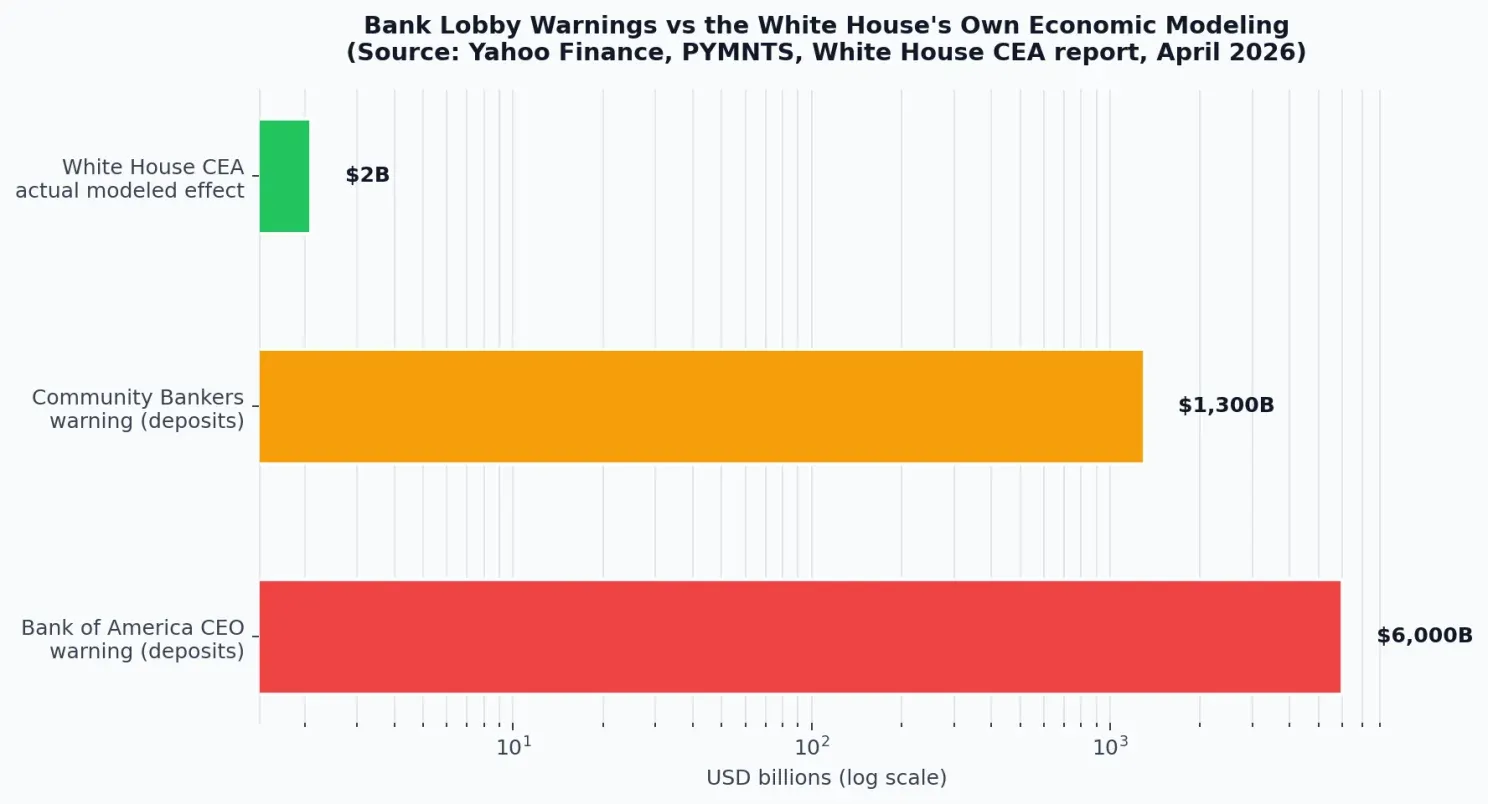
Bank executive warnings about deposit flight risk against the White House’s own economic modeling of the actual effect. Note the logarithmic scale, required because the gap between the claims is roughly 3 orders of magnitude. Source: Yahoo Finance
The report goes further, calculating the consumer cost of a ban rather than only the bank lending benefit. Banning stablecoin yield would come at a net welfare cost of approximately $800 million, reflecting the value consumers lose from forgoing competitive returns on their digital dollar holdings. Put plainly, the CEA’s own modeling suggests a ban would protect the banking system’s lending capacity by roughly 0.02% while costing consumers an estimated $800 million in forgone benefit, a trade that does not favour the restriction on the numbers presented.
The banking lobby’s response has been to dispute the question the CEA asked rather than its math. The American Bankers Association argued the report analysed the wrong scenario entirely, writing that focusing on the effects of a prohibition “risks creating a misleading sense of safety by avoiding the much more consequential scenario: yield-paying payment stablecoins scaling quickly.” This is a fair methodological point worth taking seriously rather than dismissing outright. Modeling the effect of a ban today is a different question from modeling what happens if the stablecoin market grows substantially larger with yield intact, and reasonable economists could genuinely disagree about which scenario matters more for policy.
The White House’s own modeling found banning stablecoin yield would boost bank lending by 0.02%, while costing consumers an estimated $800 million in forgone benefits. Banks are citing figures 3,000 times larger than what the government’s own economists found.
The Part That Undercuts the Systemic Risk Argument Entirely
Whatever the merits of the deposit flight debate, the legal structure of stablecoins makes the specific fear Dimon has voiced considerably harder to sustain. The GENIUS Act, the stablecoin framework signed into law in July 2025, explicitly requires issuers to maintain reserves on at least a one-to-one basis, held in cash, insured bank deposits, short-dated Treasury bills, or similarly liquid, safe assets. Critically, issuers are legally barred from lending those reserves out.
This is the detail that separates a stablecoin issuer from an actual bank in a way that matters enormously for systemic risk. A traditional bank takes your deposit and lends it out many times over through fractional reserve banking, which is precisely the mechanism that produces bank runs when depositors lose confidence simultaneously. A GENIUS Act compliant stablecoin issuer cannot legally do this. The dollars backing the token sit in reserve rather than being re-lent, which means the specific blow-up scenario Dimon has warned about publicly does not map cleanly onto how these instruments are actually structured under current law.
The Hypocrisy That Is Hard to Look Past
Here is where the story stops being a straightforward policy disagreement. While Dimon has spent months publicly working to restrict yield-bearing digital dollars for everyone else, JPMorgan has been building its own tokenized dollar. JPM Coin, ticker JPMD, moved from a pilot phase into live institutional use in November 2025, issued natively on Base, the public Ethereum layer-2 blockchain built and operated by Coinbase, the same company run by the executive Dimon called full of it.
JPMorgan’s position is that JPMD is legally distinct from a reserve-backed stablecoin: it is a direct, tokenized claim on an actual bank deposit rather than a separate reserve-backed instrument, and it remains restricted to institutional clients who pass full KYC and compliance checks rather than being available to retail users. That is a genuine legal distinction, not a semantic one. But Kinexys global co-head Naveen Mallela told Bloomberg that deposit tokens give institutions an edge over stablecoins specifically because they “can be yield-bearing,” which is precisely the feature Dimon has spent months arguing crypto platforms should not be allowed to offer without bank-style regulation.
Dimon’s own April 6 shareholder letter is the clearest evidence that JPMorgan sees this as existential competition rather than a minor product experiment. In that letter, he described blockchain-based rivals including stablecoins, smart contracts, and tokenization broadly as “a whole new set of competitors that are emerging,” referred to stablecoins as a potential alternative to bank deposits, and told shareholders the bank needed to move faster to compete. Weeks later, he was on national television describing the same competitive threat as an illegitimate loophole that Congress should close.
The Compromise That Collapsed, and the August Deadline That Matters
The Clarity Act’s path through the Senate has been genuinely difficult, and stablecoin yield is only one of 3 sticking points. Democrats have pushed for stricter ethics provisions addressing potential profit conflicts for government officials with crypto holdings. Law enforcement groups have raised concerns about developer protection language in the bill potentially creating enforcement gaps. On the yield question specifically, Senators Thom Tillis and Angela Alsobrooks brokered a compromise that bans passive rewards paid simply for holding a balance, while permitting activity-based rewards tied to actual transactions, payments, or liquidity provision. Coinbase backed the updated bill ahead of the Senate Banking Committee’s May 14 markup, which advanced the legislation by a vote of 15 to 9.
JPMorgan and the American Bankers Association rejected even that compromise, calling activity-based rewards a disguised idle-holding loophole and continuing to push for tighter restrictions. Dimon’s public position remains unambiguous: “We’ll fight it. If we lose, we lose and we’ll live.”
Prediction markets are treating the bill’s passage as close to a coin flip. Galaxy Research’s Alex Thorn has given the bill roughly 70% odds of passing before the August recess, while Polymarket traders have priced it closer to 61%. The Senate’s summer recess is the deadline that carries real weight. If leadership does not bring the bill to a floor vote before recess, its odds of passing this year decline substantially as Congress turns to defense appropriations and midterm campaigning.
The Wild Card That Makes Washington’s Decision Less Consequential Than It Looks
While the Clarity Act negotiations were still unresolved, the market moved anyway. On June 30, 2026, a consortium of more than 140 companies launched Open USD, ticker OUSD, run by an independent entity called Open Standard, with founding partners including Visa, Mastercard, American Express, Stripe, Coinbase, BlackRock, BNY, Google, and Shopify. Bridge co-founder Zach Abrams serves as Open Standard’s founding CEO.
What makes OUSD structurally different from Circle’s USDC or Tether’s USDT is the reserve yield model. Existing issuers keep the interest earned on the Treasury bills and cash backing their tokens as company profit. OUSD is designed to let partner businesses mint and redeem the token with no fees and no volume caps, while distributing nearly all of the reserve yield back to the partners actually using the token, after a small management fee retained by Open Standard. It is, in effect, the yield-sharing model that Dimon has spent months fighting Congress to restrict, being built voluntarily by some of the largest payment and financial institutions on Earth, independent of what Washington decides.
The market’s reaction to the announcement was immediate and severe. Circle’s stock fell as much as 17% on the day of the announcement, closing down roughly 16.5%, its sharpest single-day decline since the company’s IPO, extending a broader pullback that has left the stock down more than 55% from its mid-May highs. Some analysts, including ARK Invest’s Lorenzo Valente, have raised legitimate doubts about whether a 140-plus member consortium can move fast enough to actually compete, pointing to the mixed track record of prior consortium stablecoin efforts like Diem. It is also worth noting that OUSD is not live yet; the token is expected to launch later in 2026, starting on Solana, and the exact partner roster has already shown some churn since the initial announcement.
On June 30, 2026, Visa, Mastercard, Stripe, Coinbase, and BlackRock launched a stablecoin designed to share yield with the businesses using it. Circle’s stock fell 17% that day. This is the exact model Jamie Dimon has spent months fighting in Congress, being built voluntarily by the industry itself.
The Volume Numbers That Show This Is Not a Speculative Sideshow
Whatever happens with the Clarity Act or OUSD specifically, the broader stablecoin market has reached a scale that makes this a genuinely significant piece of financial infrastructure rather than a niche crypto product. Visa’s Onchain Analytics dashboard, developed jointly with Artemis, Allium Labs, and Castle Island Ventures to filter out bot activity and exchange rebalancing, recorded adjusted stablecoin transaction volume of $1.79 trillion in June 2026, a 63% increase from May’s $1.1 trillion and a 125% increase year over year, narrowly surpassing the previous record of $1.78 trillion set in February 2026.
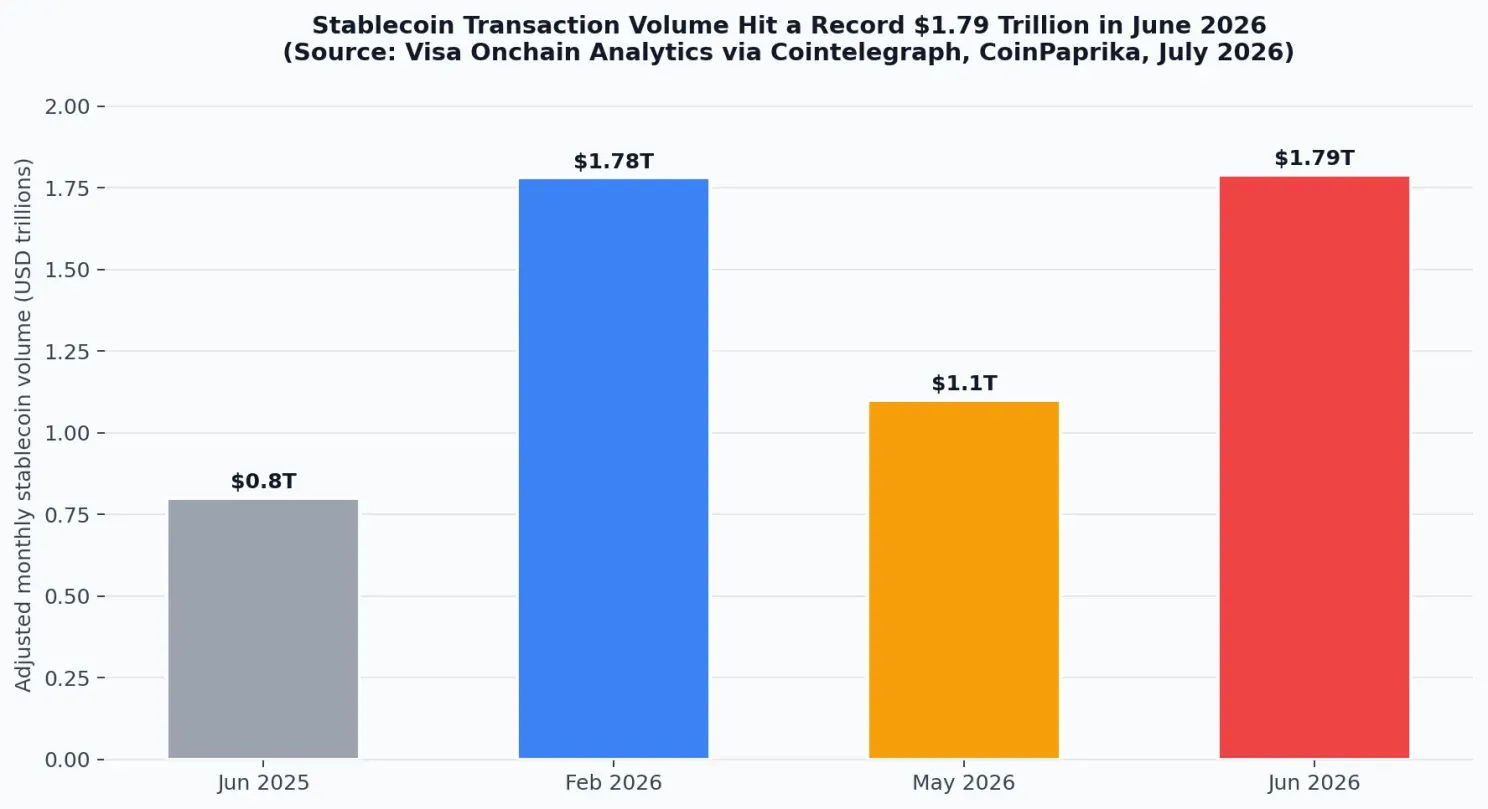
Adjusted monthly stablecoin transaction volume, filtering out bot and exchange-rebalancing activity to show genuine economic usage. Source: Visa Onchain Analytics dashboard, via Cointelegraph and CoinPaprika, July 2026.
What makes this figure particularly notable is the timing. This record came during a broader crypto market downturn, meaning the growth reflects real payment, settlement, and DeFi usage rather than speculative trading activity. “This surge underscores the growing role of stablecoins as essential infrastructure for value transfer, liquidity provision, and decentralized finance activity that persists independently of speculative price movements,” Nick Ruck, director at LVRG Research, told Cointelegraph.
The network breakdown contains a detail that adds a genuine layer of irony to the whole dispute. Base, Coinbase’s Ethereum layer-2 network, handled the largest share of stablecoin volume in June at $565 billion, roughly 31.5% of the total, narrowly ahead of Ethereum’s mainnet at $562 billion. Base is the exact network JPMorgan chose to issue its own JPMD deposit token on.
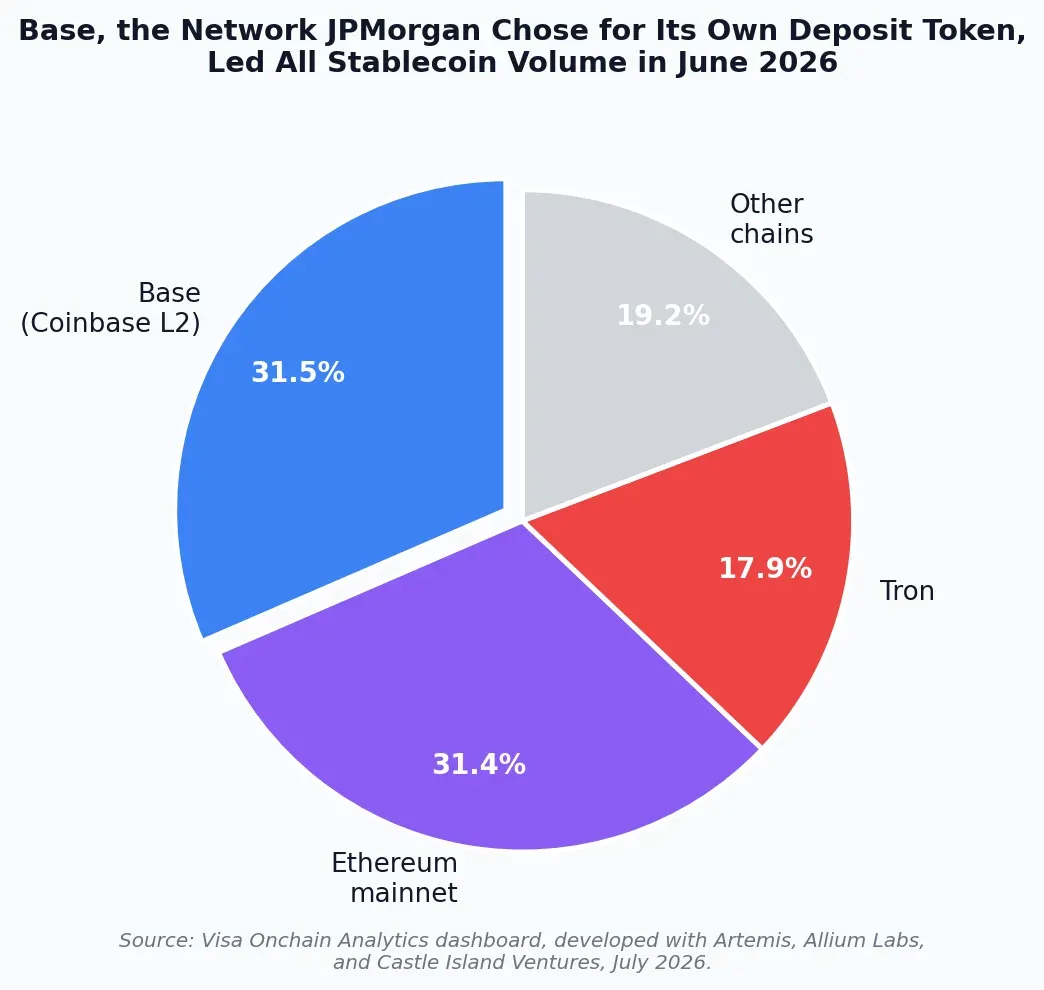
Network share of adjusted stablecoin transaction volume, June 2026. Base, the platform JPMorgan chose for its own tokenized deposit product, led all networks. Source: Visa Onchain Analytics dashboard, July 2026.
What This Actually Comes Down To
Dimon is correct on one specific point: yield-paying digital dollars genuinely threaten a very profitable line of traditional banking business. The spread between what banks pay depositors and what they earn lending or investing that same money is one of the most durable profit engines in modern finance, and a stablecoin paying a meaningful yield on idle balances directly competes with that spread.
Where the argument runs into trouble is the specific justification offered for restricting it. The systemic risk case rests on deposit flight numbers that the government’s own economic modeling found to be overstated by roughly 3 orders of magnitude. The shadow banking case rests on a legal structure, fractional reserve lending, that GENIUS Act compliant stablecoin issuers are explicitly barred from using. Whatever risks yield-bearing stablecoins might pose, they do not appear to be the specific risks Dimon has publicly described, at least not according to the analysis conducted by the administration that would ultimately need to defend any resulting policy.
None of this means banks are wrong to want a level playing field on compliance, anti-money-laundering obligations, and consumer protection; those are legitimate regulatory questions worth resolving carefully regardless of which side of the yield debate you land on. What it does mean is that the specific systemic-collapse framing Dimon has used publicly does not hold up well against the numbers his own government has produced, while the same institution he leads is simultaneously building the product category he is publicly trying to restrict.
Whether the Clarity Act passes before the August Senate recess, and whether Open USD gains genuine adoption once it actually launches later this year, are the 2 things worth watching closely. Between the 2, the market may end up building the yield-sharing model regardless of what Washington ultimately decides.
Sources
- CoinDesk: The Banks Will Not Accept It, Dimon Escalates Battle Over Stablecoin Rewards — Davos exchange detail, full Fox Business quote, Bank of America CEO Brian Moynihan’s parallel comments to Armstrong.coindesk.com. Accessed 17 July 2026.
- Yahoo Finance: JPMorgan CEO Jamie Dimon Rags on Coinbase CEO Brian Armstrong’s Crypto Lobbying Push — Full Fox Business interview quotes, USDC 3.5% yield product context, Senate Banking Committee timeline.finance.yahoo.com. Accessed 17 July 2026.
- CNN Business: Big Banks’ Gloves Come Off in Their Fight With Crypto — Armstrong’s “kind of sad” response, Faryar Shirzad statement, law professor Hilary Allen’s broader deregulation framing.cnn.com. Accessed 17 July 2026.
- Crypto.news : Brian Armstrong Rebukes Dimon’s Stablecoin Attack — Davos quote sourcing, Coinbase’s $1.35 billion 2025 stablecoin revenue, Galaxy Research and Polymarket passage odds.crypto.news. Accessed 17 July 2026.
- Yahoo Finance: White House Council of Economic Advisers, Stablecoin Yield Doesn’t Threaten Small Banks — $2.1 billion lending increase figure, $500 million community bank figure, ICBA’s $1.3 trillion and $850 billion warnings.finance.yahoo.com. Accessed 17 July 2026.
- PYMNTS: White House Economists Challenge Banks’ Claims on Stablecoin Yield — $800 million net welfare cost figure, sixfold market growth worst-case scenario.pymnts.com. Accessed 17 July 2026.
- The White House: Effects of Stablecoin Yield Prohibition on Bank Lending, April 2026 — Original CEA report and modeling methodology. GENIUS Act reserve requirements detail.whitehouse.gov. Accessed 17 July 2026.
- DL News: White House Economists Say Stablecoin Yields Are Fine, Banks Are Having None of It — American Bankers Association’s methodological rebuttal, Coinbase’s Paul Grewal reaction.dlnews.com. Accessed 17 July 2026.
- J.P. Morgan Newsroom: JPM Coin (JPMD) USD Deposit Token Available for Institutional Clients — Official JPMD launch announcement, Base network confirmation, B2C2 and Mastercard pilot partners.jpmorgan.com. Accessed 17 July 2026.
- Yahoo Finance: JPMorgan Brings Dollar Deposit Token to Coinbase’s Base Network — Naveen Mallela’s yield-bearing quote, JPM Coin collateral use on Coinbase.finance.yahoo.com. Accessed 17 July 2026.
- Crypto.news : Visa, Mastercard, Coinbase and BlackRock Unite Behind Open USD — Full OUSD partner list, Coinbase and Ripple’s consortium history context.crypto.news. Accessed 17 July 2026.
- CoinDesk: Circle Slides as Stripe, Coinbase and BlackRock Back Rival Stablecoin Network — Official OUSD launch date and mechanics, Zach Abrams quote, full 140+ partner roster.coindesk.com. Accessed 17 July 2026.
- BigGo Finance / Cointelegraph: Stablecoin Volume Hits Record $1.79 Trillion in June — Visa Onchain Analytics record volume figures, Nick Ruck and Zach Pandl quotes.cointelegraph.com. Accessed 17 July 2026.
- TronWeekly: Stablecoin Transaction Volume Surges 63% to $1.79 Trillion — Network-level breakdown: Base at $565B (31.5%), Ethereum at $562B, Tron at $320B.tronweekly.com. Accessed 17 July 2026.
Related stories

Crypto & markets
Richard Heart Beat the SEC on a Technicality, Then His Own Tax Office Caught Up With Him in…
On 14 October 2026, Turkish police arrested the founder of Hex and PulseChain on an Interpol red notice issued for Finland, which suspects him of gross tax evasion. He had walked away from a $1 billion SEC case 18 months earlier, not because a court cleared him, but because the judge found no US jurisdiction. I went through the whole arc, the sacrifice mechanism, the allegations, the dismissal that was not an acquittal, and a blockchain whose biggest customer was its own founder.
Crypto & markets
Will Altcoins Ever Recover? The Honest Answer Is Not the One X(Twitter) Wants.
Note: This article is for informational purposes only and does not constitute financial or investment advice.

Crypto & markets
7 Crypto Mistakes That Could Wipe Out Your Portfolio in 2026
Note: This article is for informational purposes only and does not constitute financial or legal advice.