Japan Gave the World Robots, Bullet Trains, and PlayStation. So Why Is It Losing the AI Race?
This is the question that does not quite make sense on the surface.
Last verified Also on Medium

On this page
This is the question that does not quite make sense on the surface. Japan is the country that gave the world the Shinkansen, precision manufacturing that redefined what quality meant in every industry it touched, consumer robotics that no other nation could match, and entertainment hardware that shaped how an entire generation experienced technology. The country practically invented the idea of engineering perfection as a competitive advantage.
Now look at the AI landscape. Japan has 251 AI companies, including 93 startups. The United States has approximately 30,000. China has around 5,000. Germany has 1,500. Japan is the world’s fourth-largest economy, home to some of the most technically sophisticated manufacturing on earth, and it has roughly one-eighth the AI company density of Germany.
Generative AI usage among Japanese people sits at 26.7%, according to Japan’s Ministry of Internal Affairs and Communications 2025 White Paper. In the United States, the figure is 68.8%. In China, 81.2%. Japan’s usage rate is not just lower. It is approximately 40% of America’s and 30% of China’s. Among corporations, only 1.9% of Japanese firms have adopted AI in core business functions, compared to 6.1% in the United States.
So what happened? The answer is not one thing. It is several things that compounded on each other over 30 years, and understanding them separately is the only way to understand how they combined into something this significant.
The Lost Decade Created a Corporate Culture That Punishes Risk
The starting point for understanding Japan’s technology trajectory in the 21st century is the 1990s, not the 2020s. When Japan’s asset price bubble collapsed at the start of the 1990s, it triggered what became known as the Lost Decade, a period of economic stagnation, corporate restructuring, and profound institutional conservatism that reshaped how Japanese companies thought about innovation. East Asia Forum’s June 2026 analysis documented the direct consequence that since the Lost Decade, the share of loss-making Japanese firms has increased from 40 to 50% to 60 to 70%. Government subsidisation policies keep many of these firms alive but have reinforced productivity stagnation rather than resolving it.
The cultural consequence of that era is harder to quantify but easier to observe. Japanese corporate culture adopted a deep aversion to failure. The instinct became to wait, to study, to build consensus before moving, to ensure that any new initiative had been de-risked as thoroughly as possible before commitment. In a period of incremental, predictable technological change, this approach was viable. In the era of AI, where the field changes monthly and first-mover advantages compound rapidly, it became a structural disadvantage.
Sam Ghiotti, founder and CEO of Habitto, described the cultural gap at Japan Fintech Week 2026 in terms that are worth sitting with: “The biggest shock as a founder in Japan is that Americans need to be first and Japanese need to be right.” That is not a criticism. It is a description of two genuinely different philosophies of innovation. The problem is that in the current AI landscape, being right and being first are not equally weighted. The technology moves fast enough that waiting for certainty means arriving after the market has already formed.
The Talent Problem Is Structural
Japan’s IT talent shortage is not the kind that can be solved by training more people quickly. It is a convergence of demographic decline and technological acceleration that was decades in the making. JapanDev’s April 2026 analysis put the current IT talent gap at 220,000 positions. The Japanese government’s own Ministry of Economy, Trade and Industry projects a shortage of 790,000 IT workers by 2030. The country is losing 500,000 working-age adults per year while simultaneously trying to digitise industries that have operated on analogue processes for decades.
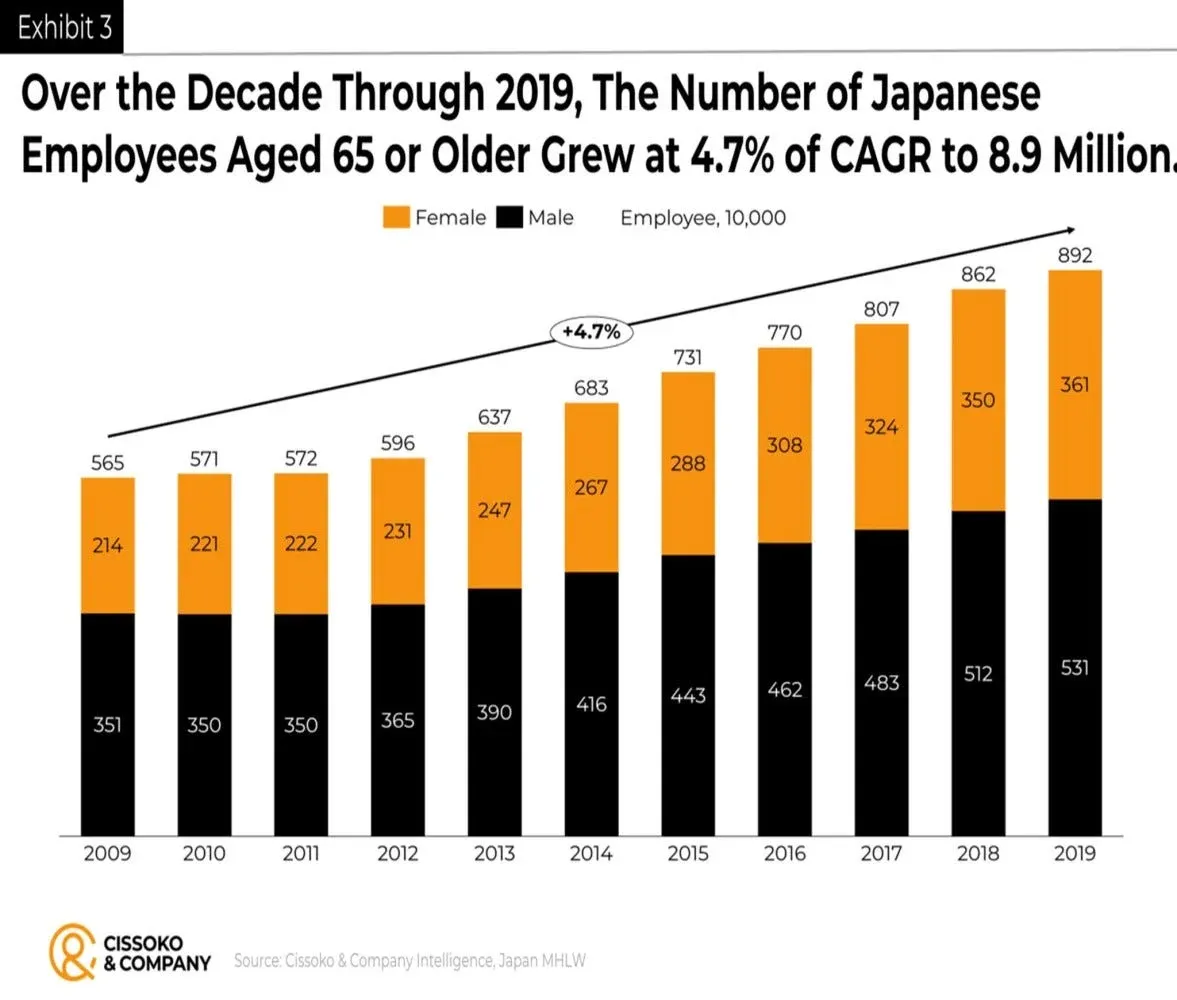
The researcher numbers are particularly revealing. Research published by Cissoko and Company in March 2026 found that between 2011 and 2022, the number of researchers in Japan’s technology sector decreased by 27%, falling to approximately 145,662. This happened during the exact period when AI research was accelerating globally. Overall PhD researchers in Japanese enterprises grew by 8% in the same window. The technology sector specifically moved in the opposite direction.
The OECD’s own labour market study on Japan, published in November 2025, found that Japanese companies struggle significantly more than US counterparts with AI-related talent shortages. The most pressing problem is not a lack of PhDs or engineers in the abstract. It is a lack of employees capable of promoting AI adoption using workplace experience and basic AI knowledge, the middle layer of people who translate technical capability into business application.
The language barrier compounds all of this in a way that is easy to underestimate if you have not worked inside the Japanese tech ecosystem. The vast majority of foundational AI research is published in English. The most important open-source models, the documentation, the research papers, the GitHub repositories, the developer communities: essentially all of it is in English first. Japanese engineers working at the frontier of AI need strong English proficiency in addition to technical ability. That combination narrows the talent pool significantly in a country where workplace English proficiency remains lower than most other developed economies.
The Software Gap That Hardware Excellence Could Not Hide
Japan’s technological reputation rests primarily on hardware. The Shinkansen is a feat of precision engineering. PlayStation hardware was genuinely ahead of its time in multiple generations. Japanese robotics represent decades of mechanical and electromechanical excellence. Japanese manufacturing quality systems influenced global industry for fifty years.
Software is a fundamentally different discipline. It rewards iteration speed, failure tolerance, rapid deployment, and the ability to ship something imperfect and improve it in production. These are not values that the Japanese corporate culture of the Lost Decade era naturally produced. The result was that while Japan dominated global hardware manufacturing, it never built a comparable domestic software industry. The companies that could have pivoted from hardware excellence to software innovation largely did not.
The gap became visible at scale when the smartphone era arrived. Japan had Sharp, Sony, Fujitsu, and Panasonic all building mobile handsets. It had its own domestic mobile internet ecosystem called i-mode that predated the western mobile web by years. None of it translated into global software platform dominance. Apple and Google captured the smartphone software layer, and Japanese hardware companies watched their mobile businesses shrink. The pattern repeated itself with cloud computing, where Amazon, Microsoft, and Google established the dominant infrastructure globally while Japanese firms remained primarily consumers rather than providers. Japan’s AI infrastructure market is projected to exceed $5.5 billion in 2026, 7 times its size three years ago, but the underlying models and platforms are almost entirely American.
The Corporate Structure That Slowed Everything Down
Japan’s keiretsu system, the interlocking networks of companies, banks, and suppliers that dominated Japanese business for decades, provided extraordinary stability during Japan’s high-growth era. It reduced short-termism, protected workers, and enabled the long-horizon investment that produced world-class manufacturing. AInvest’s June 2026 analysis described the same system as a barrier to the speed and risk-taking that AI development requires. Lifetime employment guarantees, cross-shareholding arrangements, and deeply embedded consensus-building processes make rapid pivots extremely difficult. A startup in Silicon Valley can decide to rebuild its entire technical stack in a week. A division of a large Japanese keiretsu company might spend six months building the internal consensus required to initiate a pilot programme.
This is not abstract. The OECD study found that Japanese firms were slow to adopt AI even for basic tasks including translation, document drafting, and coding. These are not cutting-edge applications. They are entry-level AI use cases that require minimal technical sophistication to implement. The barrier is not capability. It is institutional inertia.
The venture capital ecosystem that produced OpenAI, Anthropic, and the wave of AI startups in the US simply does not exist at comparable scale in Japan. AI startups accounted for over 60% of global VC investment in 2025. Japan’s venture market, while growing, operates at a fraction of the capital deployment and risk tolerance of Silicon Valley. The result is that Japan produces very few AI-native companies and a large number of traditional companies trying to add AI capabilities to existing operations.
What Japan Is Actually Doing About It
Having laid out the problems, it is important to be precise about what is changing, because the picture is not static.
The Japanese government has moved faster than most people outside Japan realise. Japan passed an AI Promotion Act in May 2025, adopted a formal AI Basic Plan in December 2025, created a Prime Minister-led AI Strategic Headquarters, and committed more than 10 trillion yen in public support for AI and semiconductor infrastructure. Hello World Japan’s May 2026 analysis noted that the official language of Japan’s AI strategy is unusually direct that the government explicitly acknowledges it is behind and frames the strategy as recovery rather than regulation. The Ministry of Economy, Trade and Industry has earmarked 1 trillion yen over five years from fiscal 2026 to develop foundation models at the one-trillion-parameter scale.
Foreign investment is arriving at scale. Microsoft announced a 1.6 trillion yen investment in Japan from 2026 to 2029. Nvidia has partnered with Fujitsu to build full-stack AI infrastructure. SoftBank launched an AI Boost Program in September 2025 providing free access to high-performance GPU systems and Nvidia engineering support for Japanese startups.
Adoption is finally accelerating at the consumer level too. Microsoft’s AI Economy Institute Q1 2026 report found that AI adoption in Japan increased 3.4 percentage points in the first quarter of 2026, more than three times faster than the global average. NTT Docomo data shows usage nearly doubled between February 2025 and February 2026. The country is moving. It is just moving from a position that was significantly further back than most observers had appreciated.
Japan’s most interesting AI company right now is Sakana AI, co-founded by David Ha, former head of research at Google Brain. Sakana AI is pursuing a different philosophy from the frontier model race: smaller, more efficient models that draw inspiration from nature-based collective intelligence rather than brute-force scaling. Ha has argued publicly that the frontier model approach may be flawed and expensive in ways that create genuine opportunity for a different path. Whether that argument proves correct will say a great deal about whether Japan’s latecomer position is a permanent disadvantage or a chance to skip directly to what works.
The Counterintuitive Case for Japan
Here is something worth sitting with. BusinessWorld’s May 2026 piece made an argument that runs against the obvious reading of the data: Japan’s late start may actually be an advantage. The country can observe what worked and what did not in the US and China, skip the expensive failed experiments, and deploy AI directly into problems it genuinely has solutions for.
Japan has an ageing population and a shrinking labour force. Those are real constraints that AI can genuinely address in ways that produce measurable economic value. There is less of the cultural anxiety about AI displacing workers when the workforce is already shrinking and the pressure is to find workers at all. The adoption case in Japan is not philosophical. It is practical and urgent.
Japan also has world-class hardware manufacturing, robotics infrastructure, and manufacturing precision that most AI-native countries do not. The integration of AI with physical systems, the embodied AI frontier that most US AI companies are only beginning to approach, is a domain where Japan’s existing capabilities are genuinely relevant. The question is whether the cultural and institutional barriers can be overcome fast enough to deploy those advantages before the window closes.
Japan did not fail at AI because it lacked intelligence or technical capability. It fell behind because the institutional structures and cultural values that made it excellent at hardware-era innovation are precisely the ones that slow you down in software-era innovation. The country built extraordinary tools for a world that was moving slower than the one that arrived.
The honest answer to why Japan is behind in AI is that it is the accumulated consequence of 30 years of corporate conservatism, a structural talent shortage that demographic decline made almost inevitable, a software culture that never matched the hardware excellence, and an institutional speed mismatch with an industry that rewards moving fast and accepting failure as a data point rather than a catastrophe.
The question that matters now is whether the government investment, the foreign capital, the accelerating adoption curve, and companies like Sakana AI pursuing genuinely different approaches can compound quickly enough to change the trajectory in a meaningful timeframe. The window is real but it is not unlimited.
Japan has surprised the world before. The question is whether the surprise is still possible in a field where the compounding advantage of being early is this significant.
Sources
- Japan Ministry of Internal Affairs and Communications: White Paper on Information and Communications 2025 — Japan generative AI usage rate 26.7%. US 68.8%. China 81.2%. Corporate AI strategy adoption: Japan 42 to 50%, US and China above 80%.medium.com. Accessed 30 June 2026.
- AInvest: Japan’s AI Problem Is Not the Technology, June 2026 — OECD: 1.9% of Japanese firms adopted AI in core business functions vs 6.1% in the US. Japan AI infrastructure market projected to exceed $5.5 billion in 2026.ainvest.com. Accessed 30 June 2026.
- Bitget: Japanese Companies Lean on Big Tech to Close AI Gap, April 2026 — Japan has 251 AI companies vs 30,000 in the US, 5,000 in China, 1,500 in Germany. Microsoft 1.6 trillion yen investment announcement. Sam Ghiotti quote on Americans needing to be first vs Japanese needing to be right.bitget.com. Accessed 30 June 2026.
- East Asia Forum: Japan’s AI Transition Faces Stumbling Blocks, June 2026 — Loss-making Japanese firms risen from 40 to 50% to 60 to 70% since the Lost Decade. Structural barriers: stagnant competition and higher education weaknesses.eastasiaforum.org. Accessed 30 June 2026.
- JapanDev: Japan Faces 220,000 IT Talent Shortage in 2026, April 2026 –220,000 current IT talent gap. 790,000 shortage projected by 2030. 500,000 working-age adults lost per year.japandev.jp. Accessed 30 June 2026.
- Cissoko and Company: Japan’s Talent Crisis in the Age of Agentic AI, March 2026 — Technology sector PhD researchers fell 27% between 2011 and 2022 to 145,662.cissokmamady.com. Accessed 30 June 2026.
- OECD: Artificial Intelligence and the Labour Market in Japan, November 2025 — Japanese companies more likely than US counterparts to cite AI talent shortage as adoption barrier. Government target of 2.3 million digital technology workers by FY2026.oecd.org. Accessed 30 June 2026.
- Hello World Japan: How Japan Wants to Win in AI, May 2026 — AI Promotion Act May 2025. AI Basic Plan December 2025. 10 trillion yen public commitment. METI 1 trillion yen for foundation model development.helloworldjapan.com. Accessed 30 June 2026.
- Nippon.com : China’s Speed in AI Leaves Japan in the Dust, January 2026 — Comparison of China’s trial-and-error AI deployment approach vs Japan’s consensus-driven model. DeepSeek’s iPhone 4 moment analysis.nippon.com. Accessed 30 June 2026.
- Disrupting Japan: The Future of AI Looks Very Different in Japan, June 2026 — Sakana AI and David Ha’s alternative approach to frontier model race. AI startups at 60% of global VC investment in 2025.disruptingjapan.com. Accessed 30 June 2026.
- BusinessWorld: Japan’s an AI Laggard. That Could Be Its Edge, May 2026 — AI adoption in Japan up 3.4 percentage points in Q1 2026, more than 3x the global average. NTT Docomo data: usage doubled Feb 2025 to Feb 2026.bworldonline.com. Accessed 30 June 2026.
Related stories
AI & GPU compute
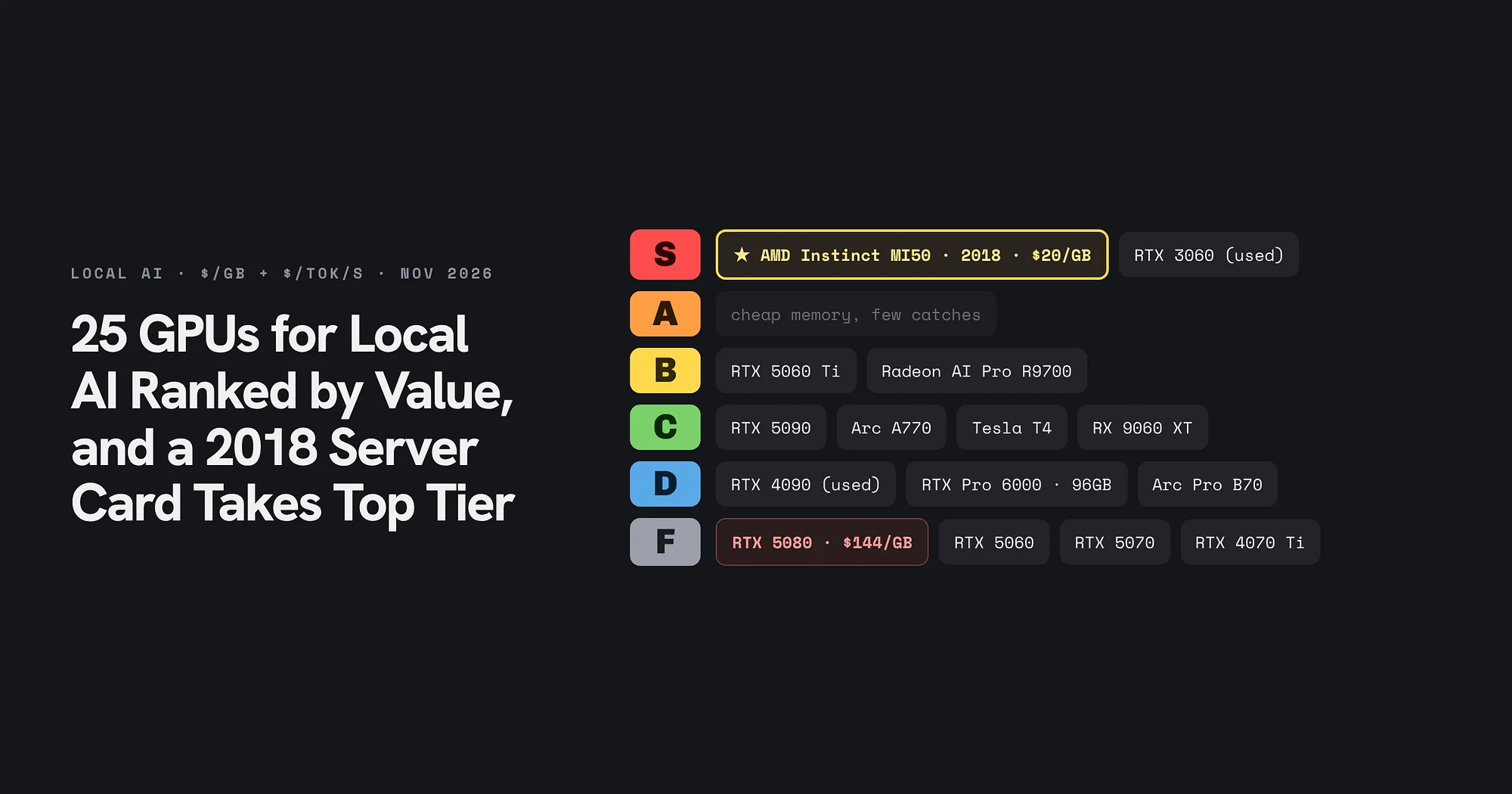
25 GPUs for Local AI Ranked by Value, and a 2018 Server Card Takes Top Tier
A November 2026 price snapshot grades 25 cards on dollars per gigabyte and dollars per token per second. The AMD Instinct MI50 and a used RTX 3060 take S tier, the RTX 5080 lands in F, and memory decides almost every grade.
AI & GPU compute
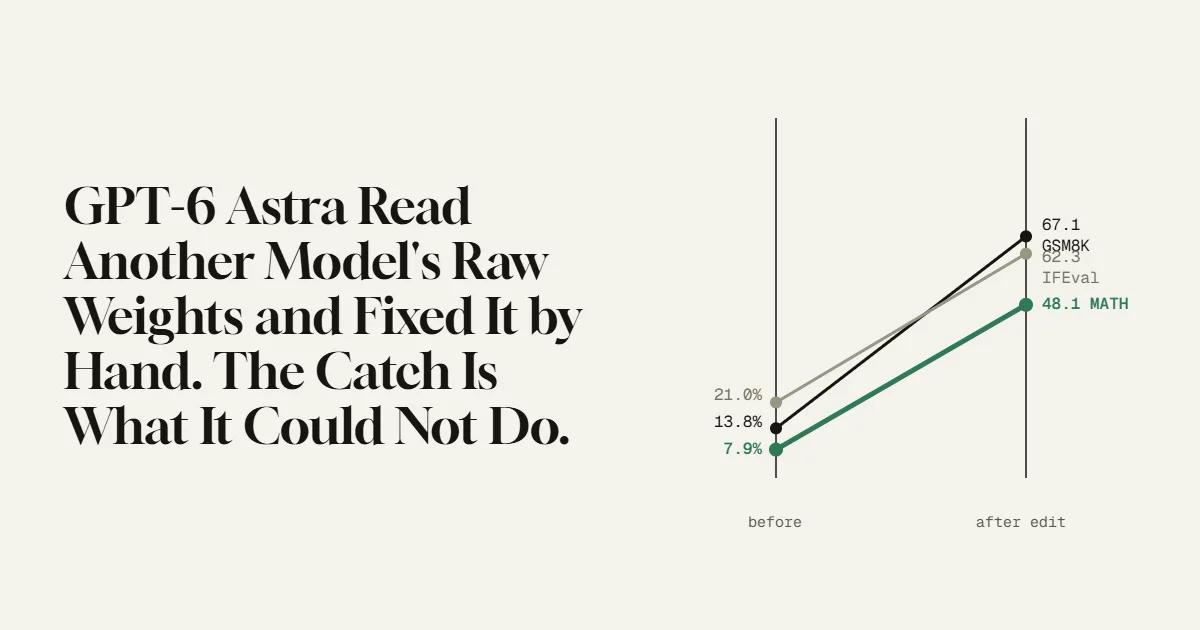
GPT-6 Astra Read Another Model’s Raw Weights and Fixed It by Hand.
MIT researchers had GPT-6 Astra edit 0.016% of a small model’s weights, with no training, and its math score jumped from 7.9% to 48.1%. The number is real and the method is strange. The limit they found in the same paper is the part worth understanding.
AI & GPU compute
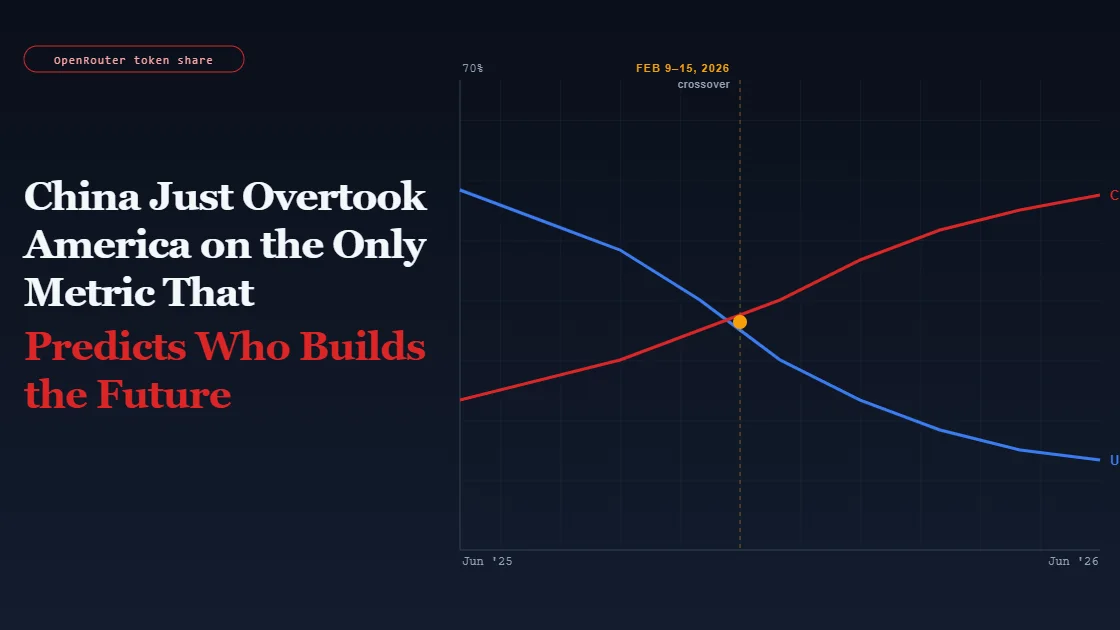
China Just Overtook America on the Only Metric That Predicts Who Builds the Future
Note: This article discusses ongoing industry developments and government policy. It is for informational purposes only.