MacOS Quietly Vanished From the Official Unix Registry
For almost 20 years, “macOS is certified Unix” was a real bragging right. I dug into what that certification actually required, and the honest answer is that no Mac anyone uses has ever met it. Here is what disappeared from the Open Group’s list in October 2026, and why it matters less than the headlines suggest.
Last verified Also on LinkedIn
On this page
- What actually happened on the registry
- Why macOS was ever on that list
- What the certification was ever for
- The certification almost nobody can actually meet
- How that compares to a real certification
- The certification used to buy real money
- Why Apple stopped caring, and why it barely matters
- What this actually changes for you
For most of 2 decades, one of the quiet flexes in computing was that macOS is certified Unix and Linux is not. I heard it from university professors, from developers who came up in the 90s, from people who wanted a machine that was Unix without the rough edges. Then, sometime between October 7 and October 11, 2026, Apple’s entries slipped off the front page of the Open Group’s Unix registry, with no announcement, no blog post, nothing. I went looking at what that certification was, what it actually required, and whether losing it means anything. The answer turned out to be more interesting than the disappearance itself.
What actually happened on the registry
The Open Group owns the Unix trademark. It is the body that gets to say a given operating system is Unix or is not Unix, and it keeps a public list of certified products. If you pull up a Wayback Machine capture from October 7, 2026, Apple is there, macOS version 26 Tahoe, both the Intel and Apple Silicon builds. A capture a few days later shows only IBM, Hewlett Packard Enterprise, and the SCO Group. Apple is gone from the index.
Here is the odd part. macOS is not fully gone. Filter the registry by the specific standard, Unix 03, and macOS Tahoe is still listed there, with its certificate dated 29 August 2025. So the certificate exists, the product record exists, but the entry vanished from the main list that aggregates everything. Nobody at Apple or the Open Group has said why. It could be a removal, it could be a site bug, though a bug that selectively drops only Apple for a week is a strange kind of bug. Several people who tracked the exact product record landed on the same cautious read. The record stands, the front page listing is gone, and the reason is unexplained.
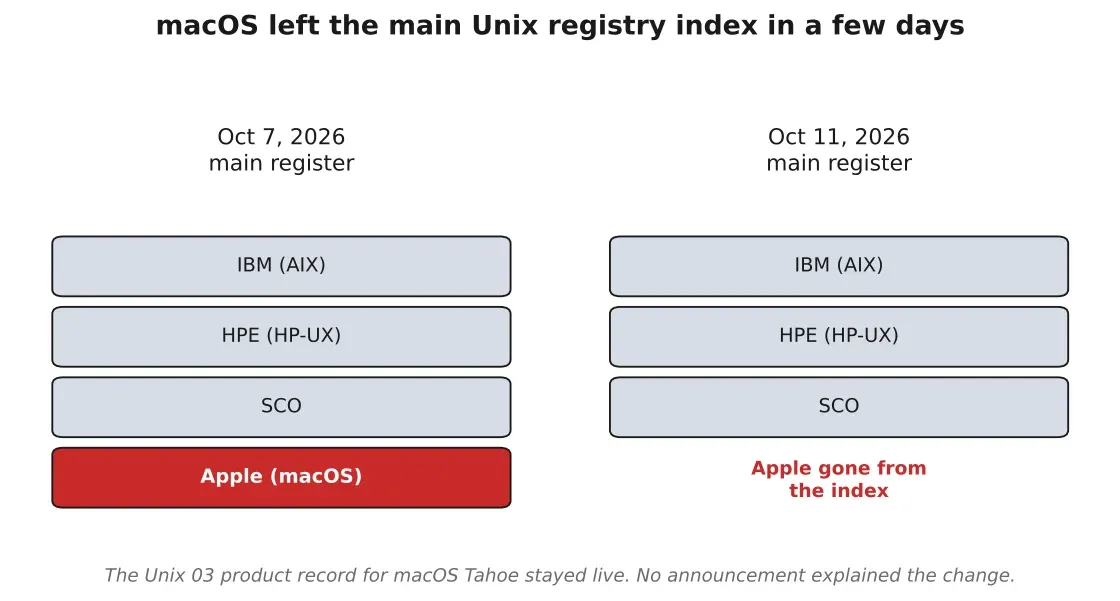
Figure 1. macOS disappeared from the main Unix registry index between October 7 and 11, 2026, while its Unix 03 product record stayed live. No announcement accompanied the change. Source: Open Group registry, Wayback Machine captures
Why macOS was ever on that list
To see why this is funny more than tragic, you have to know why Apple bothered in the first place. macOS has been Unix certified since OS X 10.5 Leopard, registered in 2007. That was a moment when Unix still carried weight. The people who had lived through the Unix peak of the 80s and 90s were still running labs and making purchasing decisions, and calling your product Unix was a direct line to developer credibility.
Steve Jobs understood this better than anyone, and he said it out loud, repeatedly. Back in 2001 he was already telling reporters that Apple would become the largest Unix supplier in the world by volume by the end of the year. At Macworld New York in 2002 he put it plainly from the stage. macOS is “the number one supplier of Unix in the world. Bigger than Sun, bigger than Linux, bigger than anyone.” Apple was selling a point and click machine to people who had been wrestling with the MS DOS command line, and the Unix label was how Jobs told developers it was serious underneath.
The technical lineage was real, which is part of why the pitch worked. Apple did not fake a Unix core. Jordan Hubbard, who co-founded FreeBSD in 1993, joined Apple in July 2001 to run its BSD technology group and later became Director of Unix Technology. The macOS kernel, XNU, is a hybrid of the Mach kernel and BSD code that has been synchronized with FreeBSD, and a large part of the user space traces back to FreeBSD too. The joke inside the name says the rest. XNU stands for “X is Not Unix,” which is the kind of thing only people who deeply respect Unix would name their Unix like kernel.
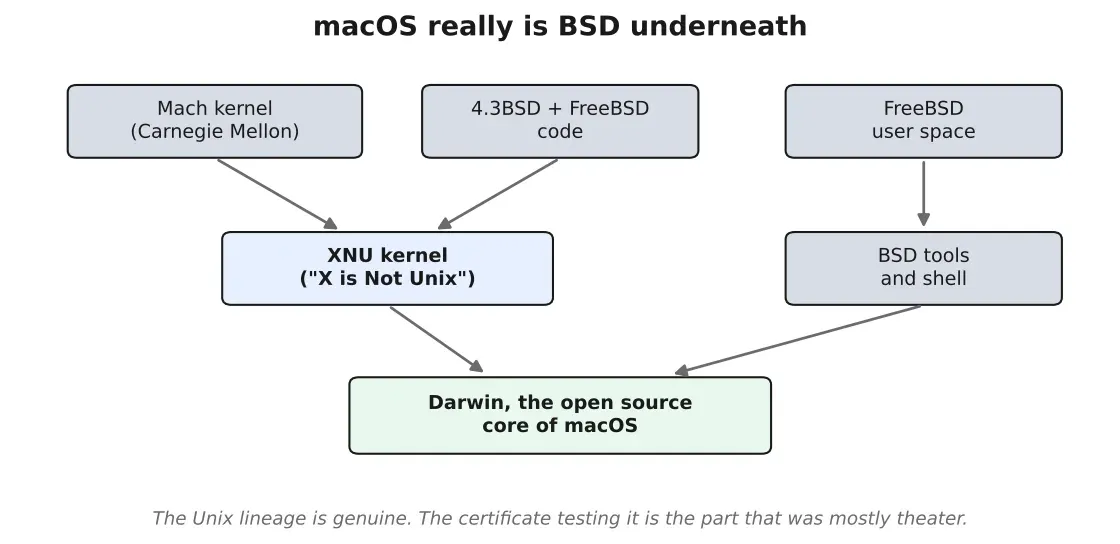
Figure 2. The Unix lineage under macOS is genuine. XNU blends the Mach kernel with BSD code, and the user space descends from FreeBSD, all shipped as the open source Darwin core. Source: XNU and Darwin lineage
There was a fight over the label, too. The Open Group sued Apple over its use of the Unix name for Mac OS X, and Apple countersued, arguing the term had become generic and the trademark should be invalid. The case went through discovery and mediation without a public settlement. What Apple did in the years after was simpler than winning. It just paid for the certification and kept paying, year after year, long past the point where it mattered to the marketing.
Apple kept the mark almost continuously for nearly 2 decades, with 1 gap. Leopard 10.5 was certified in 2007, Snow Leopard 10.6 followed, then 10.7 Lion was never registered as a Unix 03 product, a lapse that Andrew Josey, the Open Group’s standards lead, later confirmed. Apple picked it back up with Mountain Lion 10.8 in 2012 and held it straight through to macOS 26 Tahoe, whose certificate is dated 29 August 2025. Then came the quiet exit from the index in October 2026.
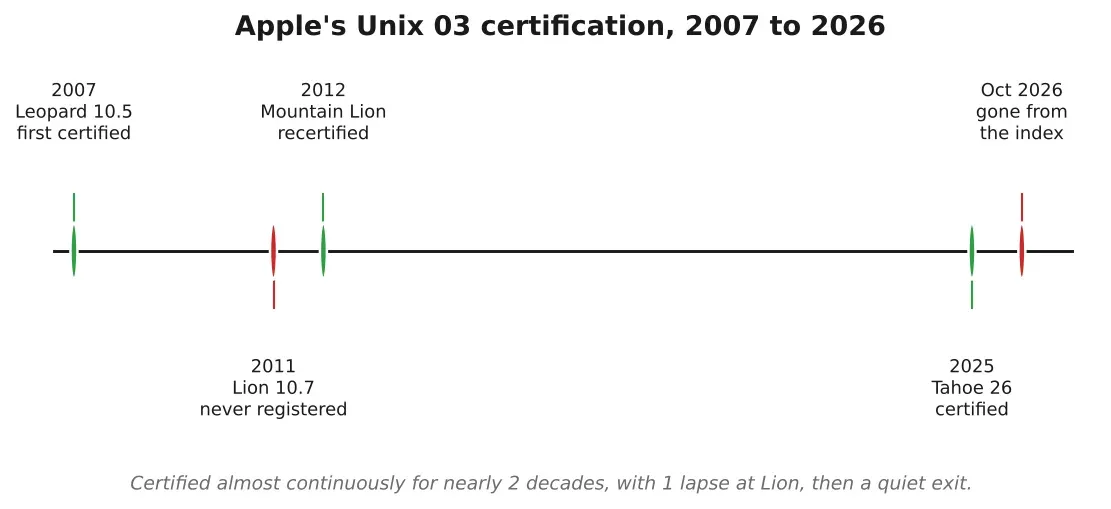
Figure 3. Apple held Unix 03 certification from Leopard in 2007 almost continuously, with 1 lapse at Lion in 2011, through Tahoe in 2025, then slipped off the registry index in October 2026. Source: Open Group register and Apple certification histor
What the certification was ever for
To judge whether losing the mark matters, it helps to know why the mark exists. Through the late 1980s and early 1990s, Unix went through what people later called the Unix wars. AT&T had System V, Berkeley had BSD, and nearly every hardware vendor shipped its own incompatible variant, so a program written for Sun’s Unix would not simply run on IBM’s or HP’s. The fragmentation was brutal. The database maker Informix at one point supported more than 100 different Unix systems. Software had to be ported again and again, which is the opposite of the portability Unix was supposed to deliver.
The fix was a shared standard. 2 rival camps, the Open Software Foundation and Unix International, buried the hatchet and formed the Common Open Software Environment alliance in March 1993, and the Unix trademark passed to X/Open later that year. That group, which merged into the Open Group in 1996, produced the Single Unix Specification, the actual document the certification tests against. The versions line up with the marks. Unix 95 arrived in 1994 with 1,168 interfaces, Unix 98 in 1997 with 1,434, Unix 03 in 2002 with 1,742, and the current Unix V7 in 2008 with 1,833. The whole point was to let a vendor prove, on paper, that its system met a common bar so buyers could trust their software would run.
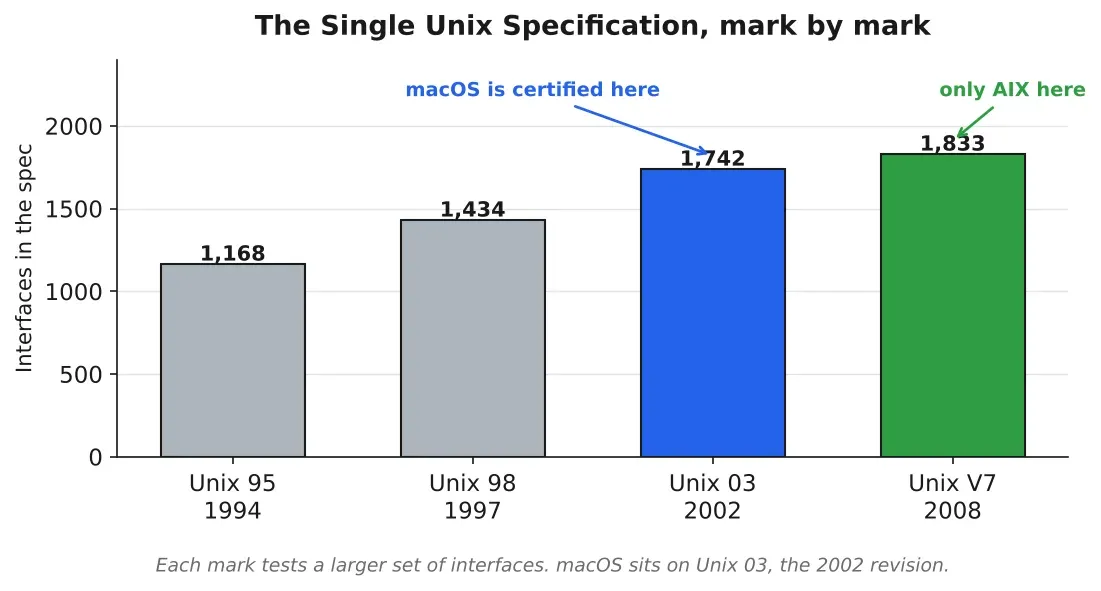
Figure 4. The Single Unix Specification grew through 4 marks, from Unix 95 to Unix V7, each adding interfaces. macOS is certified to Unix 03, the 2002 revision. Source: Single Unix Specification history, The Open Group
The core of that standard is POSIX. The Single Unix Specification’s base is, by the Open Group’s own description, technically identical to the POSIX standard, which is the thing that actually decides whether your code ports. That distinction matters for the rest of this story, because it separates the part of Unix certification that changed from the part that did not.
The certification almost nobody can actually meet
Now the part that reframes the whole thing. Apple has been paying to certify a configuration of macOS that effectively does not exist on anyone’s machine. In January 2025, Thom Holwerda published a piece on OS News with a blunt title, Apple’s macOS Unix certification is a lie, and the evidence is sitting in Apple’s own public conformance statements.
At the end of each conformance statement there is a field where the vendor lists the additional steps needed to make the system pass. For macOS 15, the version right before Tahoe, the list is long. To pass Unix 03 you have to disable System Integrity Protection, the security layer that stops even privileged code from modifying system binaries. You have to enable the root account, which is off by default. You have to turn on core file generation, disable timeout coalescing, mount the file system with strict access time updates, and reformat your APFS volume as case sensitive, which on its own requires a reinstall because APFS ships case insensitive. You have to disable Spotlight, the background file indexer. Then, to pass the UUCP tests, you copy a set of ancient Unix copy binaries into a new location and set their permission bits by hand.
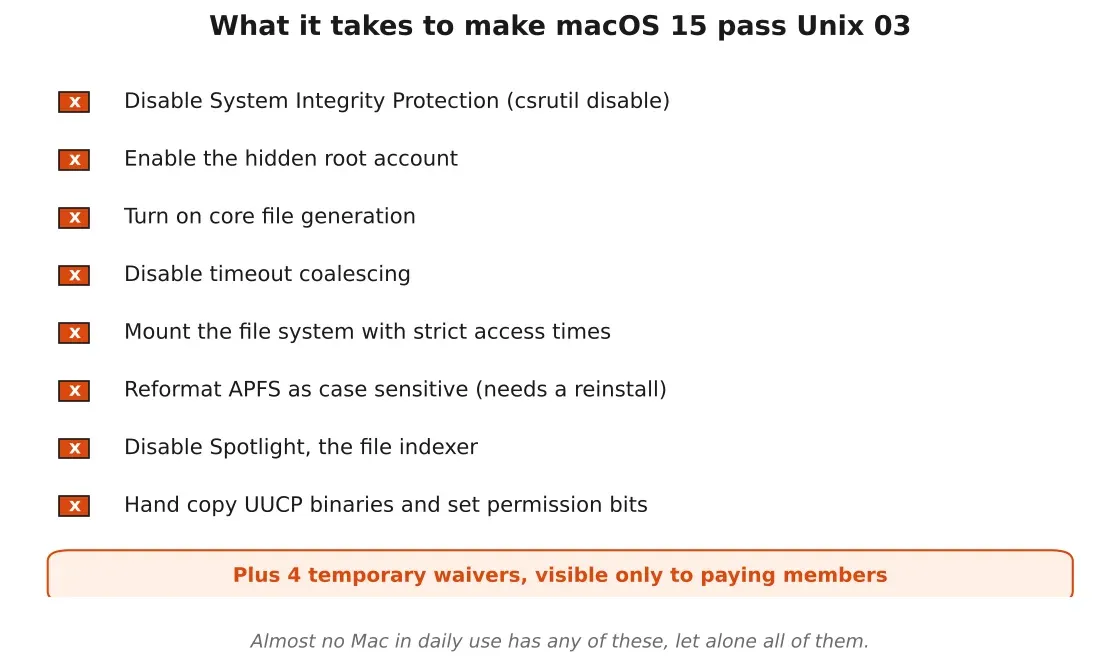
Figure 5. The changes Apple documents to make macOS 15 pass Unix 03 certification. Almost no real Mac has any of these, let alone all of them. Source: Apple conformance statements, via OS News analysis 2025
On top of those changes, Apple holds 4 temporary waivers, granted at the Open Group’s discretion for implementation errors judged minor, valid for 12 months before the vendor is supposed to fix them. Those waivers are only visible to paying members, so outsiders cannot even read what was waived. Stack it all up and the conclusion is hard to dodge. There is effectively no macOS system in daily use, outside the certification test rig itself, that actually meets the Unix 03 standard Apple pays to claim.
How that compares to a real certification
The reason this stands out is that other certified systems do not need any of it. For fairness, Holwerda checked the other conformance statements, in case everyone cheats and the whole process is theater.
The only operating system currently certified to Unix V7, the latest version of the spec, is IBM’s AIX 7.2 or later. Its conformance statement contains exactly 1 required change, setting a socket listen queue length to 5 with a single command. That is the whole list. HP-UX 11.31 for Itanium has remarks in its appendix, but they are informative and specify no changes. Solaris has a pile of remarks about differences between its x86 and SPARC builds, again with no required changes. 1 command for AIX, nothing for the others, against a wall of security teardowns and reinstalls for macOS.
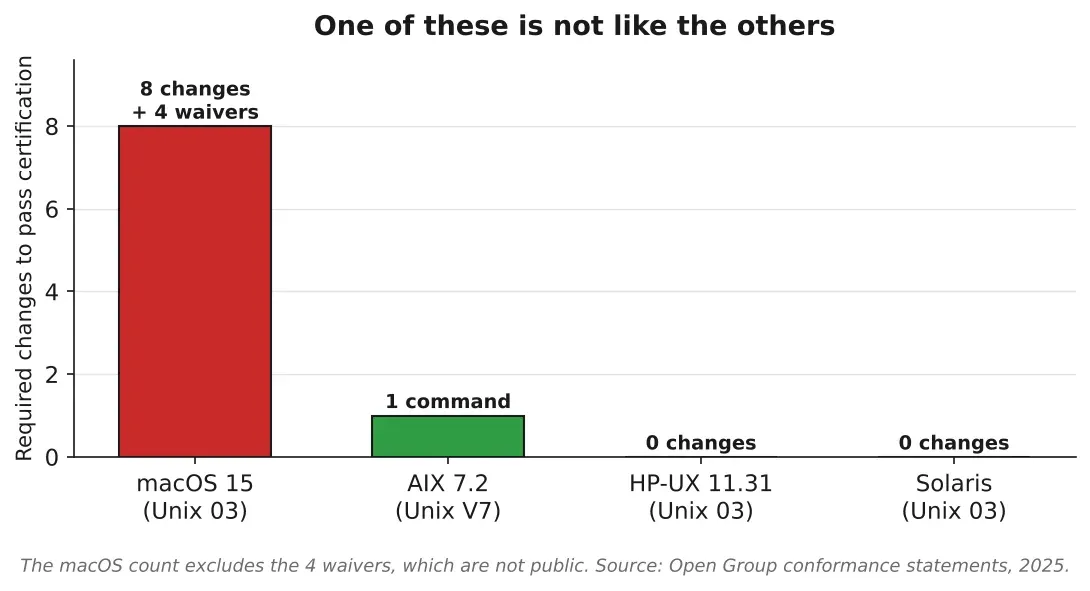
Figure 6. What each certified Unix requires to pass. AIX needs 1 command. macOS needs its entire security model dismantled plus 4 waivers. Source: Open Group conformance statements, 2025
There is also a version gap worth naming. macOS sits on Unix 03, a spec released on 30 January 2002, despite the name. The current mark is Unix V7, tied to the 2008 revision of the spec, and the only thing on that list is AIX. So even the certification macOS holds is a generation behind the current standard, and it meets that older standard only in a torn down configuration nobody runs.
The certification used to buy real money
There was a time when this label was not a vanity badge. In the 1980s and 1990s, standards compliance was written into government purchasing rules. The US federal standard FIPS 151–2 required certain government computer purchases to be POSIX compliant, and that requirement was strong enough that Microsoft built an entire POSIX subsystem into Windows NT, shipped in 1993, purely so NT machines would stay eligible for federal contracts. Windows NT 3.5, 3.51, and 4.0 were all certified against FIPS 151–2. Microsoft did not add POSIX to NT because anyone loved it. They added it because contracts demanded it.
Unix certification sat in the same world. For a stretch, being able to say your system was certified Unix or POSIX compliant was a gate to government labs, universities, and defense work that would not sign a purchase order otherwise. That is the market Apple was partly chasing when it certified Leopard in 2007 and when it sold its Xserve rack machines to institutions. The mark was a key to a room with budget in it.
That room mostly emptied out. Linux, which never carried the Unix trademark, became acceptable and then dominant in exactly those institutional and server markets, and procurement rules relaxed to accept de facto standards, not just certified ones. Once the buyers stopped asking for the certificate, the certificate stopped being worth chasing, which is the quiet economic story under Apple’s registry entry going stale.
Why Apple stopped caring, and why it barely matters
Apple did not suddenly lose the technical ability to be Unix. The Darwin core, the XNU kernel, the BSD user space, the whole foundation, none of that changed when the registry entry vanished. What changed is the audience. The Apple of 2007 was courting developers, and Unix was a credential worth buying. The Apple of 2026 sells to visual creatives who have never typed csrutil in their life and do not care whether a trademark body in a registry somewhere blesses the kernel. There is no mention of Unix in Apple’s marketing anymore. It does not appear in release notes. For a company Apple’s size the certification fee is a rounding error, so cost is not really the story either. Someone may simply have looked at the renewal and asked why they were still paying for a label no customer reads.
There is a deeper point underneath, which several engineers have made for years. Because the Unix copyright and the Unix trademark ended up owned by different organizations, the word Unix no longer cleanly means one thing. The BSDs are Unix derived in every sense except the narrow one that copyright law cares about. macOS is BSD derived through and through. If anyone seriously challenged the trademark in court on the grounds that the term has become generic, which is close to the argument Apple itself once made, the Open Group might well lose it. In normal usage, when a developer says a system is Unix, they mean it behaves like Unix and descends from Unix, not that someone paid a certification fee this year.
What this actually changes for you
If you use a Mac, nothing changes. Your shell works the same, your BSD tools work the same, the POSIX behavior most software actually depends on is untouched, because that was never the thing the Unix 03 certificate was really testing. POSIX compliance, the standard that genuinely matters for portability, is a separate question from the Open Group’s Unix branding, and it is the one worth watching if Apple ever starts trimming. The registry entry was always more flag than foundation.
What the disappearance does is puncture a particular flex. For the handful of people who liked to say macOS is Unix and Linux is not, the first half of that sentence just got weaker, and it was already resting on a certification that described a machine none of them were running. Linux, which was never certified and never paid the fee, meanwhile became the practical standard that the entire server world runs on. The label and the reality drifted apart a long time ago. October 2026 just made the paperwork match.
Sources
- Open Group Unix certified products registeropengroup.org. Accessed 21 October 2026.
- Thom Holwerda, Apple’s macOS Unix certification is a lie, OS News 2025osnews.com. Accessed 21 October 2026.
- macOS Tahoe Unix 03 certificate, Open Groupopengroup.org. Accessed 21 October 2026.
- AppleInsider, Apple’s Leopard gains Unix 03 certification, 2007appleinsider.com. Accessed 21 October 2026.
- MacTech, Apple being sued over Unix trademark, 2003mactech.com. Accessed 21 October 2026.
- The Open Group, Apple registers Mac OS X 10.8 Mountain Lion to the Unix 03 standard, 2012blog.opengroup.org. Accessed 21 October 2026.
- Jordan Hubbard, FreeBSD co-founder and Apple Unix leaden.wikipedia.org. Accessed 21 October 2026.
- XNU kernel lineageen.wikipedia.org. Accessed 21 October 2026.
- DEV Community, macOS Tahoe and Unix certification, checking the exact product recorddev.to. Accessed 21 October 2026.
- Single Unix Specification historyen.wikipedia.org. Accessed 21 October 2026.
- The Open Group, Unix historyunix.org. Accessed 21 October 2026.
- Unix wars backgrounden.wikipedia.org. Accessed 21 October 2026.
- Microsoft POSIX subsystem and FIPS 151–2 procurementen.wikipedia.org. Accessed 21 October 2026.
Related stories
Linux & open source
AI Is Quietly Dismantling the Thing That Kept People on Windows and macOS
For 30 years the reason you could not simply switch to Linux was the software. Photoshop, Office, the apps you needed and the file formats they locked you into. In October 2026 a single developer used Claude Code to rebuild Adobe’s core creative apps in Rust and gave them away. I think the moat that protected proprietary software just sprang a leak, and the legal fight over whether that is allowed is going to be the real story.
Linux & open source
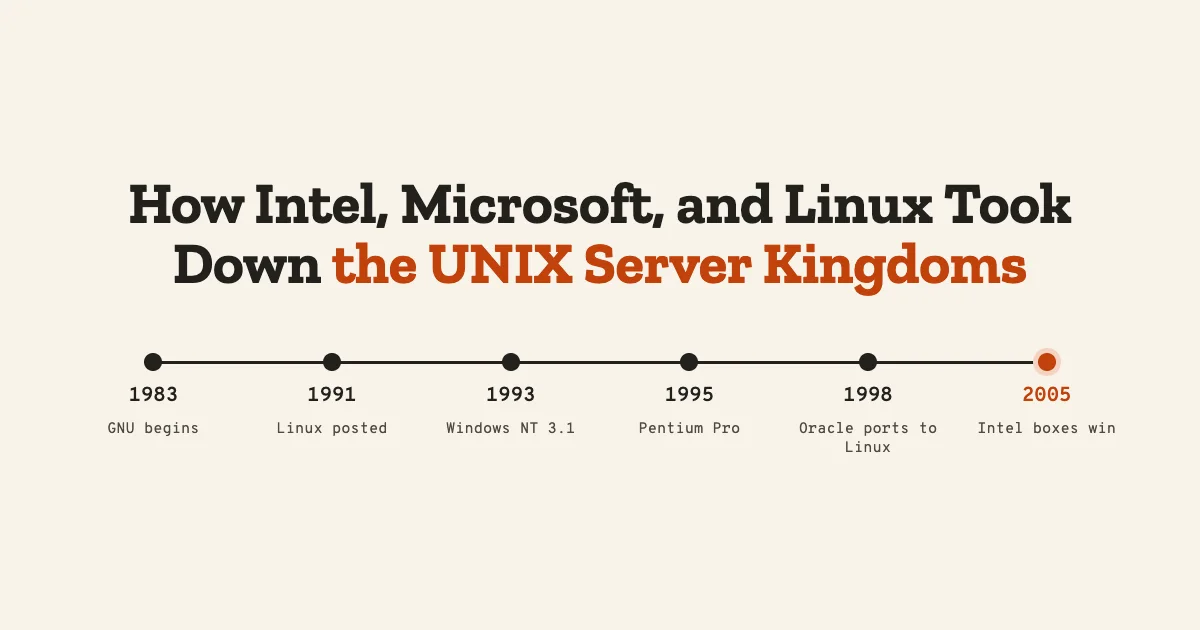
How Intel, Microsoft, and Linux Took Down the UNIX Server Kingdoms
Going into the 1990s, a serious enterprise server meant a proprietary UNIX system running on custom RISC silicon, and it cost a fortune. By 2005 most of that market had been eaten by cheap Intel boxes running either Windows or Linux. I went back through how that happened, because it is one of the cleanest examples in computing history of a business model getting beaten on economics while its technology stayed ahead.
Security
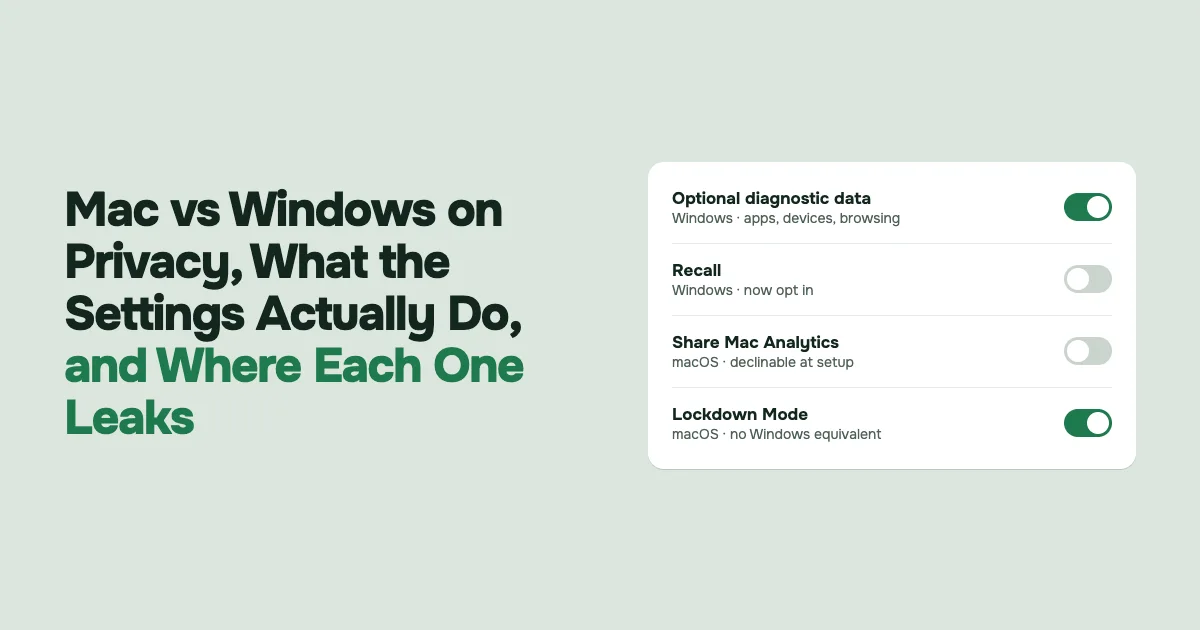
Mac vs Windows on Privacy, What the Settings Actually Do, and Where Each One Leaks
Most people run either Windows 11 or macOS, and both collect data, hand some of it to governments, and run advertising businesses. I went through what each system actually knows about you, what you can switch off, and where the real differences are, using the published numbers rather than brand loyalty. If privacy is your top priority the honest answer is neither of them, and I will get to that.