Siemens Deleted a Popular Open Source Project on Its Way Out the Door, and the AGPL Made Sure That…
In October 2026, months after buying Altair for $10.6 billion, Siemens retired the OpenRadioss website and deleted its GitHub repository, pointing users to a paid product. The code was under the AGPL, so within days a Rocky Linux founder had forked it into a new project called OpenCourant. I went through what happened, why deleting the repo was the self defeating part, and what the license actually guaranteed.
Last verified Also on Medium
On this page
Open source has a recurring fear with a clumsy name, EEE, for embrace, extend, extinguish. A company adopts an open project under a permissive license, builds a user base on its version, quietly adds features that lock people in, and eventually takes the whole thing proprietary. The more mundane version is simpler, a company buys a project, promises to keep it open, and later decides it would rather you pay. It does not happen often, because the backlash is bad and the license usually does not allow a clean exit. In October 2026 it happened to OpenRadioss, and the way Siemens did it turned a quiet retirement into a public mess.
If you visit the old OpenRadioss GitHub page now, you get a 404. The website no longer loads the project either, it redirects to a Siemens page telling you the future of Radioss is a paid product called Simcenter. I want to walk through how a widely used open source tool got deleted, and why the delete button was the mistake.
What Radioss is and how it got here
Radioss is a finite element solver, software that simulates how physical structures behave under extreme, fast, highly non-linear events, car crashes, impacts, and blasts. If you have seen a slow motion simulation of a vehicle crumpling in a safety test, that is the kind of problem Radioss handles. It has been an industry tool for decades, developed by the French firm Mecalog with roots going back to the 1980s.
The ownership changed hands the way these things do. Altair Engineering, a company based in Michigan, acquired Mecalog and its Radioss technology in 2006 and renamed it Altair Radioss. Then in September 2022, Altair did something generous. It kept its commercial product, and it also released a community edition under the GNU AGPL license, a genuinely open source version called OpenRadioss. For 4 years that version was the one students, researchers, and engineers reached for when they needed serious crash simulation without a commercial license. It built a real community around teaching and research.
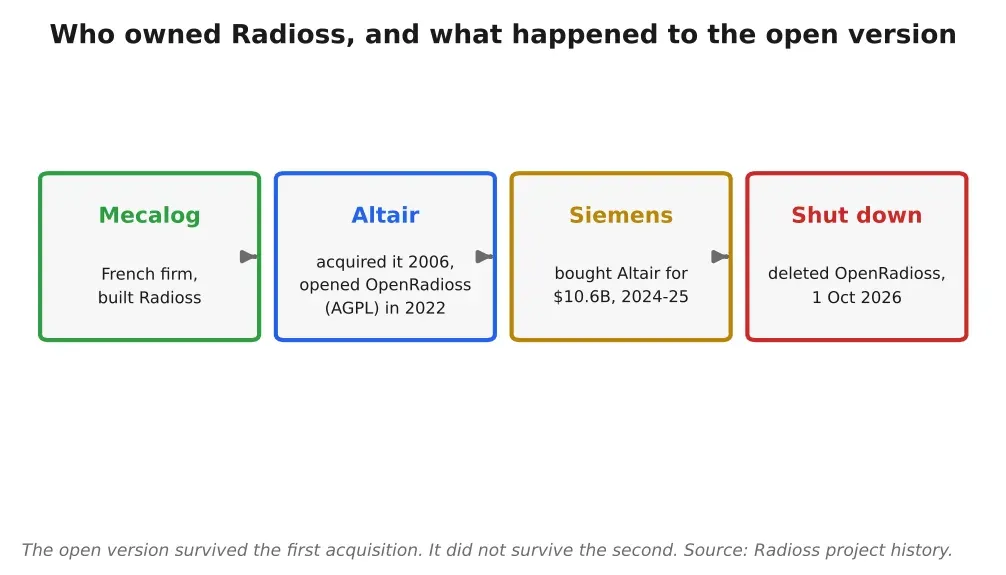
Figure 1. The ownership chain. Radioss came from the French firm Mecalog, was acquired by Altair in 2006, opened as OpenRadioss under the AGPL in 2022, and passed to Siemens when it bought Altair, after which the open version was shut down. Source: Author diagram based on Radioss project history
Siemens buys the company, then the project
The trouble started with an acquisition. In October 2024 Siemens announced it would buy Altair for about $10.6 billion, a deal that closed in 2025. Radioss was a small piece of that, Siemens was mainly buying Altair’s broad portfolio of simulation, high performance computing, and data science software to fill gaps in its own lineup. When you buy a company that size, you absorb everything it owns, including an open source project with an active community.
At first nothing changed. Siemens renamed the commercial product to Simcenter Radioss and folded it into its Simcenter suite, which is a normal thing to do after an acquisition. OpenRadioss kept running, development continued, and the community had no particular reason to worry. That held for about a year.
The part that made people angry
On 1 October 2026, the situation changed. Siemens retired the OpenRadioss website and, shortly after, removed the GitHub repository, as reported by Michael Larabel at Phoronix. The site now redirects to a blog post titled the future of Radioss is Simcenter. The post frames it in the language these announcements always use, that after 4 years of successful community driven research, Siemens is consolidating its efforts and entering a new chapter, focusing future investment on the Simcenter portfolio to provide support for production grade simulation. The FAQ tells visitors who relied on the free version to explore Simcenter Radioss and its R&D program through Siemens.
Read plainly, it is a redirect from a free tool to a paid one, built in part on 4 years of unpaid community research and development that the previous owner had committed to keeping open. That alone would have annoyed people. Deciding to stop supporting an open source project is a company’s right. Announce it, leave the code where it is, and let whoever wants to maintain it carry on.
That is not what happened. Siemens deleted the repository. A project that thousands of people depended on returned a 404, and Phoronix noted the repo was removed, not archived, when archiving would have preserved it in read only form at no cost. There was no practical reason to delete it. It reads as a deliberate attempt to make a clean copy harder to find and fork, an extra kick on the way out that was never going to win anyone over. Nobody who just got locked out of a tool they relied on responds by happily buying the paid version.
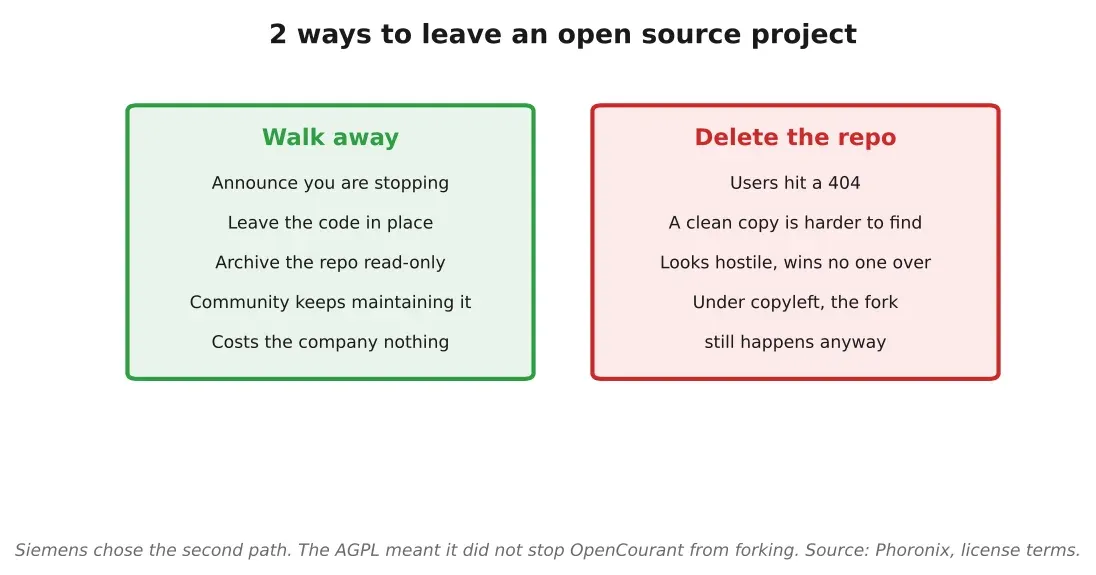
Figure 2. 2 ways to leave an open source project. Walking away leaves the code in place for the community to maintain. Deleting the repository strands users, and under a copyleft license it does not even stop the fork. Source: Author diagram of the 2 exit paths
Why the AGPL made the delete pointless
The delete button did not work the way Siemens might have hoped, because of the license. OpenRadioss was released under the GNU AGPL, a strong copyleft license. Once code is published under it, anyone who received a copy has the right to use, modify, and redistribute it, and that right does not expire when the original owner changes its mind. Deleting the central repository does not revoke the license on every copy already out in the world. It just makes the most convenient copy harder to reach.
So the code was never really Siemens’ to pull back. Any engineer, lab, or company that had cloned the repository, and in a 4 year old project with an active user base that is a lot of them, still held a fully licensed copy they were free to republish. A permissive giveaway can sometimes be quietly walked back. A copyleft project, once it is out, stays out. That is the entire point of the license, and it is why the deletion looked less like a power move and more like a company forgetting which license it was dealing with.
Rocky Linux picked it up within days
The fork that matters is called OpenCourant, and it is serious because of who is behind it. It was announced on 1 October 2026 by Brian Clemens, a founder and vice president of the Rocky Enterprise Software Foundation and Rocky Linux. This is not a random one person fork with no staying power. Rocky Linux was started in 2020 by Gregory Kurtzer, who had co-founded the original CentOS, after Red Hat turned CentOS into the less stable CentOS Stream and left a lot of enterprises without the free, bug-for-bug compatible version of Red Hat Enterprise Linux they had been running production systems on. Rocky Linux filled that hole and has kept a major enterprise distribution going ever since, with a commercial sponsor in Kurtzer’s company CIQ. The same organization taking over OpenRadioss means the fork has real institutional weight behind it, people who have already proven they can run a serious project long term after a corporate owner pulled the rug.
The handover was not clean, precisely because of the deletion. The team built OpenCourant from the latest open source code they could obtain and kept the AGPL license. The problem was that a proprietary input reader library had never been kept in git, and the newest copies they could recover from public sources were months older than the rest of the code base expected. Because the repository had been deleted outright, there was no up to date backup to pull from, so the project put out a call asking anyone with a recent OpenRadioss package to help recover the missing pieces. A community member who had archived the original package came forward, the team verified it against an independently recovered binary of the same build, and the gap started closing.
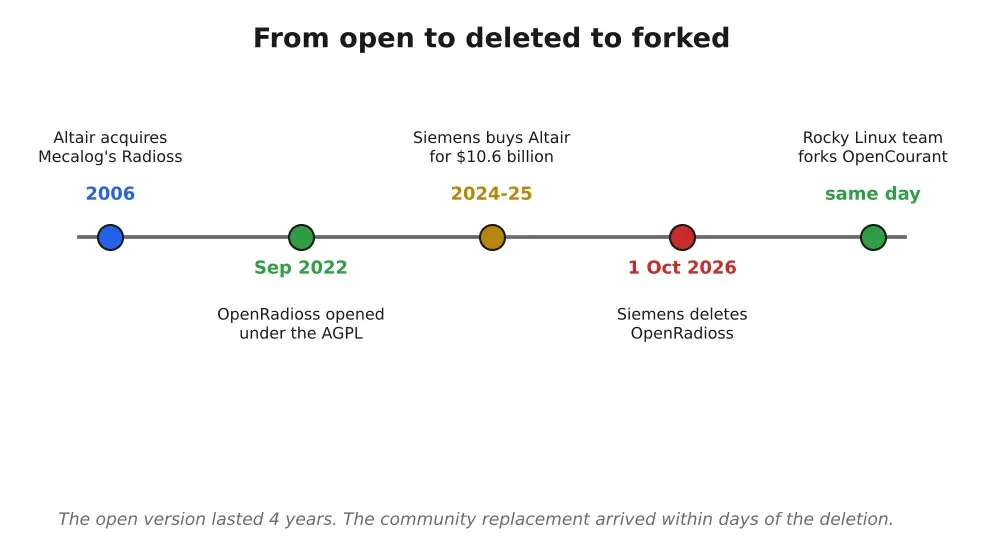
Figure 3. The timeline, from open to forked. OpenRadioss ran openly for 4 years, Siemens deleted it on 1 October 2026, and the Rocky Linux team announced the OpenCourant fork the same day, shipping builds within days. Source: Author timeline based on Phoronix, FOSS Force, and OpenCourant records
This keeps happening, and the fork keeps winning
OpenRadioss is the latest entry in a pattern that has been building for years, a company that owns a widely used open source project decides it wants more money from it, changes the terms, and the community forks the code and walks away. The specifics differ, but the shape is the same, and the forks have been doing well.
In 2021 Elastic moved Elasticsearch off the open Apache 2.0 license, and Amazon forked it into OpenSearch, now a Linux Foundation project. In August 2023 HashiCorp moved Terraform to the restrictive Business Source License, and within 2 weeks users forked it into OpenTofu, also under the Linux Foundation. In March 2024 Redis abandoned its BSD license, breaking a 2018 pledge to keep it, and 8 days later contributors forked Valkey from the last open version, again under the Linux Foundation, and many of Redis’s own external contributors moved over to it. Each time, a neutral foundation ended up hosting a fork with more organizational diversity than the relicensed original.
OpenRadioss is a sharper version of the same story, and the license made the difference. Those earlier cases were relicensing, a company changing the terms on new versions while the old open code stayed available to fork. Siemens went further and deleted the code outright. The twist is that it did not matter. Because OpenRadioss was AGPL, a strong copyleft license, the deleted code was already free in every copy that had been downloaded, so the fork was as clean as the others despite the repository being gone. A company can change a license going forward. It cannot un-free code that is already out under copyleft.
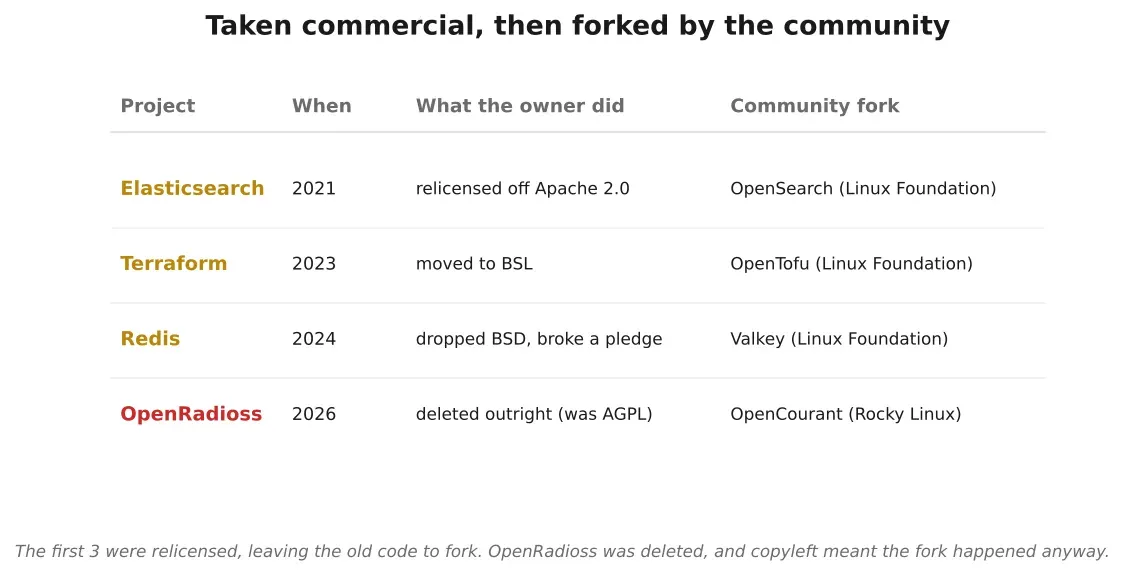
Figure 4. OpenRadioss joins a run of open source projects taken commercial, each answered by a community fork under a neutral foundation. Elasticsearch, Terraform, and Redis were relicensed, OpenRadioss was deleted, and all 4 were forked. Source: Author chart based on relicensing and fork reporting
Where it stands now
By the Tuesday after the shutdown, OpenCourant was shipping builds for the 3 platforms Radioss had supported, Linux x86–64, Linux arm64, and Windows x86–64. One reader function is still missing across all platforms, and the project is asking anyone holding an OpenRadioss package from August or September 2026 to check whether it contains the piece. You can get involved through the OpenCourant GitHub, the project’s discussions, or the Rocky Linux community channels, and the team has specifically said it wants to hear from former OpenRadioss maintainers and community leaders.
The speed of the recovery is the real story. A company with a $10.6 billion acquisition behind it deleted a project, and within days a volunteer backed organization had a working, rebranded, actively maintained replacement on 3 platforms. That is what a copyleft license buys a community, the ability to route around an owner who changes the rules.
The part worth remembering
A company doing something does not mean its engineers agree with it. A Siemens employee commented publicly that watching this was sad, that some of them had been pushing hard for open source culture inside the company, and that setbacks like this one were disheartening. That rings true at most large companies, where a decision from the top does not reflect the people who have to watch it land. Plenty of engineers inside Siemens almost certainly wanted this handled differently.
The lesson for anyone depending on a corporate backed open source project is that the license is what you are actually relying on, more than any company promise. Altair’s pledge to keep Radioss open meant nothing once Altair no longer owned it. The AGPL, on the other hand, meant everything, because it is the reason OpenCourant exists at all. If you build on an open project owned by a company that could be acquired, check the license, keep your own copy of the code, and know that a strong copyleft license is the thing that lets the community survive a new owner who would rather you paid.
Sources
- Radioss and OpenRadioss, Wikipediaen.wikipedia.org. Accessed 25 October 2026.
- Siemens ends the open source OpenRadioss project, Phoronixphoronix.com. Accessed 25 October 2026.
- Rocky Linux rescues OpenRadioss from Siemens, FOSS Forcefossforce.com. Accessed 25 October 2026.
- OpenCourant projectopencourant.org. Accessed 25 October 2026.
- Siemens to acquire Altair for $10.6 billion, TCT Magazinetctmagazine.com. Accessed 25 October 2026.
- What happens to relicensed open source projects and their forks, The New Stackthenewstack.io. Accessed 25 October 2026.
- Rocky Linux, Wikipediaen.wikipedia.org. Accessed 25 October 2026.
Related stories
Linux & open source
Asahi Linux Dropped MIT for GPL After Alleged AI Code Laundering
On November 7, 2026, Asahi Linux said it is moving every repository to GPL v2 or later. Asahi alleges that unreleased code was lifted from personal forks and that some of it was rewritten with LLM help to hide its origin. The report names no one, and the legal and community questions are still open.
Linux & open source
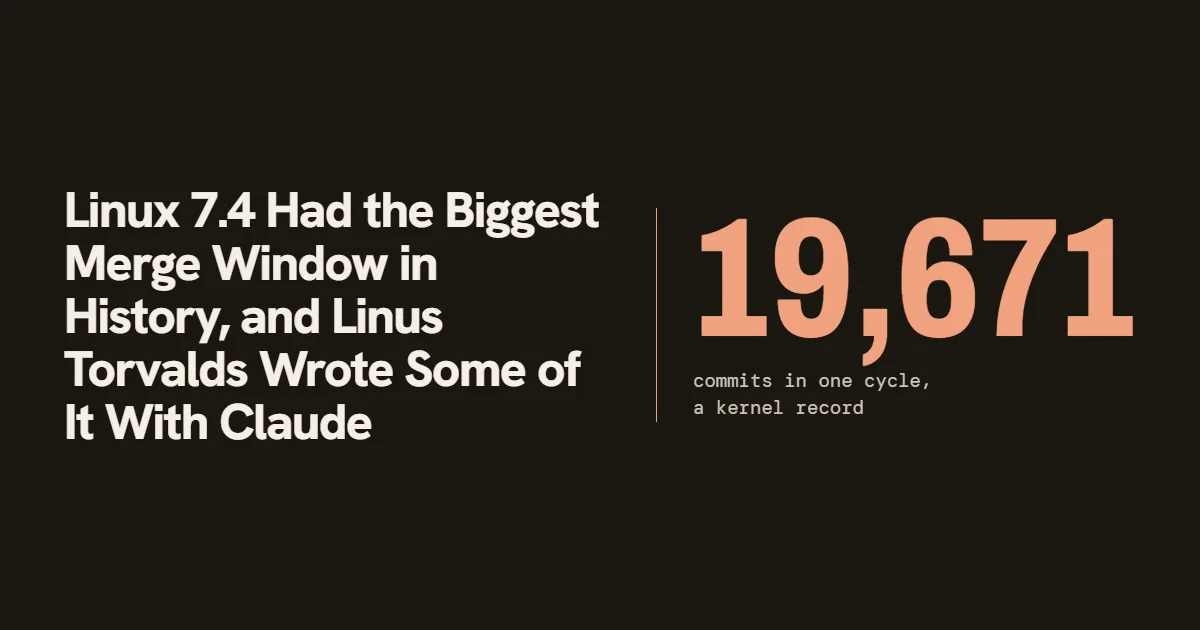
Linux 7.4 Had the Biggest Merge Window in History, and Linus Torvalds Wrote Some of It With Claude
The kernel just took in nearly 20,000 commits in one cycle, a record. The reason is the same force straining its maintainers, AI. The release is the clearest look yet at what that help gives and what it costs.
Linux & open source
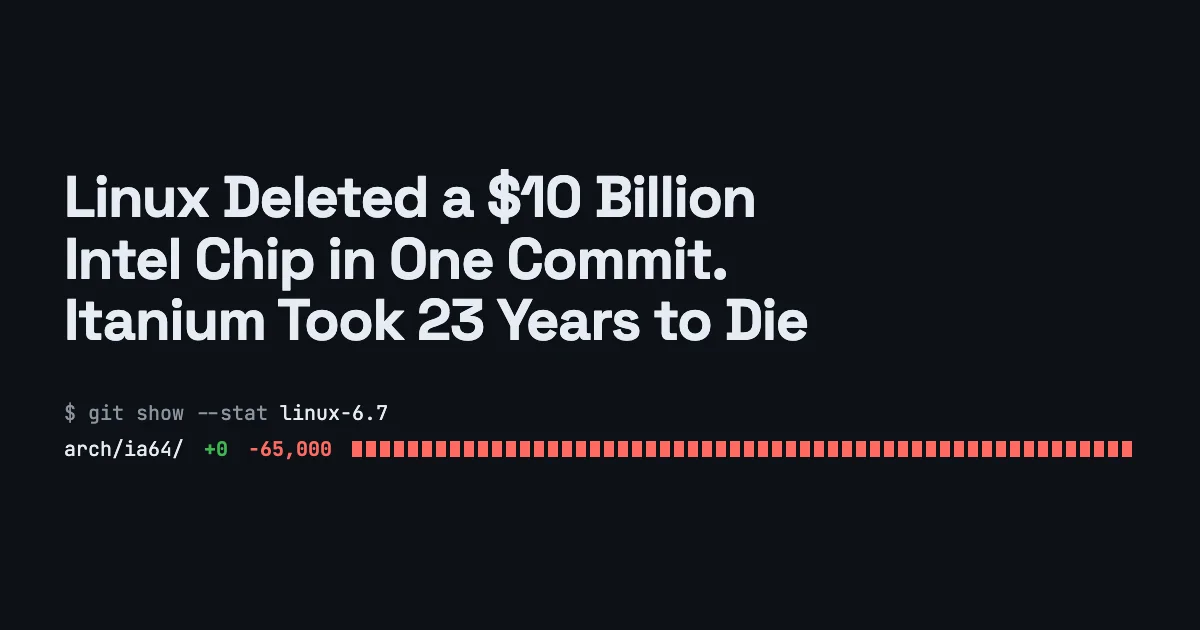
Linux Deleted a $10 Billion Intel Chip in One Commit. Itanium Took 23 Years to Die
Intel and HP spent roughly $10 billion building Itanium, the chip that was supposed to replace x86 forever. Analysts projected $38 billion in sales by 2001. In Linux 6.7, released in January 2024, the kernel deleted about 65,000 lines of Itanium support in one go, because nobody was left to maintain it. I went through why the most expensive bet in CPU history ended as a pile of deletions, and what it taught Linus Torvalds about anyone who promises the future needs a clean break.