The AI CEOs Said Humans Were Replaceable. The Winning Hackathon Products Disagree
I want to tell you something that might change how you read every AI press release from this point forward.
Last verified Also on Medium
On this page
- AI Still Can’t Be Trusted to Decide Alone
- What the Winning Product Did?
- What That Actually Tells You
- The Black Box Is Still a Black Box, But Now It Talks
- What the Winning Product Did
- Showing the Reasoning Isn’t the Same as Opening the Box
- LLMs Start From Scratch Every Single Time
- What the Winning Product Did
- Now Move the Water Bottle
- Klarna Found Out the Hard Way
- How to Read Any AI Pitch Backward
- The ‘Harness Engineer’ Example
- What This Means for You and Where the Real Jobs Are
- The Roles the AI Transition Is Actually Creating
- What the Hackathon Actually Proved
What 3 prize-winning products from a major Google hackathon actually reveal about where AI is right now and what it means for the jobs everyone said were disappearing.
I want to tell you something that might change how you read every AI press release from this point forward.
Not because AI is a scam or a bubble, it isn’t. But because there’s a specific and repeatable gap between the pitch and the product, and once you learn to see it, you can’t unsee it.
Here’s where I want to start. Every AI lab CEO has, at some point in the last two years, told an audience some version of the same story, the models are getting smarter, the context windows are getting longer, the reasoning chains are getting more reliable, and soon any month now the AI will handle the work. Your workflows. Your decisions. Your contracts and by implication, a meaningful chunk of your headcount. Then Google DeepMind ran the Gemini 3 Hackathon a global competition open from December 2025 to February 2026, with a $50,000 grand prize and thousands of entries from developers around the world. The judges looked at everything. And the three products they rewarded most weren’t the ones that pushed AI farthest into autonomy. They were the ones that built the most thoughtful systems for managing what AI can’t yet do reliably.
1. Grand prize: a team that kept the human making the final call.
2. Second place: a team that forced AI to narrate its reasoning so humans could check it.
3. Third: a team that built a workaround for the fact that AI wakes up with no memory every single session.
Read that again slowly. The winning designs are a map of AI’s current limitations, dressed up as features.
I want to walk you through each one what the product does, what limitation it’s actually compensating for, and what that tells you about the real shape of AI work in 2026 and then, because understanding the landscape is only half the value, I want to give you something practical a concrete playbook for finding and landing the jobs this AI transition is actually creating, using the platforms and tactics that are working right now.
Let’s get into it.
AI Still Can’t Be Trusted to Decide Alone
What the Winning Product Did?
The grand prize went to a product called Globot. The scenario it’s designed for is genuinely high-stakes, a logistics or supply chain manager needs to make a million-dollar rerouting decision while a geopolitical crisis or natural disaster is breaking in real time. Every minute costs money. Every wrong call costs more.
The architecture uses 5 AI agents. The first 4 each own a specific slice of the problem. One pulls geopolitical signals from Reuters and Bloomberg. One calculates the financial impact of different routing options. One redraws the shipping routes. One checks whether the reroute would affect the cargo’s insurance status.
Then a fifth agent runs and its only job is to go back through what the other 4 just produced and actively look for errors, contradictions, and gaps in the reasoning.
After all 5 agents have finished, the system hands the consolidated output to a human being for final sign-off. That human approval step isn’t a safety layer added on top of an otherwise autonomous system. It’s a core architectural component. Without it, the product doesn’t work as intended.
What That Actually Tells You
You’ve probably heard of this design pattern under different names. Anthropic baked a version of it into Constitutional AI, where one model generates an output and a second model evaluates it against a written set of principles. Different companies call these agents ‘critics,’ ‘judges,’ ‘reviewers,’ or ‘validators.’ The name changes. The underlying design doesn’t, you add a checking layer because you don’t fully trust the layer it’s checking.
And here’s the thing the pitch decks skip. Even after the critic runs, you still can’t trust the system to make a high-stakes decision autonomously. The critic can hallucinate too. The reasoning can look internally consistent and still be built on a false premise. The logic can pass a surface-level check and fail in the field.
This isn’t speculation. Carnegie Mellon research — in collaboration with Salesforce found that leading AI agents fail approximately 70% of standard office tasks when operating autonomously. These weren’t edge cases or adversarial prompts. These were routine tasks, data analysis, writing performance reviews, basic problem-solving. Tasks that any competent human employee handles without much thought.
So ‘humans are needed’ isn’t a thoughtful gesture toward human dignity in the workplace. It’s an engineering necessity. The phrase is load-bearing euphemism for: ‘the AI alone isn’t reliable enough yet.’
And here’s what that creates downstream something none of the lab CEOs seemed to factor into their headcount projections:
- Someone has to build the agents and keep them running
- Domain experts have to validate the outputs at regular intervals
- A human sits at the end of every high-stakes pipeline before anything goes live
- That human needs enough expertise to catch what the critic missed — which means you can’t fill that seat cheaply
You aren’t saving the cost of human labour. You’re restructuring it. The roles changed shape. In many cases, they became more expensive and harder to fill. The jobs didn’t disappear they evolved into something the original pitch didn’t anticipate and definitely didn’t budget for.
THE QUESTION TO ASK ANY “AUTONOMOUS AI” PITCH
What happens if you remove the human from the loop? If the honest answer is “it stops being reliable for anything that matters,” then you’re not buying an autonomous system. You’re buying a sophisticated first-draft machine with a human still doing the final check. That’s still valuable but it’s a very different product claim.
The Black Box Is Still a Black Box, But Now It Talks
What the Winning Product Did
2nd place went to a product called Aegis. The problem it solves is real and important, when a major natural disaster hits, a regional emergency response system can receive tens of thousands of distress signals within minutes. Calls. Texts. Social media posts. Drone feeds. All arriving simultaneously, all requiring triage decisions that determine who gets help first.
No human team can process that volume in real time. The architecture is, again, multi-agent coordinator routes incoming signals, a triage agent assigns priority scores, a surveillance agent analyses drone imagery, a logistics agent calculates the fastest rescue routes, and a reporter summarises the mission after the fact.
The problem the team ran into during early testing, users couldn’t act on the priority scores. Not because the scores were wrong but because the AI gave them a ranked list with no visible reasoning. One casualty ranked above another, but there was no explanation of why. Black box output in a life-or-death context. Nobody would trust it.
The fix was straightforward in concept and genuinely useful in practice, force every agent to display its reasoning next to its recommendation, visible on the main interface in real time. You see the priority score and the logic behind it, side by side.
The industry calls this ‘Explainable AI.’ It’s been a buzzword in enterprise AI for years and it’s a real improvement. But it’s worth being precise about what it actually does.
Showing the Reasoning Isn’t the Same as Opening the Box
Explainable AI gives the black box a narrator. That’s useful. But it’s not the same as making the black box transparent.
The model is still doing what it does. The explanation you see is the model’s own account of its reasoning which can itself be wrong, incomplete, or post-hoc rationalisation of a decision it made through a process that isn’t actually inspectable. You’re not seeing inside the model. You’re seeing a readable summary it generated about itself.
And here’s the dangerous second-order effect that doesn’t make it into the product demo. Deloitte UK, in research prepared for the UK Ministry of Defence, documented something called automation bias: the tendency for people to trust automated outputs over their own judgment, even when the evidence points the other way. Their report describes it like this imagine you’re driving and you see a 30mph sign on the road. Your car’s dashboard shows 60. Do you trust the sign or the instrument panel? Studies show a meaningful proportion of people accelerate. The machine has replaced their judgment instead of supporting it.
The Deloitte report’s conclusion about AI in defence contexts is unambiguous: “In this situation, the use of AI has unwittingly impaired the operator’s judgment, rather than improving it.”
This isn’t just a military problem. A 2023 study by researchers from the University of Pennsylvania and the Council on Foreign Relations surveyed 9,000 people across nine countries and found strong evidence for automation bias in high-stakes decision-making with a twist that should give you pause, people with moderate AI familiarity showed the highest automation bias. Not beginners, not experts the people in the middle. The ones who know enough to feel confident, but not enough to catch the subtle failures.
When you attach a confident, well-structured explanation to an automated decision, the human reviewer is statistically more likely to approve it including when it’s wrong. The explainability feature that was added to increase trust has also, as a side effect, increased the likelihood that errors slip through unchallenged. Add to this the financial reality. Every additional agent in the pipeline isn’t free.
Gartner’s 2026 analysis found that agentic workloads consume 5 to 30 times more compute than standard single-model interactions for equivalent business outcomes. In a multi-agent setup where each agent re-ingests prior outputs as context, a single task can run 10–15× the token count of a one-model call. Anthropic now bills agentic tool calls as a separate line item.
Fortune reported in May 2026 that inference costs now represent 85% of enterprise AI spend up from 40% in 2023. A five-agent system with a critic is not a cheap solution. It can run to four or five figures in US dollars monthly for a single modest project. That’s in the neighbourhood of a full-time engineer salary. Not instead of in addition to.
TWO TRUE THINGS THAT COEXIST
Explainable AI is better than unexplainable AI. Showing reasoning is more useful than hiding it. Both of these are genuinely true. But a confident, readable explanation of a wrong answer is arguably more dangerous than a cryptic one because it’s much harder to push back on something that looks rigorous. The explanation is not proof of correctness.
LLMs Start From Scratch Every Single Time
What the Winning Product Did
3rd place went to a product called Netra. It’s an accessibility tool for people with limited vision. The demo shows a user asking the system to help locate their water bottle. The AI scans the room, identifies where the bottle is relative to surrounding objects, and narrates the location precisely ‘on the desk, to the left of your silver laptop, approximately a metre away.’
Genuinely useful. The underlying architecture is what the team called a ‘Memory Palace’ a persistent file that builds a spatial map of the user’s environment over time. The idea is that the AI accumulates context about a person’s space across sessions, so it doesn’t have to rediscover everything from zero each time the app opens.
It’s a thoughtful solution to a real problem. And it illustrates with uncomfortable precision one of the most structurally significant limitations of current large language models.
Now Move the Water Bottle
Seriously. Move the water bottle to the kitchen. Don’t tell the AI. Come back the next day. The AI will still tell you the bottle is on the desk, to the left of the laptop. It rdwill say so with the same calm, measured confidence as yesterday. Because from the model’s perspective, the file says it’s there, the file is treated as ground truth, and the model has no mechanism to distinguish between data that’s current and data that’s six weeks stale.
This is statelessness one of the defining structural characteristics of current LLMs. Every session, the model starts fresh. It has no continuous thread of experience. No awareness of time passing. No internal sense that the world might have changed since its last update. The Memory Palace workaround solves the ‘no memory’ problem and simultaneously creates a new one: a model that treats stale data with the same confidence as fresh data, because it has no mechanism to tell the difference.
At demo scale, this is manageable. At production scale, it becomes a data retention liability, a contamination risk, a scope creep issue, and in certain contexts medical, financial, legal a potential regulatory problem.
Klarna Found Out the Hard Way
You want to see what statelessness looks like in a production deployment that didn’t work? Look at Klarna. In February 2024, the Swedish fintech company announced with considerable fanfare that its AI assistant had handled 2.3 million customer service conversations in its first month of global operation. Equivalent, they claimed, to the work of 700 full-time agents, operating 24/7 across 35 languages.
The CEO publicly described wanting Klarna to be OpenAI’s ‘favourite guinea pig.’ By mid-2025, Klarna was quietly rebuilding its human customer service capacity. The statelessness problem was central, if a customer switched from chat to phone, or if their connection dropped mid-session, the bot forgot them completely. Every channel restart was a blank slate. No history. No context. No continuity. Customers had to explain their situation from the beginning every single time.
CEO Sebastian Siemiatkowski’s own words to Bloomberg were remarkably candid: “We focused too much on efficiency and cost. The result was lower quality, and that’s not sustainable.” Customer satisfaction had dropped 22%. The company re-hired human agents. The ‘AI replaced 700 workers’ headline became the ‘700 workers were a premature announcement’ correction.
As of 2026, Digital Applied describes Klarna as ‘the canonical enterprise cautionary tale’ the concrete data point that investors and boards now require executives to explicitly address when proposing AI-driven headcount reductions.
THE PATTERN TO SPOT
Every time you see “persistent memory,” “context retention,” or “long-term learning” in an AI product pitch, ask how fresh is the data? How does the system know when its memory is outdated? What happens when the memory is wrong and the model doesn’t know it’s wrong? Right now, in most implementations, the honest answer is, it doesn’t know. And it’ll tell you confidently anyway.
How to Read Any AI Pitch Backward
Let me give you a framework that’ll save you a lot of money and confusion. Every solution generates a new set of problems. That’s not a cynical statement it’s just how technology works. The railroad created rail engineers, signal operators, and track maintenance crews. Nobody predicted those specific jobs from the original pitch. But they arrived, reliably, because the technology needed them.
AI is following the same pattern. The jobs aren’t disappearing. They’re changing shape, and in many cases becoming more expensive. The pitch says headcount goes down. The invoice says otherwise.
Here’s how to read it backward.
The ‘Harness Engineer’ Example
Forward reading (the pitch) -”We’re hiring AI infrastructure engineers to orchestrate sophisticated multi-agent pipelines.”
Backward reading — a single model drifts and loses coherence on anything longer than a certain context window. So you split the task across multiple narrow agents, add a critic agent to check their work, and hire a human the ‘harness engineer’ whose job is to make sure the whole crew stays on task and doesn’t spend the compute budget without converging.
That harness engineer is a specialist hire. In 2026, you’re looking at $180,000–$350,000. And you don’t get just one. Underneath them sits a cost structure that doesn’t make it into the initial pitch conversation:
- A multi-agent pipeline with a critic re-ingests each agent’s output as context for the next, so a single task can consume 10–15× the tokens of a one-model call.
- Gartner puts the agentic multiplier at 5–30× versus standard interactions.
- Databases for retrieval, orchestration services to route tasks between agents, memory stores to preserve context across sessions, monitoring dashboards to catch when the pipeline starts hallucinating
- The Stanford–Carnegie Mellon study found something genuinely worth holding onto, when humans and AI agents work together with proper collaboration design, task completion improves by 68.7% over fully autonomous AI. That’s not an argument for removing the human. That’s an argument for designing the collaboration properly from day one.
- The guardrails tell the story too. Iteration caps, cost ceilings, and timeout limits aren’t safety polish they’re admissions that left unconstrained, an agent will keep running and keep spending without necessarily reaching a useful conclusion
And finally the thing that should give every executive pause. You are building a new operating model that most people in the organisation have never worked with before, can’t audit in the traditional sense, and have almost no playbook for managing when something goes wrong.
None of that was in the pitch. All of it is a tax on the model’s current limitations, repackaged with a new job title.
THE BACKWARD READING CHECKLIST
1. What limitation is the workaround actually compensating for? That’s the real AI gap.
2. What new problem does the workaround introduce? There’s always one.
3. What is the full cost? compute, infrastructure, human oversight combined? Not just the licence.
4. What happens when the AI is wrong? Is the failure visible and recoverable, or silent and compounding?
5. What new roles does this create? Budget for them now, or get surprised by them on the invoice.
What This Means for You and Where the Real Jobs Are
Here’s the part that gets missed in most AI discourse. The conversation is almost entirely about which jobs AI will eliminate. Much less attention goes to the specific, well-compensated roles that the AI transition is actively creating and the fact that most people are still looking for those roles in the wrong places.
Let me be direct about something if you understand what you just read if you understand human should be in the middle architecture, automation bias, statelessness, and the real cost structure of agentic AI you are already more useful to most organisations than the majority of people applying for AI-adjacent roles right now.
The question is how to get in front of the people doing the hiring. And that’s where it gets interesting, because the answer is almost never ‘apply on LinkedIn.’
The Roles the AI Transition Is Actually Creating
Before we get into how to find these roles, let’s be specific about what they are. Based on the patterns visible in the hackathon winners and the broader industry trajectory, the roles with real demand in 2026 are:
- AI workflow designers: people who map out which parts of a task should go to an agent and which need a human, and can design the handoff between them clearly
- Agent oversight specialists: the humans sitting at the end of high-stakes pipelines who understand the domain well enough to catch what the critic missed
- Prompt and system architects: people who write the instructions that tell each agent what it’s responsible for, and can debug the pipeline when it drifts
- AI output auditors: roles in legal, finance, healthcare, and logistics where the cost of an AI error is high enough that dedicated human review is structurally required
- Infrastructure engineers for agentic stacks: the people who build and maintain the databases, orchestration layers, memory stores, and monitoring tools that multi-agent systems run on
- Technical writers and documentation specialists: because every one of those agents needs clear instructions, every workflow needs a runbook, and most AI teams are terrible at this
Notice something about that list? None of those roles is ‘AI replaces this person.’ All of them exist because AI has created new problems that need humans to manage. The original pitch is still wrong. The jobs are still here.
What the Hackathon Actually Proved
The three products that won the Gemini 3 Hackathon are genuinely impressive pieces of work. The teams behind them solved real problems with real sophistication. I’m not trying to diminish that.
But the reason they won is the most interesting thing about them. They didn’t win because they pushed AI farthest into autonomy. They won because they were the most honest about where autonomy currently breaks and the most thoughtful about designing systems that work within those constraints.
The grand prize os keep the human in the loop. Second place: show the reasoning so humans can verify it. Third: build a memory system because AI has none. Every one of those design decisions is a response to a real, current, documented limitation of large language models.
The pitch says the AI will handle it. The hackathon winners say here’s what it can do if you design carefully around what it can’t. Those are not the same statement. Learning to tell them apart in a job interview, in a vendor pitch, in a board presentation is one of the most valuable things you can do in 2026.
And the good news is the people who can do that clearly are exactly who the industry is hiring. The roles are real. The compensation is real. The work is genuinely interesting.
You just have to know where to look for it and how to show up in the conversation before the formal listing goes live.
If this changed how you read an AI pitch, share it with someone who’s about to sit through one. It’ll save them some money.
Disclaimer: This article reflects personal analysis and commentary based on publicly available information. All statistics are sourced from cited research. Product descriptions are based on publicly available hackathon submissions and press coverage.
Sources
- Gemini 3 Hackathon — Official Devpost page (Dec 2025–Feb 2026gemini3.devpost.com. Accessed 4 June 2026.
- Anthropic — Constitutional AI: Harmlessness from AI Feedbackanthropic.com. Accessed 4 June 2026.
- Deloitte UK — “Automation Bias: What happens when trust goes too far?” (Jan 2023)deloitte.com. Accessed 4 June 2026.
- Deloitte UK — “Defence AI: A human-centred perspective” (2025)deloitte.com. Accessed 4 June 2026.
- Horowitz & Kahn — “Bending the Automation Bias Curve” — 9,000-person study, 9 countries (2023)academic.oup.com. Accessed 4 June 2026.
- Maginative — “Klarna Dials Back its AI Customer Service Strategy” (May 2025)maginative.com. Accessed 4 June 2026.
- LaSoft — “Klarna Walks Back AI Overhaul: Rehires Staff After Customer Service Backlash”lasoft.org. Accessed 4 June 2026.
- Digital Applied — “Klarna Reverses AI Layoffs: Why Replacing 700 Failed” (2026)digitalapplied.com. Accessed 4 June 2026.
- Carnegie Mellon / Salesforce — AI agents fail ~70% of standard office tasksmlq.ai. Accessed 4 June 2026.
- Stanford–Carnegie Mellon — Hybrid AI teams beat fully autonomous agents by 68.7% (Nov 2025)edrm.net. Accessed 4 June 2026.
- Beam.ai — “What AI Agents Actually Cost” — Gartner 5–30x agentic compute multiplier (2026)beam.ai. Accessed 4 June 2026.
- Fortune — “Microsoft reports are exposing AI’s real cost problem” — Gartner 2026 agentic cost analysisfortune.com. Accessed 4 June 2026.
- Vibe Graveyard — Full Klarna AI timeline and CEO admission (Oct 2025)vibegraveyard.ai. Accessed 4 June 2026.
- Zippia — “25 Incredible Employee Referral Statistics [2026]”zippia.com. Accessed 4 June 2026.
- StaffingHub — “Referral Recruiting vs. Job Boards: The 2026 Data”staffinghub.com. Accessed 4 June 2026.
Related stories
AI & GPU compute
A Tech CEO Just Banned All AI Across His Entire Company. Here Is Why He Is Not Entirely Wrong.
Let me tell you about a conversation I did not expect to have.
AI & GPU compute
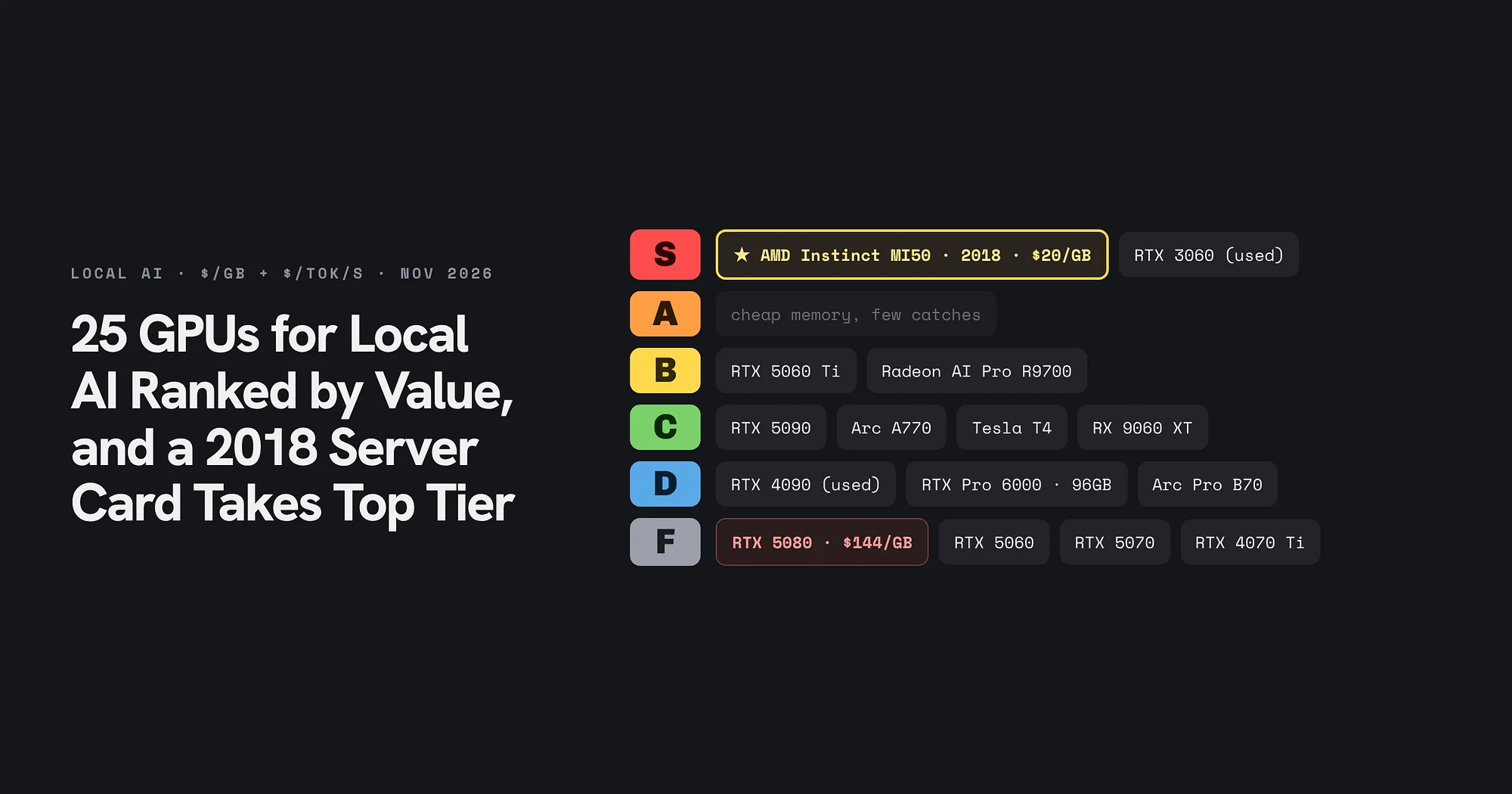
25 GPUs for Local AI Ranked by Value, and a 2018 Server Card Takes Top Tier
A November 2026 price snapshot grades 25 cards on dollars per gigabyte and dollars per token per second. The AMD Instinct MI50 and a used RTX 3060 take S tier, the RTX 5080 lands in F, and memory decides almost every grade.
AI & GPU compute
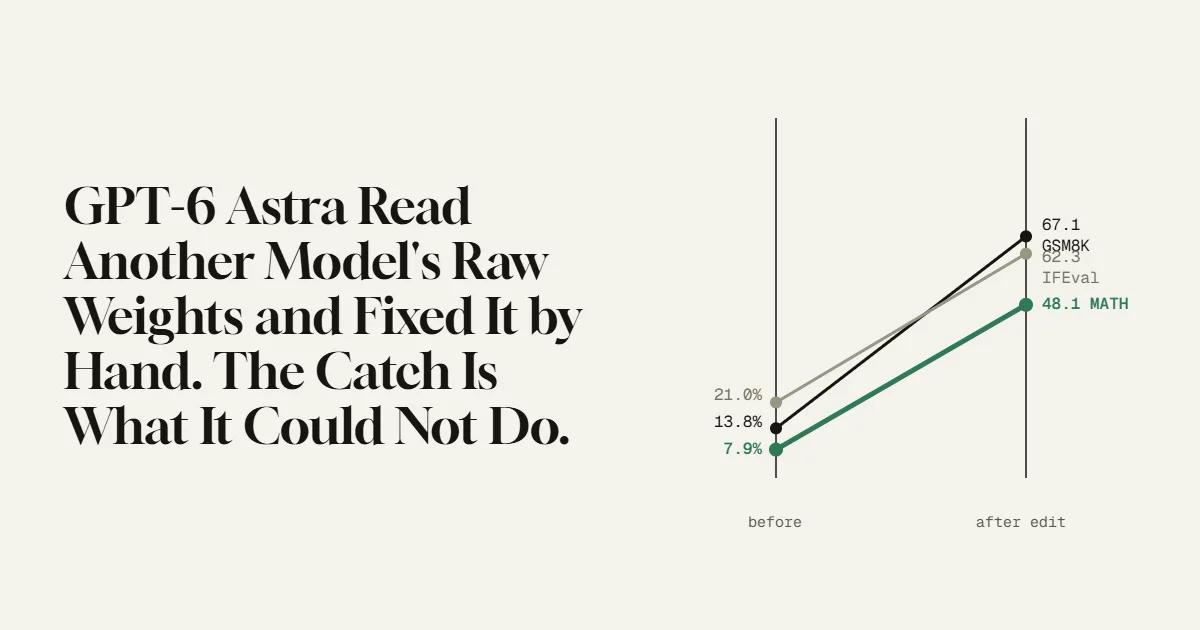
GPT-6 Astra Read Another Model’s Raw Weights and Fixed It by Hand.
MIT researchers had GPT-6 Astra edit 0.016% of a small model’s weights, with no training, and its math score jumped from 7.9% to 48.1%. The number is real and the method is strange. The limit they found in the same paper is the part worth understanding.